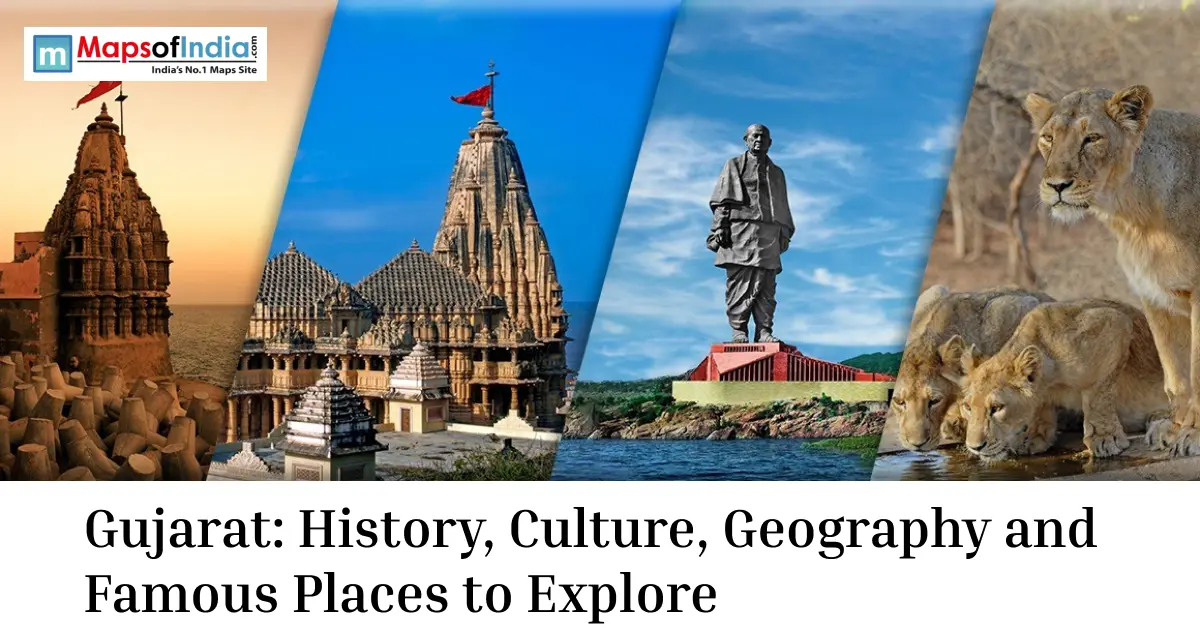
Gujarat, located on the western coast of India, is one of the country's most vibrant and economically significant states. Known for its rich history, diverse culture, thriving industries, and breathtaking landscapes, Gujarat offers a unique blend of tradition and modernity. From the vast white expanse of the Rann of Kutch and the pristine beaches along the Arabian Sea to ancient temples, UNESCO World Heritage Sites, and bustling cities like Ahmedabad, Surat, and Vadodara, the state is home to an incredible variety of attractions. As the birthplace of Mahatma Gandhi and a land shaped by centuries of trade, craftsmanship, and cultural exchange, Gujarat has played a vital role in India's historical and economic development. Whether you are interested in exploring its heritage, wildlife, festivals, cuisine, or tourist destinations, Gujarat promises an unforgettable journey through one of India's most fascinating states.
Geography of Gujarat
Gujarat lies in the west of India, bordering Rajasthan, followed southwards across Madhya Pradesh to Maharashtra, with the Arabian Sea hugging the coastline. This place has an area of approximately 196,024 square kilometres, making it the sixth-largest state in India by area. Dry salt flats prevail to the north, where the Rann of Kutch swells in the sun, and further down, in the middle, the richer soil sustains the farms. Coastline follows water far to one side, with fishing grounds and ports scattered along the curve of the water, in response to the tides. Gir Forest, where wild Asiatic lions are found nowhere else on land, is nestled in pockets of trees. It's located on the map, and for hundreds of years, people have been passing through. Imagine enormous beaches and salty coasts, fields and green spaces all coexisting without confrontations.
Ancient and Medieval History
The Gujarat state was prosperous in the days of the Indus Valley people. You can still see what was once an ancient harbour at Lothal (now all ruins), the site of the first city in India. There was a frequent change of power as one empire after another ruled. They were followed by the Guptas and smaller kingdoms that emerged in succession. Later, sea routes were a source of wealth when the sultans were in control. Trade ships ventured far from these shores, making connections to faraway lands through trade. At that time, powerful empires started to rise around the region, one of which was the Solanki Empire, famous for building the huge Sun Temple at Modhera. It had been formed by the ebb and flow of centuries and remained a place where commerce, traditions and authority were intertwined.
The Era of Mahatma Gandhi
Porbandar, a sleepy seaside town, is the birthplace of Mahatma Gandhi in 1869. His childhood home is still standing, not only in the walls but in the memories. Later, the Sabarmati Ashram sprouted up on the outskirts of Ahmedabad. In 1930, bare feet on dust trails formed history with the Dandi March. Nonviolence is not accidental; it springs from the soil of thought, and from stubborn hope. This land didn't call for change, but resonated throughout empires. Nonviolence not only recalled it stealthily leads decisions. Small acts of peace make social peace, not speeches. This is a place where a man walked to freedom barefoot. This is a place that walks his foot only now slower, only now less seen.
The Rich Cultural Heritage Is Reflected In The Festivities
Every facet of Gujarat's lifestyle is marked by a splash of colour, closely linked to its traditions. During Navratri, the atmosphere is loaded with energy as Garba and Dandiya unite people in the evenings. Colours fly free during Holi, light is wide on Diwali, and kites fly high in January during Uttarayan. Enterprise is a thing of heritage here, and business flourishes. They do not generally include meat, but instead feature plentiful dishes of vegetables that are flavoured with spices. Bandhani and Patola are two examples of the ancient crafts of Gujarat, tied in colourful threads.
Significant Cuisine and Food Culture
Gujarati food combines sweet flavours with a tangy twist, making it a unique taste. These dishes cross state lines: Dhokla to Thepla. Rather than meals, consider spreads such as Undhiyu or Fafda, which demonstrate the change in taste over the seasons. Snacks are also a thing here, with crunchy farsan everywhere. From syrup-soaked Jalebi to stacked Ghevar, all sorts of sugary delights are awaiting you. A thali comes out like a ritual, an order that is plated, and each bite narrates a part of it. Spices jump and twirl on the plate, formed by the centuries of plant cooking that occurred in the villages' interior.
Economy and Industrial Growth
Gujarat is one of the leading industrial hubs of India, with the factories towering high and the docks being quite busy. Diamond cutters polish diamonds destined for the international market, and chemical plants run alongside textile mills. It is a gateway port through which trade is carried via its ports, most notably Kandla and Mundra, two of the busiest ports of Asia. Inland, the engines of cities like Ahmedabad, Surat and Vadodara keep the production lines buzzing. Medicine makers and car assembly plants are just some of the activities that have a strong presence on vast land areas. Suddenly, Gujarat became a favourite destination for investors due to its open arms and courageous attitude.
Several Popular Locations to Visit
Gujarat boasts many tourist attractions. The white desert of the Rann of Kutch is a must-see. The Somnath Temple is one of the twelve Jyotirlingas, which is an important pilgrimage site. Other attractions are: Gir Forest for Asiatic Lions, the colourful Ahmedabad, the famous Patan and the beautiful beaches of Dwarka and Diu. All the places have different aspects of Gujarat's rich heritage and natural beauty. You will come across the amazing range of different things only a state can offer, and be surprised and delighted by them.
Wildlife and Biodiversity
The only place in India where wild Asiatic lions live, it is the Gir Forest of Gujarat. The Gulf of Kutch is nearby, where one can find the marine national park populated with marine life. Velavadar harbours blackbuck in the plains. Every year, a huge seasonal marsh, the Rann of Kutch, attracts a large flock of migrating birds. It is a haven for rare animals due to the careful management of the land. The city expands here, and nature receives a space to live.
Gujarat Stands Out
Old traditions and new thoughts weave a tapestry of Gujarat. Here, initiative is a part of the way of living for doers and builders. It was formed by bold steps taken during Independence and continues to influence the trajectory of India's growth today, which has become a source of national strength. Unique is obvious, with open hearts greeting you, meals speaking to you with their flavour, customs running deep, terrain shifting with every mile. Like energy, expressed and rooted solidly, but always forward.
FAQs
1. What is Gujarat famous for?
Gujarat is famous for the Rann of Kutch, Gir National Park, Somnath Temple, Dwarkadhish Temple, Statue of Unity, vibrant festivals like Navratri, traditional handicrafts, and its thriving industries, including textiles and diamond polishing.
2. Which is the capital of Gujarat?
Gandhinagar is the capital of Gujarat. It is known for its planned layout, green spaces, government institutions, and attractions such as the Akshardham Temple.
3. What are the top tourist places to visit in Gujarat?
Popular tourist destinations in Gujarat include the Rann of Kutch, Statue of Unity, Gir National Park, Somnath Temple, Dwarkadhish Temple, Ahmedabad, Patan's Rani ki Vav, Modhera Sun Temple, and Saputara.
4. Why is Gujarat important in Indian history?
Gujarat has a rich historical legacy dating back to the Indus Valley Civilization at Lothal. It is also the birthplace of Mahatma Gandhi, whose Sabarmati Ashram and Dandi March played a crucial role in India's freedom movement.
5. What is the best time to visit Gujarat?
The best time to visit Gujarat is from October to March, when the weather is pleasant for sightseeing, wildlife safaris, beach visits, and festivals like the Rann Utsav and Navratri.
6. Which wildlife sanctuary is Gujarat famous for?
Gujarat is best known for Gir National Park, the only natural habitat of the Asiatic Lion in the world. The state is also home to Velavadar Blackbuck National Park, Marine National Park in the Gulf of Kutch, and several bird sanctuaries.
7. What are the famous foods of Gujarat?
Gujarat is renowned for its vegetarian cuisine, including Dhokla, Thepla, Undhiyu, Khandvi, Fafda-Jalebi, Khakhra, Handvo, and the traditional Gujarati Thali, which offers a balanced mix of sweet, spicy, and tangy flavors.