

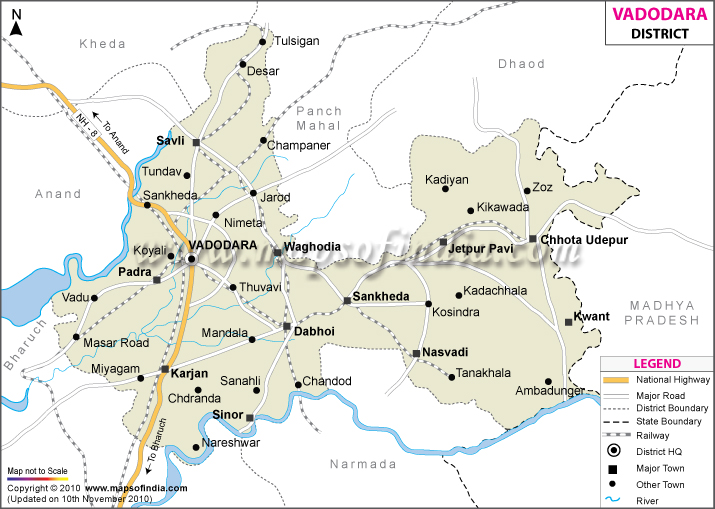



Introduction
Its administrative headquarters is located in the city of Vadodara that has always been considered as a significant political and cultural center. The city is also generally distinguished by its royal heritage, learning institutions, and historical buildings that have been preserved well. The region has over the centuries evolved into a world where modern infrastructure has developed in parallel with the traditional culture.
It is a great location in the history and culture of Gujarat. It has undergone the influence of different ruling dynasties, trade routes as well as cultural movements that gave the region its identity. There is a long history of settlement and development in the markets, temples, palaces and educational institutions.
The economy of the district is based on agriculture, industry and trade. Agricultural production is carried out with the help of fertile plains, and manufacturing and employment take place in industrial areas. The district has also grown in terms of education facilities, attracting students both in Gujarat and other regions of India.
Besides economic growth, the area has rich cultural life which is manifested through its festivals, art and community cultures. The local festivals of the district, religious practices, and cultural organizations are effective in maintaining the historical identity of the district, adjusting to modern social shifts.
History
The works of history of the Vadodara district indicate the political and cultural changes that have been going on in the western part of India over many centuries. Since land was fertile, there was access to water resources and the region strategically followed the trade routes across Gujarat, which led to the formation of early settlements in the area.
The history of this region indicates that the region was named Baroda, owing to the Sanskrit word, Vatodara, which translates to “in the heart of the banyan tree”. Gradually, this name changed and became used for the present day city and the district.
In the middle ages, the area came under the control of diverse political leaders and subsequently fell under larger political entities. Similar to other regions in Gujarat, it was exposed to the impact of the regional dynasties and trading communities which have led to the economic growth in that region.
During the eighteenth century, the district became important in the reign of the Maratha Empire. One of the largest families of Maratha dynasties known as the Gaekwad dynasty asserted its dominance over the region and established the city of Vadodara as their capital. The period led to great political and economic development in the region under their reign.
Maharaja Sayajirao Gaekwad III is one of the most prominent kings of the Gaekwad dynasty who was ruling at the end of the nineteenth century and the beginning of the twentieth century. His reign can be remembered due to progressive reforms in education, infrastructure and the state administration. He implemented reforms that encouraged contemporary education and set up facilities that have an impact to this day on the district.
The great Laxmi Vilas Palace is one of the greatest architectural accomplishments of the Gaekwad monarchs and this is also one of the largest private houses in the world. The palace has continued to play a significant role in royal heritage and architectural greatness of the region.
Under British rule, the Baroda State was still a princely state under the Gaekwad rulers although with some autonomy but at the same time it collaborated with the British rule. Infrastructural development in the region included rail, roads and learning institutions.
Since the independent status of India was obtained in 1947, the Indian princely state of Baroda was incorporated into the Indian Union. The area was later incorporated in the state of Gujarat which was formed in 1960 through administrative reorganization. Since that time, the district has remained a developing industry, educational and cultural heritage center.
Culture
The celebration of culture in the region is among the most significant ones, namely Navratri celebrated with utmost enthusiasm. Citizens during this nine-day festival come together in large open fields where they gather to perform dances in the traditional manner such as the Garba dance and dandiya raas. The Vadodara Navratri is one of the most recognized festivals in this district which is visited and attended by various people from across the country.
Another major festival which is observed in the district is Uttarayan. The people on this day assemble on the rooftop, to play using colourful kites and celebrate the coming of the harvest season. The sky is filled with kites of all sizes and colors, bringing a sense of excitement to the towns and villages.
The district is also characterized by the tradition of performing arts and education. Music, dance, and visual arts are being advanced in cultural institutions and universities, allowing students and artists to be creative. There are museums and art galleries which exhibit the paintings, sculptures and other artifacts of historical heritage of the region.
In the Gujarati culture, traditional cuisine is a significant cultural element in the district. Meals usually consist of multiple vegetarian food items that are served in a thali. Foods that are popular are dhokla, thepla, undhiyu, and khandvi. Sweet foods like shrikhand and basundi are also popular during parties and other family lunches.
Another aspect of life that is important to culture is craft traditions. The artistic traditions of Gujarat are seen in textiles, embroideries and handicrafts that are made by the local artisans. The local markets have a tendency to sell these crafts, and this distinguishes them as having a cultural economy in the district.
Religious organizations like temples, mosques and community centers are also significant in determining social life. They are the locations where individuals congregate to pray, have festivals, and community-related services. These institutions enable the culture to be maintained and inherited by the new generations.
Language
Most of the inhabitants speak Gujarati, which is the major language of communication in the residential areas, markets and other local establishments. Gujarati is a language with a rich literary heritage and it is mainly spoken in education, mass media, and cultural activities.
There is another common language spoken and understood in the district, Hindi. Since the region receives migrants and other visitors from various regions in India, Hindi is in most cases, a linking language which enables individuals with different languages to communicate conveniently.
English has a significant role in education, business, and government administration. Several educational institutions and universities provide education in English, and the language finds application in the workplace. Consequently, a huge population especially the younger individuals have mastered English as well as Gujarati and Hindi languages.
Among the communities, Urdu is spoken and has been witnessed to add value in the literature and culture of the community. The Urdu literature and poems have had an effect on artistic work in most of Gujarat.
The coexistence of more than one language has resulted in the development of a multilingual environment that is characterized by individuals often switching to different languages depending on the situation. Social interactions in the markets, schools, and places of work usually entail the use of a mixture of Gujarati, Hindi and English languages as a representation of the diverse social makeup of the district.
Geography
The geography of the Vadodara district has a combination of plains with bodies of water together with undulating land that is characteristic of central Gujarat. The area has a diverse geographical setting because the district lies between the Gulf of Khambhat and eastern tribal areas of the state.
A number of rivers run across the district and they supply water for agricultural and everyday use. The Vishwamitri River flows through the city of Vadodara and meets the city’s and rural areas’ water requirements.
The district is predominantly very flat, which has caused it to be suitable in terms of farming and settlement. The fertile soils on the plains support the cultivation of rice, wheat, cotton and groundnuts among other crops by the farmers. Irrigation systems and canals work towards maintaining a constant availability of water in agriculture.
The district climate is of a tropical savanna. The summer is usually hot and dry where temperatures frequently exceed 40°C. Monsoon rainfall experienced during the month of June to September sustains agriculture and also replenishes the water resources. Winters are fairly pleasant and mild.
There is natural vegetation in the district such as grasses, shrubs, with sporadic trees which are characteristic of semi-arid regions. There are parts along rivers and other water bodies that sustain more plant life that supports the local wildlife.
The district has a good road network, rail transportation system and air transport. It is a major transport centre connecting important destinations such as Ahmedabad and Surat due to its central location in Gujarat. Such ties promote trade, tourism and economic development.
FAQs
Q1: What makes Vadodara district culturally unique?
It’s a city which has inherited its royal past, strong artistic traditions, colourfully festive cultures, education based legacy, and the mix of traditional and contemporary life; in all that it has developed a very distinct culture.
Q2: Why is Vadodara district famous?
Vadodara is known for the legacy of the Gaekwad dynasty, Laxmi Vilas Palace, dynamic Navratri festivals, educational institutions, and also its growing industrial base.
Q3: What is the best time to visit Vadodara?
October to February is the best time to visit which is when the weather is great for sightseeing, heritage walks and in fact at the time of Navratri festivals.
Q4: Who founded the modern Baroda State?
Baroda's capital was established by the Gaekwad dynasty which also played a large role in the development of the district’s political and cultural identity.
Q5: Which river flows through Vadodara?
The Vishwamitri River runs through our city which has for great parts of history been a feature of this district’s geography.
Q6: Why is Vadodara's Navratri so popular?
The city is home to some of the largest Garba events in Gujarat which see a yearly turnout of people from all over India.
Last Updated on : July 14, 2026
