

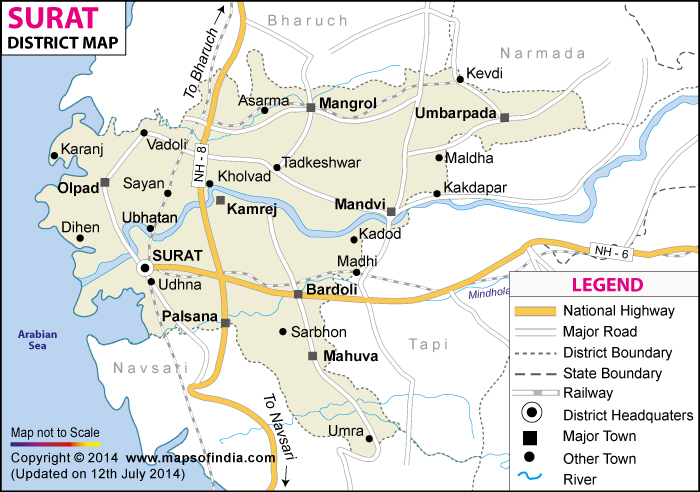



Introduction
Its administrative headquarters is Surat city which is now one of the fastest growing urban centers in India. The city is renowned for textile industry, diamond polishing industry, and a vibrant commercial atmosphere that is flourishing. These industries make the area open to workers, traders, and entrepreneurs in the rest of the country.
Traditionally, the district became a great commercial center because it was located close to the sea and there were navigable waterways. Persian, Arabic and European merchants came to the port, and they formed trading blocs that led to the development of the local economy. In the course of time, markets, warehouses, and residential areas were built in the vicinity of the port region, and they turned the region into a wealthy trading center.
Nowadays, the district is still considered an important element of industrial and commercial life in India. Economic activity is focused heavily on textile manufacturing, diamond processing, chemical industries and activities that relate to ports. The fast urbanization has brought about infrastructural, transport and educational advancements as well.
Although the district has a strong economic orientation, it has a rich cultural heritage that has been developed over centuries through interactions of various communities. The different traditions that have shaped the region are found in the religious institutions, cultural festivals and historic areas. This district is a salient component of the social and economic landscape of Gujarat due to the synergy of the past and current growth.
History
The history of the Surat district traces back to several centuries and presents the general trends in trade, political influence and culture in western India. The ancient civilizations in the area were as a result of fertile land, the presence of the sea which made trading and communication with far off areas easier.
The port city of Surat was among the key maritime control points in the Indian Ocean trade system by the sixteenth century. Other merchants who came to conduct trade in fabrics, spices, precious stones and other valuable commodities arrived in this area from different parts of Asia and Europe.
The area achieved prominence in the era of the Mughal Empire. The Mughal Empire realized the significance of the port and had systems of administration to control trade and raise the customs. Hajj pilgrims (who traveled to Mecca after leaving India) usually left the country through this port and thus it is also a major destination of religious travel.
The European trading firms had factories in the port during the seventeenth century. The most prominent ones were the British East India Company and the Dutch East India Company. These companies established warehouses and trading posts fortifying the commercial links between India and Europe.
Consequently, the area got its cosmopolitan reputation. Hindus, Muslims, Parsis, and Jains among others were communities that coexisted and worked together which enhanced the development of the city and the district.
Nevertheless, in the eighteenth century, the value of the port started to decrease because of the political unrest and the development of other ports in the western coast of India. The shift of trade routes and the opening of new hubs of commerce also added towards slowing down maritime dominance.
In the nineteenth century, the British Raj conquered the region. The colonial government brought with it new systems of rule and administrative infrastructure such as roads and railways that facilitated the unification of the district into the rest of the colonial economy. The textile production and trade would also still remain significant economic activities.
After independence of India in 1947 the district was incorporated in the newly-formed Indian republic, which was later included in the state of Gujarat in 1960 on the formation of this state. In the decades to follow the region was set off with accelerated industrial growth with textile and diamond processing being the leading ones.
Culture
Surat district has a rich history of interrelation between different communities as manifested in the cultural life of the area. A very highly celebrated festival in the district is the Navratri. Through this 9-day long festival of worship of the goddess Durga, the population is filled with thousands of people who perform the customary dances including Garba, Dandiya. Colorful costumes, songs and trade shows make the area a vibrant party of celebration.
Uttarayan is another festival that is celebrated by many people. On this day, everyone goes up the rooftops and open areas with the aim of flying kites and the sky filled with kites bedecked in color. The families and friends share the traditional food and enjoy it during the festive season.
Its culinary traditions are also an attraction of the district. Local food is representative of the Gujarati cuisine which features a sweet, spicy and savory combination. Well-liked food items are dhokla, locho, thepla and undhiyu.
The artisans and workers in the weaving field, the dyeing and embroidery have led to the creation of the unique clothing styles along with the decorative fabrics. The textile industry continues to form a big market in the district both as far as business and culture are concerned.
The type of artistic expression that is essential in the region is music, dance, and theatre. The cultural organizations and educational institutions encourage both traditional and contemporary performing arts making sure that the cultural heritage will be maintained and transferred to the subsequent generations.
Language
The languages used in the Surat district are typical of big commercial centres in India. Gujarati is usually the dominant language since most people living in the area speak it in their day-to-day life, in the local government, and during cultural occasions. In retaining the regional identity, Gujarati literature, poetry and folk traditions have a hand to play.
Hindi is generally spoken and followed all over the district and more so at markets, work places and in the public institutions. Since people from different regions in India have migrated to this region, the type of the language spoken here is mostly Hindi thus enabling the people with disparate language orientations to use it with ease.
English is also an important part of education, enterprises, and management. The language is widely spoken in professional and commercial environments and many schools and colleges teach the English language. The younger generation is becoming more conversant with English as a language of communication and source of employment in the world.
There are communities that speak Urdu and this is a language that is also used in the literary as well as the cultural heritage of the area. Historically, Urdu poetry, literature and calligraphy were a part of cultural traditions of the Muslim communities in the district.
With this, the many languages present have resulted in a multilingual situation where individuals mix languages when it is necessary, such as when dealing with Gujarati, Hindi, and English. This linguistic pliability is the mark of the district being a business and migration hub.
Geography
The coastal location and river systems of Surat district are the geographical features that shape the geography of the area. It is located on the western side of India on the Arabian sea which has been traditionally helpful in maritime trade and fishing.
Among the natural features of the area, the Tapti River is one of the most significant ones. The river goes through the district and finally drains into the Arabian Sea. It has traditionally favored agriculture, transport and settlement in the nearby regions.
The landscape of the district majorly comprises coastal plains and rich agricultural soils. Crops that grow in these plains include rice, sugarcane and cotton. The monsoonal rain that occurs seasonally and irrigation systems assist in supporting farming activities in rural areas within the district.
The area has a tropical climate, hot and humid in summer and comparatively cold winters. Majority of the yearly rainfall is received during the monsoon rains in June-September and is significant in agricultural production.
The sea influences coastal regions of the district and moderates temperatures as well as sustaining fishing communities. Many of the residents living close to the coast depend on fishing and ancillary jobs.
The growth of urbanization has been fast in the recent decades in the region of the city of Surat. There has been a change in the landscape through industrial zones, residential areas, and transport systems. Though this has grown, there are still the rural areas which have retained traditions of farming that still play a significant role in the economy of the district.
Highways, railways and air transport are well connected with the other parts of Gujarat and India. These connections help in trade, tourism and flow of goods and people which helps in strengthening the area as a major economic centre.
FAQs
Q1: Which industries fuel the economy in Surat district?
The district’s economy is based on textiles, diamond processing, chemicals, petrochemicals, port related activities and trade.
Q2: Is it true that Surat is a good area for business and investment?
Yes. Surat has great infrastructure, we see strong industrial growth there, also the labour force is very skilled and what we find is that the transport network is very developed which in turn makes it a very attractive business destination.
Q3: What makes Surat district culturally unique?
Its diverse trade past, mixed cultural groups, colorful festivals, traditional food, and textile heritage present Surat’s what is to which it is known.
Q4: Why do we refer to Surat as the Diamond City of India?
Surat is the Diamond City which processes and polishes a large share of the world’s diamonds.
Q5: What are the main sectors that make up the economy in Surat?
The district’s economic base is in textiles, diamond processing, chemicals, petrochemicals, port related activities and trade.
Q6: Why do tourists visit Surat district?
Tourists in Surat find what they are looking for in terms of historic sites, beach destinations, shopping arcades, food, cultural festivals, and also the amazing sea legacy.
Q7: When do you visit Surat district?
Between the months of November and February is the best time to visit Surat when the weather is at its most pleasant and ideal for sightseeing, shopping and exploring the city’s attractions.
Last Updated on : July 14, 2026
