

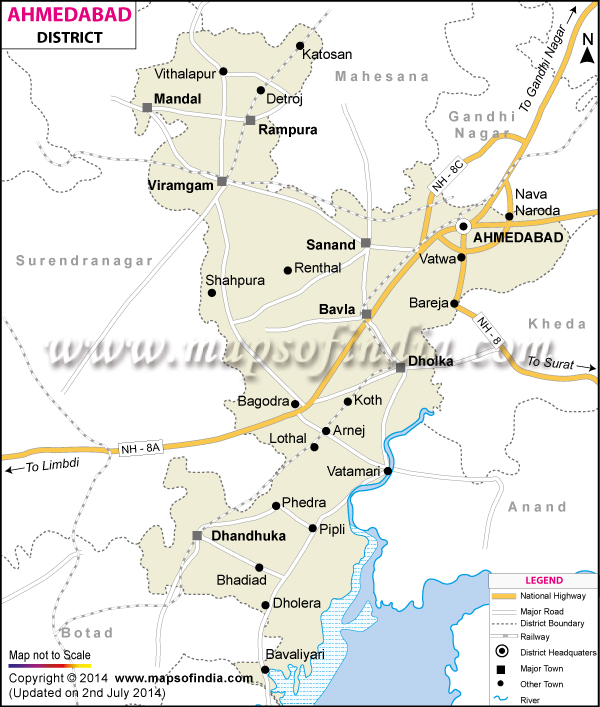



Introduction
The Ahmedabad district is among the most important regions in the state of Gujarat in the Western India in terms of history and economy. The district is located on the banks of the Sabarmati River and it has been a major location of trade, culture, and politics. It was also strategic in western India thus progressing to become a significant urban and commercial city over many centuries.
One of the largest cities in Gujarat and the most prominent ones in India is Ahmedabad and it is the city where the district headquarters is located. The area is renowned due to its historical monuments, textile industry as well as contribution towards Indian independence struggle. Besides its economic significance, the district is also heavily populated with rich cultural layers of communication between various groups of people and culture.
Traditionally, the district became one of the most important hubs of trade because the area was located on the path of several trade routes between northern and western India. Traders, artisans and merchants also helped to develop urban centers and markets which systematically turned the region into a great commercial center. Agriculture based in the rural regions was also supported by the presence of the river, which was the Sabarmati.
The district has now evolved at a rapid pace as an industrial and educational hub in times of the modern world. Other production such as textile-making, chemical industry has also boosted the local economy. Meanwhile, the area is able to maintain its architecture and historical attractions that contribute to the tourism and the interest of other researchers in the cultural background of India.
The social fabric of the district is characterized by the combination of traditions formed as a result of the centuries of migration, trades, and cultural interaction. Religions, historical areas, and cultural events remain significant in the lives of the local communities. Consequently, the district constitutes a unique blend of both the past and the contemporary in western India.
History
Ahmad Shah chose the site along Sabarmati River due to its strategic location and natural advantages. The city later served as the capital of the Gujarat Sultanate and matured into a thriving seat of administration, business and culture. This era witnessed the building of many mosques, palaces and even markets, many of which have become significant architectural sites in the contemporary world.
One of the most important monuments of this period is Bhadra Fort of 1411, which was the seat of the royalty and the administration. The other historical site which is quite conspicuous is Jama Masjid, a marvellous mosque constructed under the rule of Ahmad Shah I which featured the architectural design of the Gujarat Sultanate.
In the sixteenth century the region was taken over by the Mughal Empire; this occurred when Akbar the Mughal emperor conquered Gujarat. The city remained a trading and craft centre under the Mughal rule. The textile industry and trade grew and merchants started to get attracted by it and various regions of India and other international merchants were also attracted.
The weakening of Mughal control in the eighteenth century opened the way to further Maratha influence on the territory. During this period, there were changes in the political control, which gave an expression of the balance of power among the forces in the regions. This was later ruled by the British East India Company in the early nineteenth century which took control over the region.
During the British colonial rule, the district was characterized by a great economic and infrastructural improvement. Great roads, railways and administrative institutions were also introduced and contributed to the integration of the region into the colonial economy. The city also emerged as a great location in textile production and was nicknamed the Manchester of India as it housed many textile mills.
The district was also key to the struggles of India towards independence. Mahatma Gandhi built the most famous Sabarmati Ashram in the vicinity of a river called Sabarmati. Based on this ashram Gandhi initiated various movements that would help him gain independence from British rule. Another well-known occurrence in the ashram is the Salt March, which started at this location in 1930.
With the attainment of independence in India in 1947, the district was incorporated into the state of Bombay and then into Gujarat which was established in 1960. The region has since been able to remain an industrial, educational and cultural hub.
Culture
The cultural life of Ahmedabad district portrays the rich traditions of Gujarat and the influence of other communities that inhabited the territory for centuries. The culture is manifested in the form of festivals, food, architecture, music, and traditional crafts.
The rich festival celebration is also one of the most notable cultural aspects of the area. Gujarat also specifically celebrates the festival of Navratri and it is done with a lot of zeal. There are also the traditional types of dance performed by people in Navratri which include Garba, Dandiya Raas and they put on colorful clothes and they represent the event in large crowds.
The other significant festival that is held in the district is Uttarayan that is held in January. In this event, individuals fly kites on the rooftop of the city and other places around the city. The sky is filled with colorful kites that give the vibrant festival atmosphere which attracts visitors worldwide.
Another thing that the district is known to have is its unique architectural legacy. The historic neighborhoods have the traditional houses called pols which are densely situated residential clusters meant to be lived as a community. These areas also contain temples, wells, and community areas that portray the societal structure of the previous centuries.
Another significant cultural identity in the district is cuisine. The Gujarati cuisine has a well-known mix of sweet, salty and spicy tastes. Food made up of dhokla, thepla, khandvi, and undhiyu are popular. A large number of meals are served as a traditional thali, a combination of numerous dishes on a single plate.
Crafts and fabrics also constitute quite a considerable portion of the cultural industries of the region. Embroidered fabrics and handwoven textiles and ornaments made by the artisans can represent the traditional craftsmanship. These products are sometimes marketed in the local markets and help the district being a textile manufacturing hub.
Language
The district of Ahmedabad has language that indicates diversity of languages which are characteristic of urban areas in western India. The major language used by the majority of the population is Gujarati, which is the most common language used in the households, commercial centers, and other institutions within the area. Gujarati literature is very rich and has been in use in poetry, religious literature and in ordinary communication over centuries.
The Hindi language is also easy to understand, particularly used in business and administration. Due to the appeal of the area to migrants and people who visit the area, Hindi can be regarded as a language that draws a large number of migrants and people with a different language, that is why Hindi is a common language that enables easy communication between people who speak different languages.
English is used in business administration, education and government. Several schools and universities within the district provide courses in English, and it is also a common language in the workplace settings. Consequently, the younger generations are becoming more at ease with the idea to communicate in English in addition to Gujarati and Hindi.
Another language is Urdu, which is used by specific members of society and has led to the literature and culture of the area. Urdu poetry and literature has historically been a very dominant aspect in various regions of the western India, including this district.
This very fact as the existence of many languages has led to a multilingual environment where individuals tend to switch between the many languages depending on the scenario. This language variety is an indication of the historical background of the area where the district is situated, as a trading and a cultural hub.
Geography
Its economic and environmental features are influenced sufficiently by the geography of Ahmedabad district. The district is situated in the central section of Gujarat and on the semi-arid plains of western India.
The Sabarmati River is one of the most significant natural resources of the area as it flows through the district supplying the area with water to be used in agricultural, urban, and industrial processes. The river has been used over the years as a source of livelihood in the area.
The district climatic situation is considered to be semi-arid. The summer seasons are commonly hot and dry and the temperature can sometimes go past 40°C. The monsoon season is the season experienced between the months of June and September and the majority of the rainfall experienced in a year is attributed to this period. Winters are mild and pleasant, which is the best season to be used in tourism and other outdoor pursuits.
Urbanization has changed most of the scenery of the district particularly in the region of the city of Ahmedabad. The geography of the region has been transformed by the population growth and development of residential suburbia, industrial estates, and transport systems. Even after this development, the preservation of green areas and historic landmarks has been undertaken.
The district is also well connected with the highways, rail and air transport. Its location as a part of Gujarat enables it to become a significant transportation center that can connect various regions of the state to other parts of India. With such links, trade, tourism and economic growth in the district are enhanced.
FAQs
Q1: Why is Ahmedabad district so famous?
Ahmedabad is home to the birth of India’s freedom struggle, its great history, textile industry, dynamic festivals, and also has UNESCO recognized heritage.
Q2: Why do we refer to Ahmedabad as the “Manchester of India”?
Ahmedabad has that title which it won from its large textile industries and very strong standing as a leader in Indian textile manufacture.
Q3: What makes Ahmedabad district culturally unique?
Its rich mix of historic architecture, traditional festivals, diverse communities, crafts, and that of ancient trade heritage is what forms the district’s unique cultural identity.
Q4: What is the connection between Ahmedabad and the rest of India?
Ahmedabad is a key player in terms of road, rail, and air traffic which in turn makes it western India’s main transport and commercial hub.
Q5: When is the best time to visit Ahmedabad district?
The best time to go is between the months of November to February which is also when the weather is cool and very pleasant for sightseeing, festivals and outdoor activities.
Last Updated on : May 12, 2026
