

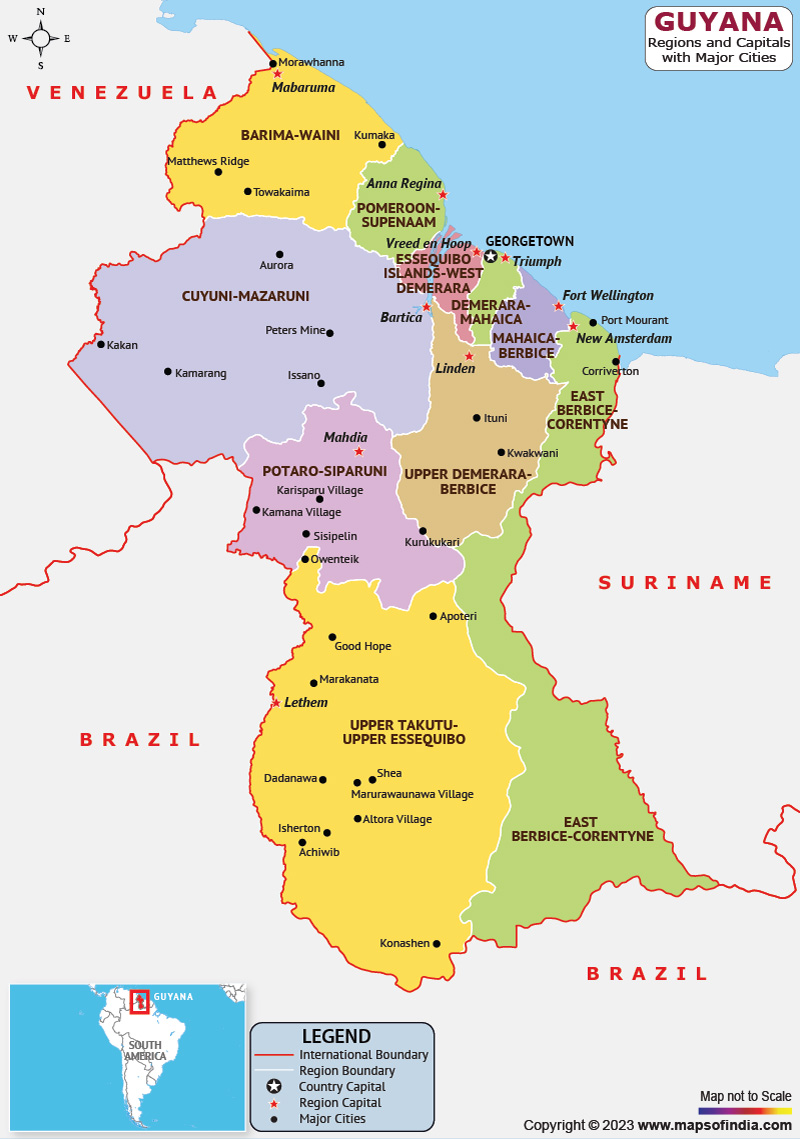





Guyana, officially known as the Cooperative Republic of Guyana has an area of 215,000 km2, making it the third-smallest sovereign state in South America's mainland. It is also the second-least populous sovereign state in the continent, and one of the least densely populated nations on Earth. It is biodiverse and has a wide range of natural habitats.
Georgetown serves as the capital. The shield-shaped landmass also referred to as the "land of many glasses of water," is commonly referred to as "the Guianas." The Wai Wai, Macushi, Lokono, Kalina, Wapishana, Pemon, Akawaio, and Warao are nine of Guyana's indigenous tribes.
History:
The British took over Guyana in the late 18th century after the Dutch colonized it. Until the 1950s, British Guiana governed it, with an economy based on plantations. As a republic within the Commonwealth of Nations, it gained independence in 1966. In 1975–76 and later in 1982–83, Guyana won two elections to the UN Security Council.
Culture:
Guyana's culture emerged due to immigrants' adaptations to and convergence with the prevailing British culture, both forced and willingly. Indian immigrants experienced less assimilation due to their late arrival and slightly more favorable circumstances, which allowed them to preserve more of their culture's distinctive traditions, food, music, and festivals. Its mixture of the dominant Indo-Guyanese and Afro-Guyanese cultures sets it apart from other regions of the Americas. In terms of food, celebrations, music, sports, etc., Guyana and the West Indies islands have a lot in common.
Language:
Guyana is the only country in South America where English is a primary language. Guyana has a large Guyanese Creole-speaking population. Some Indo-Guyanese continue to speak Guyanese Hindustani for cultural and religious reasons. Guyanese Bhojpuri may be used in folk songs, by older generations, or in a limited capacity at home.
A small portion of the population also speaks several Amerindian languages. These include Cariban languages like Macushi, Akawaio, and Wai-Wai and Arawakan languages like Arawak and Wapishana.
Geography:
It is located in Northern South America and part of Caribbean South America, bordering the North Atlantic Ocean, between Suriname and Venezuela, and has a total land area of roughly 214,969 square kilometers. The nation is located between 1 and 9 north latitudes and 56 and 62 west longitude. Guyana borders Venezuela on the west. It also borders Brazil on the west and south, and Suriname on the east. It has a 459 km (285 mi) long Atlantic coastline on the northeast. More than 90% of the population lives in the coastal plain, which makes up about 5% of the country's total area. Water is in abundance in Guyana. Many rivers enter the Atlantic Ocean, usually in a northerly direction.
| Official Name | Co‑operative Republic of Guyana |
| Capital | Georgetown |
| Population | 808726 |
| Area | 214,969 km² |
| Currency | Guyanese Dollar |
| Religion | Christianity and Hinduism |
| Language | English |
| Major Cities | Georgetown,New Amsterdam,Linden |
FAQs
Q1: What makes Guyana geographically unique in South America?
Guyana is located on the northeastern coast of South America, but it has strong historical and cultural ties to the Caribbean. It is one of the few South American countries where English is the official language.
Q2: Why is Guyana called the "Land of Many Waters"?
Guyana is known as the "Land of Many Waters" because of its extensive network of rivers, creeks, wetlands, and coastal waterways. Major rivers include the Essequibo, Demerara, and Berbice.
Q3: What is the highest waterfall in Guyana?
Kaieteur Falls is Guyana's most famous natural landmark. Located on the Potaro River, it is renowned for its exceptional height and powerful flow and is one of the country's major tourism attractions.
Q4: What is the Guiana Shield and why is it important to Guyana?
The Guiana Shield is an ancient geological formation underlying much of Guyana and neighboring parts of northern South America. It contains extensive forests, rivers, mountains, and mineral deposits and supports some of the region's richest biodiversity.
Q5: What is Guyana's landscape like?
Guyana consists largely of coastal plains, dense rainforests, savannas, mountains, rivers, and wetlands. Much of the country's interior remains sparsely populated and is covered by tropical forest.
Q6: What are Guyana's main natural resources?
Guyana has significant deposits of gold, bauxite, diamonds, timber, and other minerals. In recent years, offshore petroleum resources have also become an increasingly important part of the country's economy.
Q7: What is Guyana famous for besides Kaieteur Falls?
Guyana is known for its Amazonian and Guiana Shield rainforests, diverse wildlife, Essequibo River, indigenous communities, and ecotourism opportunities. Its forests provide habitat for species such as jaguars, giant river otters, harpy eagles, and giant anteaters.
Last Updated on: September 11, 2026

