

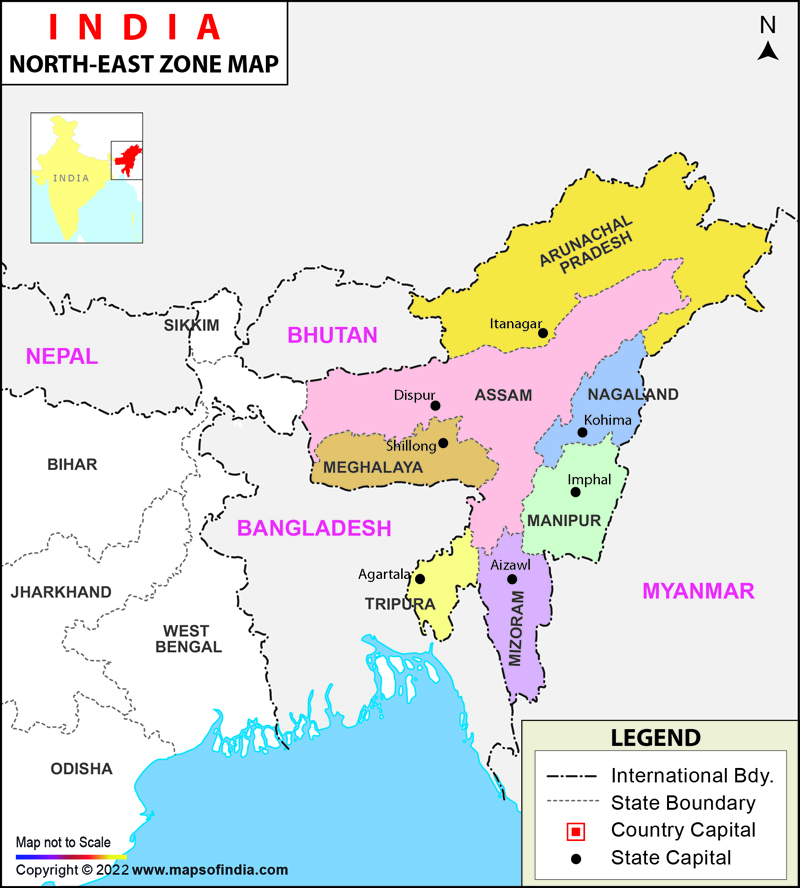



These hilly landlocked forested states at the east tip of India, share a common topography, with lush green valleys, rugged mountains and rich bio diversity, though within each there are multi-ethnic tribal communities with their own culture and languages. Each of the states in north east India touches an international boundary. Sikkim shares it with three-China, Nepal, and Bhutan; Mizoram and Arunachal Pradesh with China and Myanmar; Nagaland and Manipur share it with Myanmar; Meghalaya and Tripura with Bangladesh; and Assam with Bhutan. International and domestic tourism is restricted in the strategically important border areas and in ecologically vulnerable ones.
Cradle of biodiversity
Himalayan states of Sikkim and Arunachal have a cold climate while the rest on the gentle Purvachal ranges have hot humid summers, severe monsoons and mild winters. The Brahmaputra flows down scenic valleys to the plains of Assam and Tripura. Home to some of the wettest spots in the world and the last remaining rain forests in India, the states have numerous national parks and wild life sanctuaries supporting extremely rare and endangered species of animals, birds and vegetation. The Namdapha national park in Arunachal has snow leopards, Indian bison, and Great Indian Hornbill; Kaziranga national park, and the world heritage Manas National park in Assam are abode of the one horned Rhino, Royal Bengal tiger, elephants, deer among other species.
People
Political aspirations of the people forced the creation of separate states. Between 1960 and 1987 Nagaland, Meghalaya, Mizoram and Arunachal divided from Assam. Main tribal groups which include Abors of Assam, Garos and Khasis of Meghalaya, Kukis of Manipur, Lushais of Tripura, Angami, Ao and Phom of Nagaland, and Lepchas of Sikkim speak countless unique Tibeto-burmese languages. Bengali, Assamese and Manipuri, Mizo and English too are spoken. Agriculture is the main occupation with wide spread tea estates and rice fields. A cottage industry of handlooms also thrives.
Main Cities
Though these states have immense tourism potential, difficult access, insurgency, and lack of infrastructure has made them one of the least developed areas in India. Assam, the most populous state has places of scenic beauty in and around its capital Dispur and Guwahati , which also has the ancient Kamakhya and Kamdev temples. Other main towns are Silchar and Jorhat. Sikkim, a small peaceful hilly state, joined the Indian union in 1975. Regarded as one of the 18 bio diversity spots in the world, the state, with the capital at Gangtok, is home to Buddhist monasteries at Rumtek and Pelling and the mighty Kanchenjunga, the third highest mountain in the world. Meghalaya, its name meaning abode of the clouds, has one of the best golf courses in the country in its scenic capital Shillong. Arunachal Pradesh, the largest state of these, has its capital at Itanagar. Tripura is known for its silk, bamboo handicrafts. Agartala its capital has several temples apart from Trishna sanctuary nearby. Nagaland, home of the rare bird Blyth's Tragopan has its capital at Kohima with Dimapur the other big town. With its literacy at 90%, Mizoram, a state with rolling hills and lakes, has its capital at Aizwal . Manipur has its capital at Imphal with the other main towns at Bishnupur and Churachandpur. Keibul Lamjoa National Park in Manipur is the home of the rare Brow-Antlered Deer or Sangai and also the largest fresh water lake in India, Loktak .
Last Updated on : April 17, 2026
| India Zonal Map |
