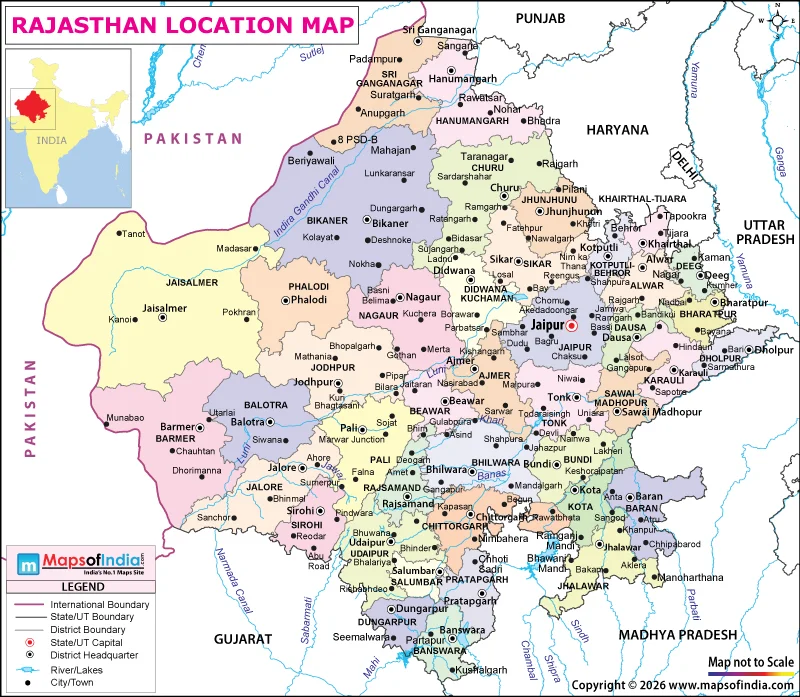
Rajasthan is a state located in the northwestern part of India. It is the largest state in India in terms of area, which is approximately 342,239 sq. km. Rajasthan borders Pakistan to the west and northwest and is surrounded by the Indian states of Punjab, Haryana, Uttar Pradesh, Madhya Pradesh and Gujarat. Its strategic location places Rajasthan between the fertile land of northern India and the dry land of western India.
Geographical Location of Rajasthan
Rajasthan extends from approximately 23°03′ to 30°12′ north latitude and 69°30′ to 78°17′ east longitude. The state occupies a large area of northwestern India, with the Thar Desert covering much of its western and northwestern region. The western side of the state is demarcated by the international border with Pakistan, which is a significant geographical boundary.
The Aravalli Range is one of the most prominent geographical features of the State of Rajasthan. It crosses the state diagonally from north-east to south-west and divides the state into various geographical divisions. The west of the Aravallis is generally arid, with large portions of the Great Thar Desert, while the eastern and south-eastern regions of Rajasthan offer abundant fertile plains, plateaus, rivers and agricultural land.
Rajasthan's Neighbouring States
Rajasthan is bordered by five Indian states. Punjab lies to the north, while Haryana is located to the northeast and east. Uttar Pradesh borders Rajasthan toward the east, and Madhya Pradesh lies along its southeastern and southern boundaries. Gujarat is situated to the southwest. Pakistan shares Rajasthan's western and northwestern boundary.
This location gives Rajasthan geographical connections with both the northern plains and the western part of the Indian subcontinent.
Location of Rajasthan's Capital
The capital of Rajasthan is Jaipur, which is located in the eastern-central part of the state. It is one of the major towns and cities in Rajasthan and has good connectivity to other major towns and cities. Other major cities, including Jodhpur, Udaipur, Kota, Bikaner, Ajmer, and Jaisalmer, are spread across different geographical parts of the state.
Physical Features and Location
The geographical position of Rajasthan is also responsible for the great geographical diversity. To the west lies the Thar Desert, which features sand dunes, dry plains and scanty rainfall. Aravalli Range forms a major geographical barrier, and parts of the Malwa Plateau and Hadoti Plateau are present in the south-eastern part of Rajasthan. The state is crossed by important rivers like Chambal, Banas, Luni and Mahi.
The position of this state in the northwestern part of India makes an important contribution to Indian geography, transportation, agriculture, tourism, as well as border security. Geographically, it is unique in India because of its topography of deserts, mountain ranges, plains, plateaus, and historic cities.


