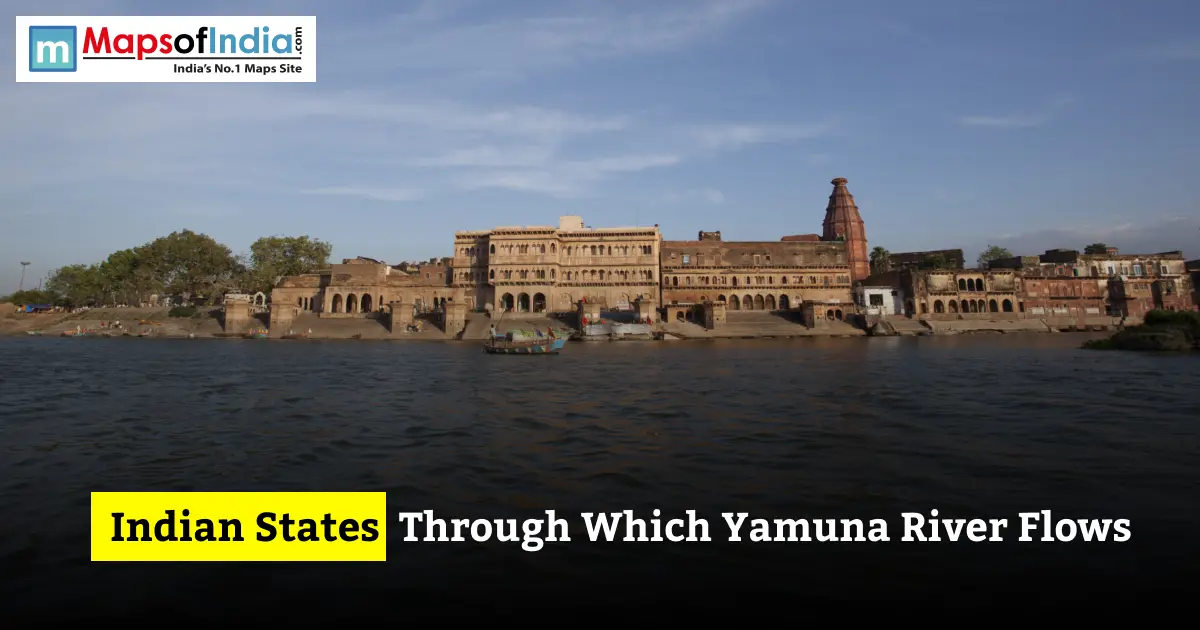
The Yamuna River flows through five states – Uttarakhand, Himachal Pradesh, Haryana, Delhi and Uttar Pradesh – before merging with the Ganga at Prayagraj. It's worth clearing up a mix-up early: while the Chambal, one of its major tributaries, cuts through Rajasthan and Madhya Pradesh, the Yamuna's own main channel never actually enters Rajasthan.
Yamuna River at a Glance
| Attribute | Detail |
| Origin | Yamunotri Glacier, Uttarakhand |
| Length | ~1,376 km |
| Confluence | Triveni Sangam, Prayagraj (with the Ganga) |
| States covered | Uttarakhand, Himachal Pradesh, Haryana, Delhi, Uttar Pradesh |
| Major tributaries | Tons, Chambal, Hindon, Betwa, Ken, Sindh |
List of Indian States the Yamuna River Flows Through
Uttarakhand
The origin state, where the river rises and carves through its Himalayan course.
Himachal Pradesh
An important border stretch.
Haryana
Where the river is tapped heavily for irrigation and drinking water.
Delhi
It's the most talked-about stretch.
Uttar Pradesh
Home to its culturally significant cities and its final confluence point.
A note on a frequent point of confusion: the Chambal, Betwa and Ken rivers. All tributaries of the Yamuna. Pass through Rajasthan and Madhya Pradesh. That's why people sometimes assume the Yamuna itself touches those states. It doesn't; only its tributaries do.
State-Wise Journey of the Yamuna River
Yamuna in Uttarakhand– Source and upper course
The river begins at the Yamunotri Glacier, near Banderpooch peak at an elevation of 6,387 metres. Genuinely high-altitude terrain, even by Himalayan standards. From here it drops through narrow valleys in the Garhwal region before widening as it nears Dehradun. This stretch also picks up the Tons, its tributary by water volume, just below Kalsi.
Yamuna in Himachal Pradesh– Role
The Yamuna doesn't travel deep into Himachal Pradesh; instead, it largely marks a boundary along the state's southeastern edge before continuing into the plains. So this short stretch matters since several hill tributaries, including the Giri, join the system from the Himachal side.
Yamuna in Haryana– Tajewala Barrage and canals
Once the river reaches Haryana, its character changes noticeably. From a mountain stream to a managed irrigation resource. The Tajewala Barrage ( the Hathnikund Barrage today) diverts much of the Yamuna's water into the Western and Eastern Yamuna Canals, which irrigate large parts of Haryana and western Uttar Pradesh. This is also roughly the point where the river's water flow starts to feel the strain of extraction, a theme that becomes more pronounced downstream.
Yamuna in Delhi– Stretch and pollution
The Yamuna's 22-kilometre passage through Delhi is short in distance but outsized in significance. This stretch carries the bulk of the river's public identity in India for better and worse. It supplies a share of the capital's drinking water yet also absorbs a heavy load of untreated sewage and industrial discharge, making it one of the most closely monitored and debated urban river stretches in the country.
Yamuna in Uttar Pradesh– Mathura, Agra, Prayagraj
The river's longest and most culturally loaded stretch runs through Uttar Pradesh. It flows past Mathura and Vrindavan, deeply tied to Krishna traditions, then past Agra, where it runs directly behind the Taj Mahal. Downstream, it absorbs the Chambal near Etawah before finally reaching Prayagraj, where it merges with the Ganga at the Triveni Sangam. The site of the Kumbh Mela.
Major Tributaries and the States They Connect
| Tributary | Origin State | Confluence Point |
| Tons | Uttarakhand | Below Kalsi, near Dehradun |
| Chambal | Madhya Pradesh | Etawah/Jalaun district, Uttar Pradesh |
| Betwa | Madhya Pradesh | Hamirpur, Uttar Pradesh |
| Ken | Madhya Pradesh | Banda district, Uttar Pradesh |
| Sindh | Madhya Pradesh | Near Auraiya, Uttar Pradesh |
| Hindon | Uttar Pradesh | Noida, Uttar Pradesh |
The Tons and Chambal deserve a mention since they're often mixed up in "which is the biggest" discussions. The Tons is the tributary by water contribution, supplying an estimated 60% of the Yamuna's total flow. The Chambal, meanwhile, is the longest by distance, running to 960 kilometres before joining the Yamuna. It also drains a considerably larger catchment area.
Importance of the Yamuna River for These States
Agriculture
The stretch between the Ganga and Yamuna forms the Ganga-Yamuna Doab, one of the intensively farmed regions in India supporting wheat, sugarcane and rice cultivation across western Uttar Pradesh and parts of Haryana.
Drinking water supply
Its canal network supplies drinking water to millions of people, including a substantial share of Delhi's population, despite the river's well-documented pollution challenges within the city.
Religious and cultural significance
Few rivers in India carry much devotional weight. Mathura, Vrindavan and the ghats along its banks are central to Krishna worship, while its confluence with the Ganga at Prayagraj makes it one of the three sacred rivers of the Triveni Sangam, alongside the mythical Saraswati.
Hydropower in the reaches
In its stretch through Uttarakhand and Himachal Pradesh, the Yamuna and its tributaries feed several small and medium hydroelectric projects taking advantage of the steep gradient before the river reaches the plains.
Yamuna River Map (States Highlighted)
The Yamuna begins in the Himalayas at Yamunotri Glacier in Uttarakhand, then it briefly passes the border of Himachal Pradesh. After that, the Yamuna spreads out across Haryana, where most of its water is redirected for farming at the Hathnikund Barrage. The Yamuna then travels a short 22‑kilometre path through Delhi, a stretch that receives a lot of attention. Next, the Yamuna enters Uttar Pradesh, the most culturally important section of its journey, passing cities such as Mathura, Vrindavan and Agra. Finally, the Yamuna joins the Ganga at Prayagraj’s Triveni Sangam.
Conclusion
Five states, one river and a journey that shifts character completely along the way. From a glacier-fed mountain stream in Uttarakhand to a heavily engineered irrigation source in Haryana, a contested urban lifeline in Delhi and finally a river steeped in devotional history by the time it reaches Uttar Pradesh. Understanding the Yamuna's state-path also clears up one of the most common mix-ups about it: the river itself skips Rajasthan entirely even though its tributaries don't.
FAQs
1. Does the Yamuna flow through Rajasthan?
No. The main Yamuna channel does not pass through Rajasthan. The confusion usually comes from the Chambal, a Yamuna tributary which does flow through Rajasthan before joining the main river in Uttar Pradesh.
2. How many states does the Yamuna River pass through?
Five. Uttarakhand, Himachal Pradesh, Haryana, Delhi and Uttar Pradesh.
3. Where does the Yamuna River originate?
At the Yamunotri Glacier near Banderpooch peak in Uttarakhand, at an elevation of 6,387 metres.
4. Which is the longest tributary of the Yamuna?
By length, the Chambal is the longest, running to 960 km. By water volume, though, the Tons contribute the most, supplying 60% of the Yamuna's flow.
5. Where does the Yamuna meet the Ganga?
At the Triveni Sangam, in Prayagraj, Uttar Pradesh. The site that hosts the Kumbh Mela.