




Introduction
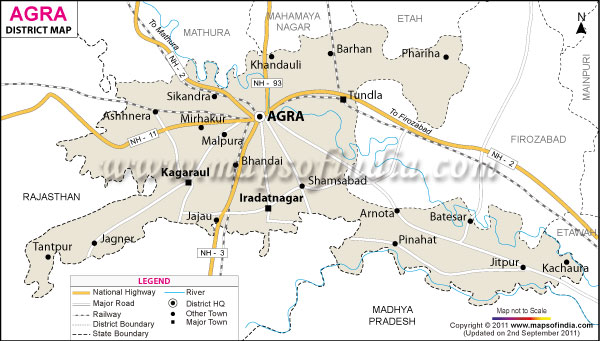
Agra district in Uttar Pradesh, clearly visible on the agra district map, India has achieved international attention as a top tourist destination. In Agra we see the Taj Mahal which is the primary draw out of which is one of the seven wonders of the world. The district has more than one point of interest which also includes many other attractions. The city has historical sites which are found all over its streets also which present a very pleasant atmosphere along with the scents of sweet dishes. Agra also serves as a key transport hub that sees millions of Indian visitors who come to India.
History
The history of the Agra district forms an extensive and thrilling narrative that resembles a cinematic experience. The area became a renowned city in the year 1504 after people had inhabited the region for thousands of years. The ruler Sikandar Lodi chose to establish his new capital in this location, which he believed to be perfect because it provided direct access to the Yamuna River for transporting both goods and troops.
The Mughal Empire took control of the district after the Lodi family rule, and this period marked the peak of the district's prosperity. The first Persian-style gardens in this area were constructed by Emperor Babur, who had a deep love for the land. The land underwent its greatest transformation through his grandson, Akbar the Great. He constructed the enormous Agra Fort from red sandstone, which established the district as the central military power of India.
During the 1600s under the rule of Emperor Shah Jahan which was a golden age for Western civilization. He had a dream to leave behind for the world a monument which will stand out in history as a tribute to his wife Mumtaz Mahal. It took him 22 years to build the Taj Mahal. The district functioned as an international hub for artistic expression during this era. The top architects and stonemasons from different nations established themselves here to work with the white marble.
The capital returned to Delhi after this period, which resulted in decreased activity for the district. The area maintained its significance because it remained important throughout the period. The Marathas and the Jats battled for possession of the fort during the period that followed 1700. The British established control over the territory in 1803. The British transformed Agra into a significant commercial centre and military base, which contributed to the city's present day development.
Pietra dura remains an exclusive craft that shaped the entire development of the Agra district throughout its entire history. This method includes the cutting of precious stones into small pieces which then are attached to marble surfaces. Kings were very into this trend and you can still see it in the walls of the tombs. Families have operated this craft for 400 years by transferring their expertise to their children throughout different time periods.
The district functions as a complete museum that people can explore today. The old city contains narrow streets, which visitors can use to experience Lodi, Mughal, and British architectural styles within one day. The historical significance of the area exists both in its important structures and in its traditional markets, which have functioned since ancient times. The location marks the beginning of numerous empires yet still stands as India's most valuable treasure.
Culture
The Agra district culture is a blend of diverse lifestyles which have coexisted for many centuries to develop a rich cultural heritage. We refer to it as a “Ganga-Jamuni” culture in which Hindu and Muslim traditions come together like two great rivers. Also they display their Christmas through New Year celebrations which include a variety of holiday festivities. That which unites us is seen in the way we dress, socialize and take part in our joint festivities.
Food stands out as the most important element of Agra's cultural identity. The district serves as the original location where people first created Petha which is a sweet dessert made from a local gourd. The entire community participates in the Petha production process, which requires thousands of people to prepare the dish using large cooking containers. The product functions as more than a dessert because it represents the city itself. Every visitor departs with a container of this soft and sweet snack to take home to their relatives.
The art culture here possesses both world-class standards and ancient roots. Families possess expert skills in marble inlay work, which people call Parchinkari. They create floral patterns on white marble by using small gemstone fragments that include lapis lazuli and malachite. The ability to execute this skill has been transmitted through generations since royal times. The process of watching a craftsman use a small stone to create a pattern on a marble slab shows how historical events unfold before our eyes.
Agra is the main hub for everything related to leather products. The district has been known for its high quality of footwear and handbags through many generations. In the local markets which include Hing Ki Mandi you will see shoemakers at work. Families which have been practicing leather work for over 100 years are very proud of this craft which has made Agra a fashion center.
The Taj Mahotsav is committed to the display of the traditional art, dance, and music of the region. The ten-day long festival provides an opportunity to see traditional dancers from all over India and relish food from every corner of the district. The culture of the region emphasizes two things: people should respect their historical traditions while they enjoy eating together and conversing with each other.
Language
In Agra district Hindi is the main language. In homes, schools and at work people use Hindi. The Hindi which is spoken in Agra district is very much like the standardized Hindi of Uttar Pradesh.
Urdu holds significant value as a language in the Agra district. Many families, especially in Muslim communities, speak Urdu in daily life. The Mughal heritage has established Urdu poetry and writing as highly respected art forms throughout the district.
Tourism has brought in visitors that require basic English which hotel and staff in shops use to communicate with. In the Agra district tour guides often use their English and at times other foreign languages to better serve international visitors.
In the Agra district we see that different communities have shared their history. In the language of the Agra district people use both Hindi and Urdu terms in their everyday speech. The residents of Agra district use their language to create what is at once a very diverse and very powerful form of communication.
Geography
The Agra district presents a landscape that consists entirely of extensive flat plains that stretch across northern India, clearly visible on the agra district map. The Uttar Pradesh map places Agra in the western part of the state, showing its important geographical position near the Yamuna River and its connection with other major regions of Uttar Pradesh. That which we see as a region does in fact be a part of the Indo-Gangetic plain which is among the world’s most productive agricultural areas. Flat terrain which is a feature here also supports large scale highway and railway development. Also due to the flatness we seem to extend for miles the green fields and active urban areas.
The Yamuna River, clearly visible on the agra district map is the main geographic feature which defines the area. It starts in the northwest territory and at the end of its course goes through the district moving in a southeast direction, clearly visible on the agra district map. The river also serves to supply water for the cities’ use and for agriculture. For thousands of years the river has played a role in the lives of the people here which also saw the construction of grand royal buildings along its banks.
Agra has unique soil because its alluvial soil contains specific characteristics. The earth develops through the process by which river silt is carried from mountain regions. The soil provides excellent agricultural conditions because it contains high nutrient levels and maintains a soft texture. The district farmers utilise the fertile land to produce large quantities of wheat, mustard and most notably potatoes.
Throughout its yearly cycle, the district goes through several changes in the weather. The area gets very hot in summer as its geography does not have tall mountains which could block warm winds. The "Loo" dry hot wind blows over the plains from April till June. Winter mornings present a very cold and quiet scene of flat land which has turned into thick white fog.
The western boundary of the district, clearly visible on the agra district map shows a gradual change in its geographical features. The flat ground meets some low, rocky hills that are part of the Aravalli range. The red sandstone which the kings used for their fort and palace construction comes from these hills. The district shows its well-known red and orange colours during sunset because of this extremely durable stone.
The district includes multiple important forest areas which extend from the Keetham Lake region. The areas function as "green lungs" for the region because they provide vital habitats which support bird and wildlife populations. The Agra district's geographic diversity which results from its wide river, flat fertile farms and western rocky hills, creates a valuable environment for the millions of residents who live there.
| Facts of Agra District | |
|---|---|
| State | Uttar Pradesh |
| District | Agra |
| District HQ | Agra |
| Population (2011) | 4418797 |
| Growth | 22.05% |
| Sex Ratio | 868 |
| Literacy | 71.58 |
| Area (km2) | 4027 |
| Density (/km2) | 1084 |
| Currency | Indian Rupee (INR) |
| Religion | Mostly Hinduism, Islam |
| Tehsils | Etmadpur, Agra, Kiraoli, Kheragarh, Fatehabad and Bah |
| Lok Sabha Constituencies | 2-Agra, Fatehpur Sikri |
| Assembly Constituencies | Agra Cantt., Agra North, Agra Rural, Agra South, Bah, Etamdpur, Fatehabad, Fatehpur Sikri, Kheragarh |
| Languages | Hindi, Urdu including Braj Bhasha |
| Rivers | Yamuna |
| Lat-Long | 27.13248,78.013115 |
| Travel Destinations | Taj Mahal, Agra Fort, Chini Ka Rauza, Taj Nature Walk, Samadh Of Soamiji Maharaj, Ram Bagh, Mehtab Bagh, Itimad-Ud-Daula'S (Baby Taj), Sikandra, Mariyam'S Tomb, Jama Masjid, Mankameshwar Mandir, Rawali, Balkeshwar Mandir, Prithvinath Mandir, Rajeshwar Mandir, Guru Ka Tal Gurudwara, Cathedral St. Peter'S, St. Patricks, Baptist Church, Sai Ka Takia, Catholic Church, Digambar Jain Temple etc. |
| Government Colleges/Universities | Agra University, Sarojini Naidu Medical College, Agra College, St. John'S College, Raja Balwant Singh College, Dayalbagh Educational Institute, Anand Engineering College, Babu Mohan Lal Arya Smarak Engg. College, College Of Pharmacy, Anand College Of Pharmacy, M.D. College etc. |
FAQs
Q1: Besides the Taj Mahal, what other sites should I see in Agra?
You must see the Agra Fort which is a huge red sandstone palace. Also the "Baby Taj' (Itmad-ud-Daula) and the sunset at Mehtab Bagh across the river are not to be missed.
Q2: Which of Agra’s special foods or sweets is known for?
Agra is known for Petha which is a sweet made from ash gourd and sugar. We have plain, saffron and nut flavored among others; “Panchi Petha” is the top shop to buy from.
Q3: Which river passes through the Agra district?
In Agra where also the Yamuna River flows, clearly visible on the agra district map and which is home to the Taj Mahal that has been very well preserved.
Last Updated on: July 02, 2026
