




Introduction
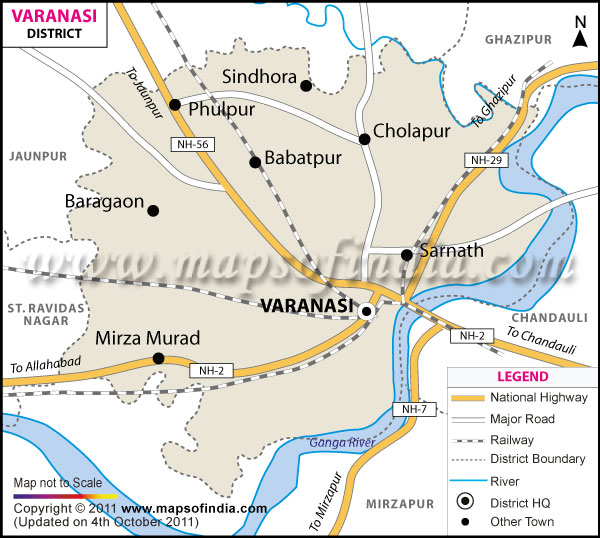
Varanasi is one of the world’s oldest living cities. It has played an important role in the spiritual and cultural life of India. It is located on the banks of the Ganga River in Uttar Pradesh, clearly visible on the varanasi district map and attracts millions of people. On the Uttar Pradesh map, Varanasi is located in the eastern part of the state near the border with Bihar, highlighting its importance as a major cultural and geographical centre of Uttar Pradesh. The city is known for its temple, busy ghat, classical music tradition, and silk saris. Morning prayer, sunset arti, and the continuous flow of rivers defined the daily lives of people. Daily life coexists with prayer and ritual and creates an environment in which the faith, history, tradition, and everyday routine combine in a unique and profound way.
History
Varanasi has a history dating back thousands of years. It is also called Banaras or Kashi and is sometimes cited as the oldest surviving city in the world. As long as people can remember, this location on the Bank of Ganga, clearly visible on the varanasi district map has been the center of the study of culture and spirituality. Many mixed images depicted a divine location where spiritual light science forever. It is thought to be the city of Lord Shiva in the Hindu mythology. First, archaeological evidence shows that people have lived here since 3000 BCE, which makes it not just the religious side but also the cradle of civilization.
The importance of the city extends beyond Hinduism. Sarnath, clearly visible on the varanasi district map or a nearby location is known by Buddhists as the site of Gautam Buddha's first discourse upon Enlightenment. Since it is associated with numerous Tirthankars, Jains also associate Varanasi with their tradition. It became a meeting point for various spiritual ways as a result of the blending of faith, where concepts and practices were openly exchanged. Not just a Center for religion, but it also became a Center for learning. The city produced work that includes Indian thought and scholars who came here to study science, philosophy, and Sanskrit. This practice was then continued by the establishment of Banaras Hindu University and the Banaras Sanskrit College to combine the traditional knowledge with contemporary teaching.
The artistic soul of the city has been preserved by generations through the long transmission of skills. It was ruled by numerous kings over the ages. After being part of an earlier Kingdom, it was ruled by the models and the guptas which promoted education and Religion in the region. Despite invasions during the Middle Ages, the spiritual significance remained unaffected. Temples are claimed to have been encouraged here even by Akbar, the Mughal emperor. Varanasi became a princely state during the British Empire, but colonial governments also had an impact. Pandit Madan Mohan Malaviya established BHU in 1916, giving the city a cutting-edge organization that represented both tradition and advancement.
Varanasi ghats are among the most remarkable characteristics of the city. Each of the more than 80 charts has a unique back story. Others are used for rites, others for cremation, and some for bathing. Hindus believe that being cremated guarantees liberation from the cycle of rebirth, and the most well-known cremation site is the Manikarnika Ghat. The Ganga arti attracts a large number of devotees and tourists every evening. With the use of lamp chants and music, priests carry out rites which produce an enduring and profoundly spiritual atmosphere. It is more than just the location to many people; it is an experience. The open meeting place of death and life, where pilgrims take a river bath as neighboring funeral pyres burn. Varanasi is special because of the way the sacred and the commonplace coexist. The history is about continuity rather than merely dates and kings.
Culture
The culture of Varanasi unfolds with myth, ritual, song, and everyday life, which is linked so deeply that it becomes impossible to differentiate between the sacred and the commonplace. Located along the Crescent shaped Bank of Ganga, clearly visible on the varanasi district map, but it is often considered to be one of the oldest continuously inhabited cities in the world.
The Kashi Vishwanath temple stands out among the other shrines that align its winding alley. It attracts followers who want the blessings of Shiva in his role as the ruler of the universe. The presence of the temple influence is not just religious practice but also the business and the social activity that comes from it. The mendicants, flower vendors, confectioneries and astrologers all take part in the sacred economy which is fueled by devotion.
Despite this, the culture cannot be reduced to ritual alone; it is equally a city of learning and intellectual ferment. The institutions like BHU have promoted modern education without serving ties to traditional tradition; the Sanskrit experts have been debating philosophy in its courtyard for centuries.
In the evening the famous Ganga aarti at Dashashwamedh ghat attracts a large crowd. The priest performs the ritual with fire and incense, with the devotional songs which fill the air. This ceremony creates a strong feeling of unity among the people from different backgrounds as they stand together in prayers. The festivals like Diwali make the city even more special when thousands of lamps light up the ghats.
It is also known for music and learning and has produced great musicians like Ravi Shankar and Bismillah Khan. Classical music is an important part of the city’s identity, and many families have passed down the generation tradition. The city is also home to Banaras Hindu university which is one of India's respected universities, attracting students from across the country.
Another important tradition of the city is the Banarasi silk sarees. Skilled weavers spend the day creating 1 sari with a detailed pattern and find gold or silver thread work. These sides are famous across India and often worn at weddings and special occasions. The craft shows the patients and the creativity of the local people. Life and death are both openly accepted in Varanasi. At Manikarnika Ghat, the funeral will take place daily. Many believe that dying in the city brings spiritual freedom. This belief shows how deeply religion shapes the mindset of the people.
Language
The main language spoken in Varanasi is Hindi but the Hindu you hear on the streets it’s not because it may not be the conventional variety found in textbooks. Most locals speak and influence in the dialect, which has its own rhythm, tone, and amusing idiom. The accent is mild but expressive, and talks often include comedy, irony, and tenderness. Please commonly spoken in and around Varanasi, especially by the families with roots in the surrounding rural district. It is full of folk songs spoken everyday which reflect the local culture. Many people can easily switch between Bhojpuri and standard Hindi depending on the circumstance, whether at home, in the market, or in a formal setting. Sanskrit has an important role in the cultural identity of the city. Even though it is hardly used in everyday discourse, it can be heard in temple rituals and traditional schools where old books are studied. Apart from this, some members of the Muslim communities speak Urdu, which adds to the linguistic diversity of the city.
Geography
Varanasi is located in eastern Uttar Pradesh on the Left Bank of the Ganga river, clearly visible on the varanasi district map. The vast slow-moving river determined both the physical environment and the city’s rhythm. The topography around Varanasi is mostly part of the Indo Gangetic plain. It is a wide expanse of fertile alluvial plane produced by the river deposit, resulting in enriched soil that is suitable for cultivation.
The city is a little elevated above the river, which is why it's famous for its carved fallen long stone stepped into the river. This natural elevation has historically sheltered part of the city from seasonal flooding, although monsoon rain can still force the river to rise and flood the lower stairs. Several small streams and ponds are located around the outskirts, though many have shrunk in size due to urbanization. The Varun and assi river, which are thought to have given the city its name, flow close to its border and eventually meet the Ganga.
The climate is mostly subtropical. Summers are long and extremely hot with temperatures exceeding 40°C. The monsoon season is between June and September. It brings heavy rain and humidity. Winters from December to February are chilly, occasionally cloudy, and particularly in the early mornings, stop the landscape comprising lush plains, sacred river banks, and a climate which has an important impact on daily living and seasonal activity.
| Facts of Varanasi District | |
|---|---|
| State | Uttar Pradesh |
| District | Varanasi |
| Location | Northern India |
| District HQ | Varanasi |
| Population (2011) | 1212610 |
| Growth | 17.15% |
| Sex Ratio | 913 |
| Literacy | 75.6 |
| Area (km2) | 82 |
| Density (/km2) | 2399 |
| Tehsils | Pindra, Varanasi |
| Lok Sabha Constituencies | Varanasi |
| Assembly Constituencies | Aajgara, Pindra, Rohaniya, Sevapuri, Shivpur, Varanasi Cantt., Varanasi North, Varanasi South |
| Languages | Hindi, Bhojpuri, Urdu |
| Rivers | Ganga, Varuna |
| Lat-Long | 25.321684,82.971296 |
| Travel Destinations | The Kashi Vishwanath Temple, Banaras Hindu University, Bharat Kala Bhawan (Art Museum), Dashashwamedha Ghat, Durga Temple, Tulsi Manas Temple, New Vishwanath Temple, Bharat Mata Temple, Ashoka Pillar, Ramnagar Fort, Alamgir Mosque, Jantar Mantar, Jain Temple, etc. |
| Government Colleges/Universities | Banaras Hindu University, Sampurnanand Sanskrit University, Mahatma Gandhi Kashi Vidyapeeth, Imania Arabic College, Central Institute Of Higher Tibetan Studies, Udai Pratap Autonomous College, Harischandra P.G. College, Agrasen Kanya P.G. Collage etc. |
FAQs
Q1: Why do people think of Varanasi as a sacred city?
Varanasi is considered to be a sacred city because of its link to Lord Shiva. Besides, it is also situated on the banks of the holy Ganga River, clearly visible on the varanasi district map. Many Hindus have the faith that if they die in Kashi, it will give them Moksha.
Q2: Why is Ganga Aarti important?
Ganga Arti is a daily prayer ceremony that is carried out at the riverbank ghats. Every evening, the Priest lights the lamp and chants hymns in honor of the river. It is famous throughout India, and thousands of pilgrims and visitors come to see it daily.
Q3: Which is the most famous temple in Varanasi?
The most famous temple in Varanasi is the Kashi Vishwanath temple. It is dedicated to Lord Shiva and is among the 12 Jyotirlingas and has great religious importance for Hindus in India.
Q4: Which is the best time to visit Varanasi?
The best time to visit Varanasi is in the winter between November and February. This is when the temperature is milder, and it is comfortable to roam in the city. Summers are quite hot, while the monsoon months bring considerable rainfall.
Last Updated on : July 02, 2026
