




Introduction
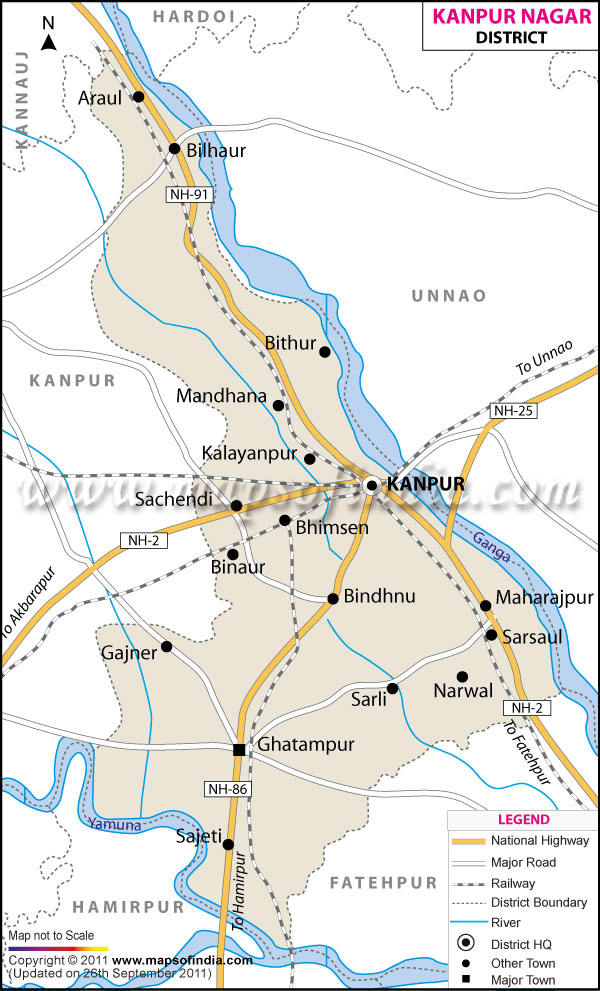
Kanpur Nagar is an administrative district of the Indian state of Uttar Pradesh, clearly visible on the kanpur nagar district map and one of the largest, which is situated to the north of the country. It is found in the centre part of the state, clearly visible on the kanpur nagar district map and it is a big urban and industrial centre in which the headquarters of the District are found in the city of Kanpur, clearly visible on the kanpur nagar district map. It is located to the south of the river Ganges and centrally located in the fertile Indo-Gangetic Plain and there has always been a benefit in the resources of agriculture as well as the commercial connections. It is based around eighty kilometers west of the state capital; Lucknow and which has conventionally been a significant interchange point between the eastern and western Uttar Pradesh.
Kanpur Nagar city, clearly visible on the kanpur nagar district map is notorious with the recognition as one of the largest industrialized areas of northern India. The textile mills made it an influential textile and leather production centre in the colonial times and it ended up being referred to as the Manchester of the East. The manufacturing, trade, education and services still characterize contemporary character of the district though industrial patterns have changed over time. Nowadays it is a mixture of the past and the present, in which densely populated urban neighbourhoods are intertwined with peri-urban and rural environments.
History
The present day Kanpur Nagar district has existed since ancient time due to the land being in the fertile Ganges plains watered down by the Ganges and the tributaries. Archeological and literary sources suggest that the greater region was a subset of early historic civilization of northern India. The rise of Kanpur as a large urban centre was much later though.
Throughout the Mughal rule, the region comprised mostly of villages and small settlements. Its metamorphosis started during the reign of the British East India Company during the late eighteenth and early nineteenth centuries. Kanpur was where the British constructed a military cantonment due to its strategic location along river ways as well as inland trade routes. As the nineteenth century came the city became very significant due to the presence of the railway. Textile mills, leather tanneries and other factories were developed which attracted labour in the surrounding countryside and increased the speed of urban growth.
This historical prominence as a place came to Kanpur Nagar in the Indian Rebellion of 1857. The rebellion in Kanpur turned out to be one of the most dramatic moments of that conflict where rebel army and British army had a serious fight with each other. The happenings in the city produced a profound mark in the Indian and the British memory of the history and served to eventually end the rule of the East India Company and the handover of the rule to the British Crown. During the next decades, the industrial investment did not stop, and Kanpur became one of the biggest manufacturing centres in northern India.
Since the year 1947 when India got its independence, Kanpur retained its industrial nature but economic changes and environmental pressure as years progressed influenced the traditional industry like textile. The ancient Kanpur district was split administratively in order to better manage it; Kanpur Nagar was the new administrative unit of the urban and semi-urban Kanpur, and Kanpur Dehat comprised the rural hinterland. Such an administrative set up still exists with Kanpur Nagar being a largely urban district with a high municipal infrastructure.
Culture
The tradition of the North India constituted of migrations, commercial and religious diversity, is the culture life of the Kanpur Nagar district. Majority of the residents are Hindus and the most important holidays such as Diwali, Holi, Navratri and Dussehra are celebrated in the neighbourhoods and the market with a lot of enthusiasm. Even the Muslim population observes two holidays Eid al-Fitr and Eid al-Adha, and they are contributing to the festal atmosphere of the district. A common practice in public celebrations is that they attract decorated streets, communal gatherings and communal foods and thus the social bond in and across communities.
The industrial history of Kanpur has also contributed to the cultural identity of the city. A socially diverse urban population was formed due to the influx of workers of various regions of Uttar Pradesh and adjacent states. This variety has been manifested in the local traditions, attire and food. The dietary staple consists of traditional North Indian dishes such as breads made of wheat, lentils and local vegetables, with the sweets served at the festivals and the savoury snacks being part of the festal and everyday life.
There are educational and intellectual institutions that have made a significant contribution to the cultural landscape of the district. Kanpur hosts some of the largest centres of higher learning principally the Indian Institute of Technology Kanpur which has helped make the city better known academically both nationally and internationally. Literary events, debates and cultural programmes held in universities, colleges and schools cultivate the expression of art and the role of the citizen. Acts in theatre, recitations in poetry and musical concerts are also conducted in an auditorium and community hall, and it has remained in touch with the classical and modern ways of artistic expression.
Temples and mosques are the main features in the city setting, which emphasize religious nature of people living there. Although fast urbanisation has brought in the concept of modern shopping malls and entertainment centers, ancient bazaars still remain as social and business centers that the generations communicate and where the past is still practiced.
Language
The official language of the Kanpur Nagar district is Hindi and the primary medium of administration, education and communicating. The standard version of Hindi, which is founded on Khari Boli is constantly learned and spoken in official and informal circumstances. In the colloquial language, the dialects of the central Uttar Pradesh can be used by the residents depending on the localities.
The Urdu language also plays a significant role in the linguistic environment of the district especially among the parts of Muslim population. It has found application in cultural, literary and religious contexts and has helped to build the excellent history of poetry and prose that is linked to North India. Signboards, newspapers and education materials could be either in Hindi or Urdu and signify the bilingual tradition of the region.
English plays an important role in higher education, business and professional life. Most of the time it is applied in technical institutions, corporate offices and in court proceedings. The existence of the nationally recognised institutions like the Indian Institute of Technology Kanpur has further strengthened the application of English in both academic and scientific discussions. However, to most of the inhabitants Hindi is the language of day to day life, socialization and local administration.
Geography
The Kanpur Nagar district is situated in the huge alluvium The Indo-Gangetic Plain, clearly visible on the kanpur nagar district map, which is also one of the most fertile agricultural areas in the world. The river Ganges runs in the north of the district, clearly visible on the kanpur nagar district map that has molded the physical landscape of the area and the history thereof. This large river has been able to provide water resources, trade and agriculture over the centuries due to the availability of this river. Most of the soils in the district are alluvial, and thus they are capable of supporting production of other crops like wheat, rice, pulses and oilseeds in rural areas.
Kanpur Nagar terrain is typically flat and the undulations are light and riverine in nature. The district has neither any tract of hills nor wooded area, and a large portion of the soil has been placed under cultivation or civilization. Small streams and irrigation canals used to irrigate lands in the peripheral areas can supplement rain.
The district climate can be said to be subtropical. Summers which last between April and June are usually hot and dry and the temperatures are likely to be high, sometimes up to 40 degrees Celsius. The monsoon season is also experienced in late June or at the beginning of July, and it receives most of the yearly rainfall that gives crops the much needed moisture. The seasons of the year are relatively cold during winters which last between December and February and might be accompanied by fogs particularly in the early mornings. The agricultural cycles and day to day activities are greatly affected by seasonal changes.
This has been brought about by the urbanization that has greatly changed the landscape of the Kanpur Nagar. The district is represented by residential colonies, industrial estates and the transport infrastructure which occupy large areas. Kanpur is a transport hub in the region as major roads and railway lines connect it with other cities of Uttar Pradesh and other areas. Even during the periods of massive urbanisation, some peripheral regions preserve the characteristics of semi-ruralisation, agricultural fields, and small villages create an intermediate zone between the city and the surrounding districts.
The recent policy discourse in the district has been influenced by environmental issues especially with regard to industrial activity and the pollution of rivers. Waste management, infrastructure development and the security of river Ganges are still being undertaken, which indicates the predicaments of rapidly urbanising territories in India.
| Facts of Kanpur Nagar District | |
|---|---|
| State | Uttar Pradesh |
| District | Kanpur Nagar |
| District HQ | Kanpur |
| Population (2011) | 4581268 (As of 2011) |
| Growth | 9.92% |
| Sex Ratio | 862 |
| Literacy | 79.65 |
| Area (km�) | 3155 |
| Density (/km�) | 1415 |
| Tehsils | Bilhaur, Ghatampur, Kanpur |
| Lok Sabha Constituencies | Kanpur |
| Assembly Constituencies | 10-Arya Nagar, Bilhaur, Bithoor, Ghatampur, Govindnagar, Kalyanpur, Kanpur Cantt., Kidwai Nagar, Maharajpur, Sishamau |
| Languages | English, Hindi, Urdu, Awadhi |
| Religion | Predominantly Hinduism, followed by Islam |
| Rivers | Ganga, yamuna |
| Lat-Long | 26.42139,80.248833 |
| Travel Destinations | Jk Temple, Green Park Stadium, Moti Jheel, Nanarao Park, Buddha Park, Japanese Garden, Mahatma Gandhi Park, Kidwai Nagar Park, Phool Bagh, Brajendra Swaroop Park, Bhagwan Parashuram Park, Palika Stadium, Tulsi Upawan, Keshav Vatika, Allen Forest Zoo, Panki Mandir, Kherepati Temple, Anandeshwar Temple, Iskon Temple etc. |
| Government Colleges/Universities | Chatrapati Shahau Ji Maharaj University, Prof. H.N. Misra College, Brahmanand Degree College, Vssd Degree College, Ppn Degree College, D.A-V. P.G. College, Halim Muslim Degree College, Bnsd College, Christ Church College, Iit Kanpur, Chandra Shekhar Azad University Of Agriculture And Technology etc. |
FAQs
Q1: What is the administrative headquarters of Kanpur Nagar district?
The administrative headquarters of Kanpur Nagar district is the city of Kanpur.
Q2: On which river is Kanpur Nagar district located?
Kanpur Nagar district is situated along the southern bank of the river Ganges, clearly visible on the kanpur nagar district map.
Q3: Why is Kanpur historically significant?
Kanpur is historically significant for its role in the Indian Rebellion of 1857 and its development as a major industrial centre.
Q4: What type of climate does Kanpur Nagar experience?
Kanpur Nagar experiences a subtropical climate with hot summers, a monsoon season and cool winters.
Last Updated on : May 08, 2026
