




Introduction
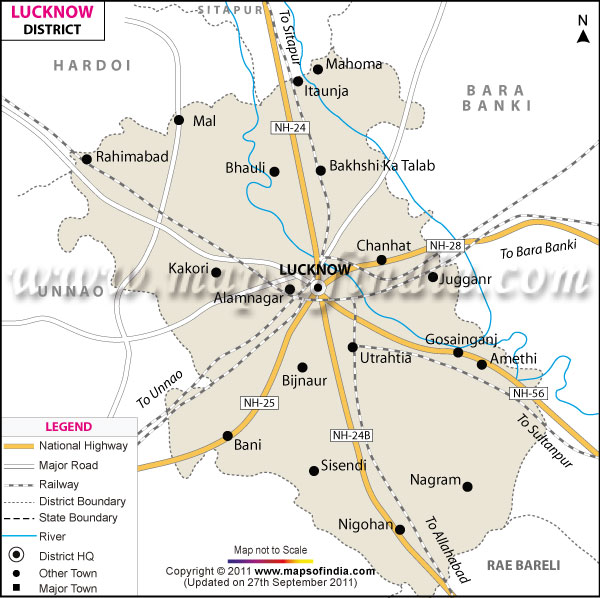
Lucknow is the capital city of Uttar Pradesh, clearly visible on the lucknow district map. It is one of the most important and old cities and urban centres in India, culturally. It is located on the banks of Gomti River, clearly visible on the lucknow district map and has a rich history, refined manners and unique blend of Mughal, Awadh, and diverse colonial cultures. The city became a significant one in the 18th and 19th centuries during the reign of Nawabs of Awadh establishing the city to be the centre of art and architecture, music, food and literature. Lucknow is especially renowned with its magnificent locations such as Bara Imambara, Rumi Darwaza and Chota Imambara presenting the Indo-Islamic architectural designs. It also is a hub for artisans and Traditional arts such as the Chikankari embroidery, and its well known Awadhi cuisine.
History
The Lucknow history is woven with the ancient roots, medieval currents and the colonial transformation that had shaped and defined it as one of the most culturally prevalent cities among the North India. Although the region portrays evidence of early settlement, the historicity of the region came out in influencing the medieval period. It is believed that the city was named after Lakshmanpur or Lakhanpur, who is the brother of Lord Ram and it is believed that he settled at the bank of Gomti River. Slowly the name came to be called Lucknow.
The city of Lucknow, clearly visible on the lucknow district map was a small town which was situated strategically in the area of Awadh in the time of Delhi Sultanate and Mughals Empire. This began to grow into a big city in the 18th century when the Mughal Empire began to crumble, and the rulers of the region acquired independence. When the first Nawab of Awadh was appointed Saadat Khan Burhan-ul-Mulk in 1722, the Mughal emperor began to give some political relevance to Awadh. However, it is under the rule of Nawab Asaf-ud-Daula ( r. 1775-1797) that Lucknow supplanted Faizabad as the Awadh capital.
The Nawabi era was the golden age of Lucknow. Nawabs have been having a great patronage to art, architecture, music, dance and literature. They had historic monuments like the Bara Imambara, Rumi Darwaza and Chota Imambara constructed, which was a combination of the Mughal and the Persian architecture. Another area where a court culture (tehzeeb) known as politeness, poetry and etiquette flourished was Lucknow. Urdu literature flourished and Kathak dance enabled it to be a sophisticated form of classical dance under the patronage of the royalty.
By the early 19th century the British influence in Awadh had become extremely high. In 1856, Awadh was annexed to the British East India Company because it was ruled by Nawab Wajid Ali Shah who was alleged to have mismanaged the administration. The result of this annexation was much bitterness and contributed to the uprising of the year 1857. Lucknow was one of the strongholds of defiance of the revolt. One of the most significant, and the protracted, of the revolt episodes, and an embodiment of both the Indian resistance to the British forces and the British arm action, was the Siege of the British Residency in Lucknow.
After the revolt, the British Crown suppressed the revolt after which Lucknow was put under their direct rule. During the colonization period, there was an overhaul of the administration in the form of new modern infrastructure, institutions of learning, and the formulation of new architecture which incorporated European and the Indo-Islamic designs. Through such transformations the city had retained its cultural traits in the culture of the Nawabi.
When India became independent in 1947, Lucknow became the capital of Uttar Pradesh, and it was evolving even towards being an administrative, educational and cultural centre.
Culture
The Lucknow culture is distinguished with its sophisticated, graceful and unique combination of Hindu and Muslim culture, largely referred to by the term Ganga-Jamuni tehzeeb, which is translatable to communal harmony and mutuality in the cultural practices. Such a syncretic culture had appeared primarily during Nawabi period of the 18th and 19th centuries, when the Awadh court was a patrons of art, literature, music, food, and manners.
The emphasis on courtesy and politeness, one of the peculiarities of the Lucknow culture, is called tehzeeb. One of the most prominent features of social interaction is gracious speech, proper interaction, and courtesy. This location played the role of a birthplace of the flourishing Urdu language, which had been a significant language of poetry, story-telling as well as courtly communication. Mushairas (poetry recitations) remained one of the established practices as literary events even up to date.
The city takes its cultural identity in the performing arts. Lucknow is considered to be one of the greatest centres of Kathak style of dance particularly Lucknow gharana, which is more concerned with elegance, narration of stories in terms of dance, and elaborate footwork. The Nawabi patronage also led to the emergence of classical music, like ghazal and thumri and is also played during cultural events.
The other element of culture is the traditional crafts. One of the common and well-known examples is chikankari, a delicate yet exquisite type of hand embroidery in the form of fine decorative floral and geometric patterns which are applied on delicate fabrics. Zardozi embroidery, which is created by using metallic threads, is also common and Mughal inspired.
Cultural content in Lucknow is largely based on the food. Such features as superb flavours, low cooking speeds (Dum Phukt), and spices were the main characteristics of Awadhi cuisine. The famous dishes include the kebabs, the Biryani, the korma and the traditional sweet. The city food culture reflects on the royal and the local cuisines.
Festivals and diverse cultures are emphasized. Hindu and the Muslim festivals are highly celebrated like Diwali, Holi, Eid and Muharram and in most cases with inter-communal festivities.
Language
Lucknow has got a linguistic culture which reflects a legacy of the historical narrative of being a great centre of administration, literature and courtly life in northern India. The predominant languages in the city include Hindi and Urdu, which are utilized to serve a major role in not only the day to day communication but also towards the cultural expression. The existence of these languages goes hand in hand with the Lucknow culture of Ganga-Jamuni tehzeeb that emphasizes the cultural unity and mutual heritage.
The Hindi language has wide usage in the official, educational, media and other communications. People speak it in the ways it is commonly spoken, i.e. in its regular Khari Boli form, though with some local forms of Awadhi as well as Hindustani in pronunciation and words, though not all. The fact that portrays the linguistic diversification of the Hindi languages in many residents means that the language used is a mixture of Hindi and local lingo.
Urdu has a very significant cultural role in Lucknow. The Nawabs made Urdu their court language, scholarly and civilized civil life. The city became one of the biggest centres of Urdu poetry, prose and academic writing. In this case, the literature genres such as ghazal, marsiya and nazm thrived and the literary events known as mushairas are still alive. Urdu is also still there during the cultural events, religious activity, and various art performances.
The other language that has contributed to the linguistic landscape is Awadhi, a local Indo-Aryan tongue. Though it can not be heard in an official setting, people can hear it in the rural environment, and at some point in an urban setting in an informal setting. It contributes to the local idioms, folk songs and oral storytelling.
Geography
Lucknow is a city where the headquarters of Uttar Pradesh are located, and it is located in the central part of Northern India, clearly visible on the lucknow district map. On the Uttar Pradesh map, Lucknow district is situated in the central region of the state, surrounded by districts such as Sitapur, Barabanki, Unnao, and Rae Bareli, making it an important administrative and geographical centre of Uttar Pradesh. It lies geographically in the alluvial plains of the middle Ganga basin, one of the most arable lands in the country. The Gomti River passes through the city, and it is one of the largest tributaries of the Ganga, clearly visible on the lucknow district map which has influenced the settlement pattern, provision of water and city development.
Lucknow possesses a general topography, characterized by low-lying, level plains and has a smooth ground. The soils of the region are generally alluvial and soils are made up of fertile loam deposits of the river systems, clearly visible on the lucknow district map that have been accumulated over centuries. There is farm work which can be undertaken in such types of soils, which are applicable in the nearby rural environment whereby other crops such as wheat, rice, sugarcane, and pulses are mostly cultivated. One of the other reasons is that it is the plain terrain that has allowed the urban infrastructure, transport networks and residential part of the urban area to grow.
The greatest natural urban characteristic is the Gomti River. It flows through the heart of the city of Lucknow and it divides it into Trans and Cis Gomti, clearly visible on the lucknow district map. In ancient times, the river, clearly visible on the lucknow district map has acted as a natural barrier whereas it has been utilized as a source of drinking and irrigation in the past and for household consumption. The riverbank development projects over the past years have transformed radically part of the banks to landscaped open spaces and enhanced urban recreation as well as environmental control.
The climate of Lucknow is humid subtropical where summer is hot, loo is in summer and cold, windy in winter. Summers are very long and can be torrid as they can exceed 40 degrees. It is the monsoon season which occurs after the month of June through September and is the time when the moderate to heavy rain is experienced and is helpful to the agricultural sector though at times it leads to flooding in the cities. Winters are not extreme and they come between November and February with the temperature falling below 10°C.
| Facts of Lucknow District | |
|---|---|
| State | Uttar Pradesh |
| District | Lucknow |
| District HQ | Lucknow |
| Population (2011) | 4589838 |
| Growth | 25.82% |
| Sex Ratio | 917 |
| Literacy | 77.29 |
| Area (km�) | 2528 |
| Density (/km�) | 1815 |
| Tehsils | Bakshi Ka Talab, Lucknow, Malihabad, Mohanlalganj |
| Lok Sabha Constituencies | Lucknow, Mohanlalganj |
| Assembly Constituencies | 9-Bakshi ka talab, Lucknow Cantt., Lucknow Central, Lucknow East, Lucknow, North, Lucknow West, Malihabad, Mohanlalganj, Sarojini Nagar |
| Languages | Hindi including Awadhi, Urdu |
| Rivers | Gomati |
| Lat-Long | 26.846128,80.947852 |
| Travel Destinations | Rumi Darwaza, Shah Najaf Imambara, Smriti Upvan, Samta Mulak Chowk, Dr. Ram Manohar Lohia Park, Indira Gandhi Planetarium, Bada Imambara, Samajik Parivartan Prateek Sthal, Hazratganj, British Residency, St. Joseph'S Cathedral, Chandrika Devi Temple, Parijaat Tree, Dr. Ambedkar Park, Lucknow Zoo, Mankameshwar Mandir, Chhota Imambara, Constantia House, Chakra Tirth Temple, Dilkusha Kothi Palace, Lucknow Residency And Museum, Bibiyapur Kothi, Husainabad Clock Tower, Chattar Manzil etc. |
| Government Colleges/Universities | Lucknow University, Babasaheb Bhimrao Ambedkar University, Dr. Ram Manohar Lohia National Law University, G.B Technical University, Integral University, Amiruddaula Islamia Degree College , Ap Sen Memorial Girls Degree College , Avadh Girls Degree College , Bsnv Pg College, Dav Degree College, It College, Jai Narain Degree College, Kali Charan Degree College, Karamat Husain Muslim Girls P.G. College, Khun Khun Ji Girls Degree College, Krishna Devi Girls Degree College, Lucknow Christian College, Mumtaz Degree College, Nari Shiksha Niketan Girls Degree College, National P.G. College, Navyug Kanya Degree College, Pt. Deen Dayal Upadhyay Government Girls Degree College, Netaji S C Bose Govt. Girls Degree College, Shashi Bhushan Girls Degree College, Shia Degree College, Vidyant Hindu Degree College, Mahamaya Government Degree College, Nadwa Arabic College etc. |
FAQs
Q1: What will be the best time to travel to Lucknow?
The best time to visit would be during the months of October- March when the weather is cool and is pleasurably good to carry out sightseeing. Summers may be very hot and on the contrary there is the monsoon with rain and may be either heavy or humid.
Q2: Does Lucknow support family tourism?
Yes, It is a family-friendly place. It has historical landmarks, parks, museums, shopping centres, and a diverse culinary experience that will serve all the age groups.
Last Updated on : July 02, 2026
