


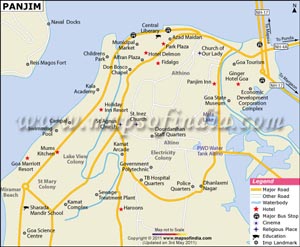

About Panaji
Usually called in the English language as “Panjim”, this is the capital city of the state of Goa in India. The name of this city is even found in the historical inscriptions that date back to the 12th Century. Included in the North Goa district, this city is located on the Mandovi River’s left bank. This city is considered to be the 3rd biggest city of the state. The city is a place of church with the Baroque architectural style and pretty villas, which are based on the cobbled streets that distinguishes the area with a Portuguese ambience. This Goan city is even known for the richness of culture and tradition as well as the idyllic beauty.
Demographics of Panaji
As per the report published after the Census operation of the year 2011, following are some of the demographic details of the city:
- Total population: 1, 457, 723
- Total male population: 7, 40, 711
- Total female population: 7, 17, 012
- Sex ratio: 968 females per 1, 000 males
- Child sex ratio (Population within the age group of 0 year to 6 years): 920 girls per 1, 000 boys
- Sex ratio (Aged 7 years and above): 973 females per 1, 000 males
- Rate of population growth: 8.17 %
Places of Visit in Panaji
Being the capital of the Goa state, this city has got many tourist attractions in and around it. Some of the famous places of interest in Panaji are as follows:
Adilshahi Palace: This 16th Century palace is popularly known as the Idalcao Palace.
Church Square: Even known as the Municipal Garden, this place is the location of the Our Lady of the Immaculate Conception Church, which was constructed in the year 1541. The architecture of this church reflects the Portuguese Baroque architectural pattern.
Dona Paula Beach: Apart from being the meeting point of 2 of the famous rivers of Goa with the Arabian Sea, this sea beach houses the Cabo Raj Bhavan, which is the Governor of Goa’s official residence, on its westernmost tip.
Goa Science Center: Opened during the month of December in 2001, this science center is situated near the capital city of Panaji.
Hanuman Mandir: Based atop a hill in Mala, this temple is known for the zatra, which is held every year in the month of February.
Kala Academy: This is one of the best cultural centers in this city of Goa, built by Charles Correa, the famous architect of India, where the art and culture of the state are being showcased.
Miramar Beach: Situated within the proximity of the city, this is among some of the most crowded Panaji sea beaches that are visited by local as well as international tourists all through the year.
Salim Ali Bird Sanctuary: Located near the Panaji city, this bird sanctuary is home to a number of endangered and rare species of birds. The nest of these resident as well as migratory birds is being named after Dr. Salim Ali, the renowned orthinologist.
Apart from the above ones, to name a few more tourist spots in Panaji are:
- Bambolim Beach
- Chapel of St. Sebastian
- Jama Masjid
- Mahalaxmi Temple
Sources of Economy in Panaji
Goa, being a very popular tourist destination to domestic as well as international tourists, the economy of its capital city mostly depends on tourism and hospitality. The tourism industry is directly related to the hospitality industry, which includes the businesses of hotels and restaurants. Thus, these have even got a significant contribution to the city’s economy. Moreover, tourism helps in the improvement of the local handicraft market. The varied kinds of adventure sports and beach carnivals can not be ignored as some of the other major resources of income for this famous city of the Goa state.
Transport System in Panaji
This Goan city can be reached from different parts of the country as well as the world by the following three major and mostly used modes of transport:
By Air: Dabolim Airport, situated at a distance of around 35 km from the heart of the city, is the nearest airport to Panaji. Besides connecting to some of the major Indian cities of Ahmedabad, Bangalore, Delhi, Hyderabad, Mumbai, Pune, Srinagar and many more, this airport has got connecting flights to the foreign lands like Amsterdam, Frankfurt, London, Moscow, Sharjah, Zurich etc.
By Rail: Karmali Railway Station, located at approximately 10 km towards the east of this city, is its closest railway station. However, the Madgaon Junction, which is based at about 35 km towards the city’s south, is the major railway station that serves the city. Almost every train passing through this station stops there, which help the city to easily connect with New Delhi, Kanyakumari and several other important cities of India.
By Road: Winding highways connect this city to the state of Maharashtra towards north and Karnataka towards south. National Highway – 4 A and National Highway – 17 pass through Goa’s capital city. Starting from non air-conditioned ordinary buses to air-conditioned luxury ones, every kind of bus services are available in Panaji, which ply to and from Bangalore, Hyderabad, Mangalore, Mumbai, Pune etc. Kadamba Bus Stand is one of the major bus terminals in the city from where buses are run by K. T. C. (Kadamba Transport Corporation), M. S. R. T. C. (Maharashtra State Road Transport Corporation) and K. S. R. T. (Karnataka State Road Transport).
Last Updated on 2/28/2012
|
Maps and Information on Panaji
| ||||
