






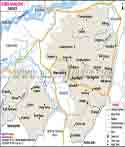
About
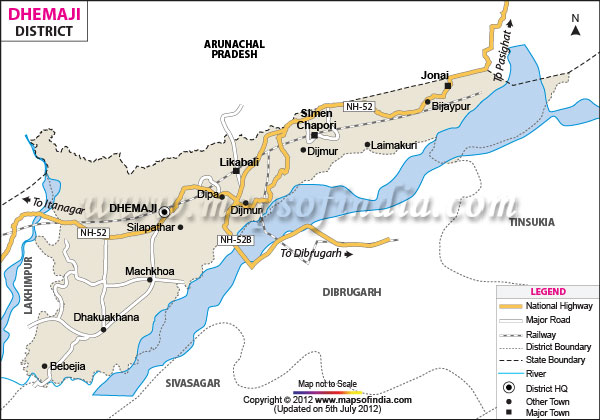
As part of Assam, Dhemaji is one of the most beautiful places in the north of the river Brahmaputra. It's more like a little town that hasn't kept pace with the surrounding cities and towns. So tourism here started not long ago and it grew to be a tourist destination mainly because it proved to be the greatest retreat for those who desire some time away from the hustle and bustle of cities. Dhemaji has Arunachal Himalayas as a background in the north which is a magnificent site to see.
In Assamese, "flood" is called "Dhal" and "playing" is "Dhemali". The area became known as the “playground of floods” or “Dhal Dhemali” over a period of time. Later on “Dhal” was deleted and Dhemali was evolved to Dhemaji. Hence the name sums up the constant fight against the vagaries of nature.
History & Culture
It is believed that in 1240 Chow Chukafa the first King of Ahom rule constructed his capital at a site named Haboong in the area of Dhemaji. The King transferred the capital from Haboong due to perennial flood in the area and the area came under the dominion of Chutias thereafter and it continued from 1223 to 1523. In 1523, the Ahom King Chuhung-Moong fought and killed the Chutia king Natipal, and the land again came under the dominion of Ahoms.
The entire Dhemaji district was formerly inhabited by many indigenous tribes like as Mising, Sonowal Kachari, Bodo Kachari, Deori and Laloong. Besides this, several tribes viz. Ahom, Rabha, Tai - Khamti, Konch, Keot, Koiborta, Brahman, Kayastha, Kalita etc. migrated in distinct times of time span.
One of the most widespread belief is that - there was a river which used to shift its path very regularly and resulted unanticipated flood covering different portions of the land. Flood and playing in Assamese are Dhal and Dhemali respectively and thus the area when flood is a perennial phenomena may be called as a playground for flood i.e., in Assamese it became to be Dhal Dhemali with the ellapsation of time the word Dhal was omitted and also the word Dhemali started to be pronounced as "Dhemaji".
The existing geographical region of Dhemaji district was formerly a part of the erstwhile Lakhimpur District with its seat at Dibrugarh. In 1971, Dhemaji was created as a Sub-Division, including Jonai and Dhakuakhana (presently under Lakhimpur District). On 14th August/1st October 1989, Dhemaji was declared as an autonomous district including Jonai and Dhemaji (Sadar) Sub-Divisions.
Economy
Agriculture is the backbone of economy of Dhemaji and most of its inhabitants is engaged in farming. The district is covered by alluvial soil deposited by Brahmaputra, Subansiri and Jiadhol rivers and is suitable for growth of variety of crops. The main crop of the district is paddy (rice) and next to it is mustard, lentils, sugarcane and vegetables. Also there is a growing interest in horticulture in the region with cultivation of crops including banana, orange and pineapple. Dhemaji is one of the significant agricultural hubs of Assam despite the periodic floods. Efforts are underway to improve sustainable and flood resistant farming practices.
The natives of the state have other means of income like sericulture, fishing and driftwood industry. Sand deposition and other harmful impacts of the repeated floods have also generated some fertile lands in the district which are particularly ideal for the agricultural needs. So many of such folks are moving to better pastures inside the district to carry out horticulture pursuits. It is one of the economically underdeveloped areas due to lack of adequate communication system, paucity of power and lack of proper irrigation & marketing facilities, however it still has a big number of agricultural land. The district is poorly developed with very few agriculture based industries. The gross domestic product in the district for 2018-19 was Rs. 4,36,613 lakh at current pricing and Rs. 3,08,831 lakh at constant 2011-2012 prices. The Net Domestic Product of the district for 2007-2008 was Rs. 97,389 lakh at current pricing and Rs. 71,991 lakh at constant 1999-2000 prices. Per Capita Income or NDDP, At Factor Cost in the district for the year 2018-2019 Rs. 56,388 at current pricing and Rs. 40,639 at constant 2011-2012 prices.
Tourism
Malinithan
This religious place is located at a distance of around 42 km away from the district toward the north eastern side. This site of worship was erected in honour of Goddess Malini who was worshipped here since the ancient times. It is a popular pilgrimage destination in the mountainous ranges of Arunachal Pradesh and attracts a lot of devotees and pilgrims almost throughout the year. Many archaeological excavations have been done in this spot out of which several designs of flowers, sculptures of deities and animals, broken panels have been found. Some of the noted granite stone sculptures here are Surya riding a chariot, a Nandi bull, Lord Indra on his mount Airavata and Ganesha mounted on a mouse. This temple area is also recognised for the excavation of many historical monuments.
Gerukamukh
Nestled in the lap of Assam, Dhemaji district offers a beautiful backdrop and among its many attractions, one of the most renowned destinations is Gerukamukh which is situated approximately 44 kms away from Dhemaji. One of the peculiar features of Gerukamukh Sobansiri is that the major tributary of River Brahmaputra run through these planes from highlands. The riverbed is a mix of pebbles and sand and boulders. It is regarded to be one of the most beautiful places to arrange a picnic and spend a day out with your friends and family in the middle of the green valleys and paddy fields.
Maa Manipuri Than
Maa Manipuri Than is one of the most visited pilgrimage place among the several attractions in this area which is situated toward the south western side of Dhemaji. This temple was built during the period of the Ahom kingdom. It is an ancient temple surrounded by thick grasslands and hills and is still considered to be a location of great importance at Dhemaji. It is stated that King Gaurinath Singh had built the temple so that the people living here may prepare for the Mua Mariah Renaissance. Today, a number of devotees visit this holy place to have the blessings of the almighty and also to have a glance of the cultural and historical importance. The local people live surrounding this site are recognised to be the creators of magnificent arts and crafts.
Demographics
Dhemaji district consists of a population of 686,133 people. Males constitute 51.2% and 48.8% are females. The area covers 3,237 sq km and has a population density of 212 people per square km. It has 92.96% of the population residing in rural areas and 7.04% in urban areas. The sex ratio in the district is at 953 females per 1000 males. The large proportion of the population that resides in rural areas is representative of the agricultural economy of the region as it consists of villages and farmers.
Administration
Dhemaji is one of the districts of Assam with administrative headquarters at Dhemaji Town. The district is administered by the Deputy Commissioner who oversees revenue administration, development and disaster management besides the working of various other government departments.
There are several revenue circles and development blocks in the district through which government provides services to the people residing in towns and villages. In addition, local administration also covers the Panchayati Raj institutions of Gaon Panchayats and the Zilla Parishad that look after the developmental activities in the district at the village level.
Floods present one of the major challenges to the administration of Dhemaji district. This district located in the riverine tract is traversed by rivers like Brahmaputra, Jiadhal and Gainadi among others and experiences severe flooding and erosion during monsoon.
This necessitates the carrying out of flood preparation and relief works, repair of roads and bridges and rehabilitation and resettlement of families affected by floods in the district.
FAQs
Q1:What is the area of the district?
The area constitutes of 3237 sq km.
Q2:Which rivers flows through this area?
The Brahmaputra is the main river flowing here.
Q3:What is Maa Manipuri Than famous for?
It is famous for its pilgrimage reasons.
Q4:What are the main crops grown?
Rice is the main crop grown here.
Q5:Which communities live in Dhemaji?
Assamese constitutes the main population.
Q6:What is the sex ratio of this area?
It is 953 females per 1000 males.
Last Updated on : October 15, 2026
