






About
Among Indian towns, Deoghar stands distinct due to its name's origin - formed from two parts: "dev," referring to deities, and "ghar," meaning home. This place carries spiritual weight, often named Baidyanath Dham or Baba Dham in religious contexts. From the northern edge, Bhagalpur borders it; to the far east, Dumka defines its limit. Southward connects Jamtara, while Giridih forms the western boundary. Each adjoining region shapes access routes and regional ties.
From above, the land appears irregular, shaped by numerous stony elevations and extended crests separated by sunken zones. Thick woodland stretches across much of the region. Rising distinctly are Phuljari, reaching 750 metres, followed by Teror at 670 metres. Beneath nearly seven-tenths of the surface lies solid crystalline bedrock - classified as Chotanagpur granite gneiss. Over this base rests a formation dominated by Chotanagpur granites and banded metamorphic layers, interwoven occasionally with altered sedimentary and basaltic materials. Stony textures define the earth here; reddish sand-laden clays dominate, retaining little moisture yet still capable of supporting crops. In lower tracts, darker deposits occur naturally.
History and Culture
Lost in ancient times, the beginnings of Baidynathdham remain unclear. Referred to as Haritakivan or Ketakivan within classical Sanskrit literature, its early identity emerges through these names. Deoghar appears later in records, likely emerging alongside construction of the grand shrine dedicated to Lord Baidyanath. While no clear account identifies who first raised the temple, fragments at the front section are attributed - by tradition - to Puran Mal. This figure connects to the lineage of the Giddhour royal family, with work placed around the year 1596.
The district took shape on 1 June 1983. Before that date, it belonged to Santhal Pargana. This area appeared in 1885 after being separated from Bhagalpur and Birbhum. Because of the Santal rebellion during 1854–1855, Santhal Pargana was created. Evidence points to habitation starting far earlier than written records show.
From writings by the Chinese visitor Huen Tsang, travelling through India during 645 AD, slight details emerged regarding the region. Lofty structures made of brick and stone near the Ganges were observed, recorded within his accounts of Tailiyagarhi Fort. Mention appears again much later in the Bhavishyat Puran, composed between the fifteenth and sixteenth centuries. Within its passages rests reference to the sanctuary dedicated to Lord Baidyanath. Though separated by time, both sources point quietly toward enduring landmarks.
On 16 July 1855, fighting began near Payalpur in Bhagalpur - one early clash with British forces. From there, unrest moved outward, touching regions now known as Dumka, Godda, and Sahibganj. In later years, residents took part when salt laws were challenged, during acts of civil resistance, while rejecting imported alcohol and fabric, even through the upheaval of 1942. Though quiet in records, their presence marked each event.
Known for its rich traditions, the region holds status as Jharkhand's cultural heart. Residing here are many groups - Bengalis, Biharis, and indigenous tribes forming a core part, while others such as Gujaratis, Punjabis, Tamils, Malayalis, Telugus, Marwaris, and Rajasthanis have settled across time. Because of this blend, speech varies greatly from place to place within the area. Among observances marked each year appear Diwali, Holi, Chhath, Durga Puja, Ramanavami, Eid, Saraswati Puja, and Makar Sankranti. Linked closely to factories and mineral extraction, Vishwakarma Puja carries particular weight. Though varied in origin, celebrations shape much of public life.
Economy
Religious visitors shape much of the economic activity, influencing how services are structured. Information technology drives industrial output, while farming remains a steady contributor alongside energy production. Services form a core part, supported by travel-related operations and local business networks. Medium-sized ventures operate within these areas, adding diversity without shifting focus. Dependence on visitor spending continues to guide development patterns across regions.
Farming along with related sectors supports a significant share of the economy. Wheat stands first among cultivated plants, followed by maize, paddy, pulses, alongside oilseeds. Dry conditions dominate across months, broken solely by monsoon rains bringing 1,200 to 1,300 mm annually. Work in fields depends heavily on seasonal rain, limited mostly to one crop each cycle. Because of this pattern, many residents travel temporarily to urban centers seeking income.
Marked by the Committee on Agro-Climatic Regional Planning as suitable for horticulture, the area falls within the scope of the National Horticulture Mission - support offered for establishing plantations. Still, industrial growth has seen little advance; instead, many rely largely upon natural systems to sustain daily life.
Tourism
Among India's key spiritual centers, this region draws visitors through faith-driven travel, outdoor pursuits, or landscapes shaped by natural forces. Its appeal unfolds across sacred sites, rugged terrain, yet quiet wilderness alike.
Located in Deoghar, the Baideanth Jyotirlinga shrine - often called Baidyanath Dham - is counted among twelve revered shrines linked to Shiva’s radiant form. Within its sprawling grounds stands the central sanctum dedicated to Baba Baidyanath, housing the sacred lingam, accompanied by two dozen subsidiary shrines. Beyond Shaivite significance, this site holds importance in Shaktism; tradition states it marks where Sati’s heart descended. When Shiva carried her lifeless body in grief, Vishnu intervened with his spinning discus, scattering her remains across the land. Fifty-one such spots became known as Shaktipeethas, places of divine feminine power - one being this very location
Every summer, around July or August, pilgrims begin arriving by the millions. Most start in Sultanganj, carrying river water collected near its banks. The journey unfolds across roughly 108 kilometres of open road. These travelers follow an old path through Bihar's rural stretches. Their destination stands in Deoghar: a temple known as Baidyanath Dham. The liquid they carry comes from the Ganga, considered sacred by many. Devotion, rather than speed, sets the rhythm of their steps. Over weeks, small groups merge into long streams of walkers. Exact numbers shift yearly, yet totals often reach seven or eight million. Worship drives each person forward, step after step. Arrival happens slowly, marked more by endurance than haste.
Some 10 kilometres distant lie the Tapovan Caves and Hills, home to a shrine known as Taponath Mahadeva. Within one cavern rests a Shiva lingam, believed to have been visited long ago by Sage Valmiki during his spiritual retreats. At 146 feet tall rises the Naulakha Mandir, shaped like the buildings seen at Belur Math's Ramakrishna Mission - though dedicated entirely to Radha-Krishna; construction was supported by nine lakh rupees, which gave it its title. Beyond that point, 21 kilometres away, rests Trikut Hill, where peaks connect through stories to Brahma, Vishnu, and Mahesh - with one summit climbing to 2,470 feet above ground level. Flowing around lower slopes, the Mayurakshi River traces quiet loops through ancient rock.
Demographics
Around 14.9 lakh individuals live within the region. Of these, males account for roughly 52 percent - about 7.8 lakh - while females make up 48 percent, totaling approximately 7.2 lakh. When viewed through social group distribution, three-quarters belong to the general category. Belonging to Scheduled Castes are 13 out of every hundred residents. Twelve per hundred identify as part of Scheduled Tribes. Children below six years represent nearly one-fifth of all inhabitants. Among that younger cohort, just over half are male; slightly less than half are female. Household count reaches close to 2.6 lakh units. Each residence hosts around six members on average
One square kilometer in rural territory typically shelters 526 persons; urban plots show a marked increase beyond that figure. Nearly 83 of every hundred humans live outside metropolitan boundaries - cities host just a minor share. As distance spreads across land, population density shifts noticeably toward concentrated hubs Population counts rose steadily during the early twenty-first century. Over ten years - from 2001 through 2011 - growth reached a measured 16 out of every hundred. Such increase unfolded mostly outside metropolitan boundaries
With reference to the 2011 census, literacy across the district stands at 64.85 percent - males record 76.85 while females account for 51.8. Among those who can read and write, numbering 793,538 overall, men make up 489,837, women stand at 303,701.
Hindi, Khortha, and Bangla hold official status here; alongside them exist tongues such as Angika and Santhali. Rooted in time, the area has drawn people from many corners of eastern India - this mix now lives within its speech.
Administration
From the top, authority sits with the Deputy Commissioner of Deoghar, an officer drawn from the Indian Administrative Service. Here, supervision takes root; from this point, guidance moves on toward department leaders managing designated tasks. Coordination emerges from this central point, linking separate arms of governance into shared motion. Development initiatives move forward under watchful review, ensuring alignment with broader objectives. Welfare efforts reach communities only after passing through structured channels managed at this level.
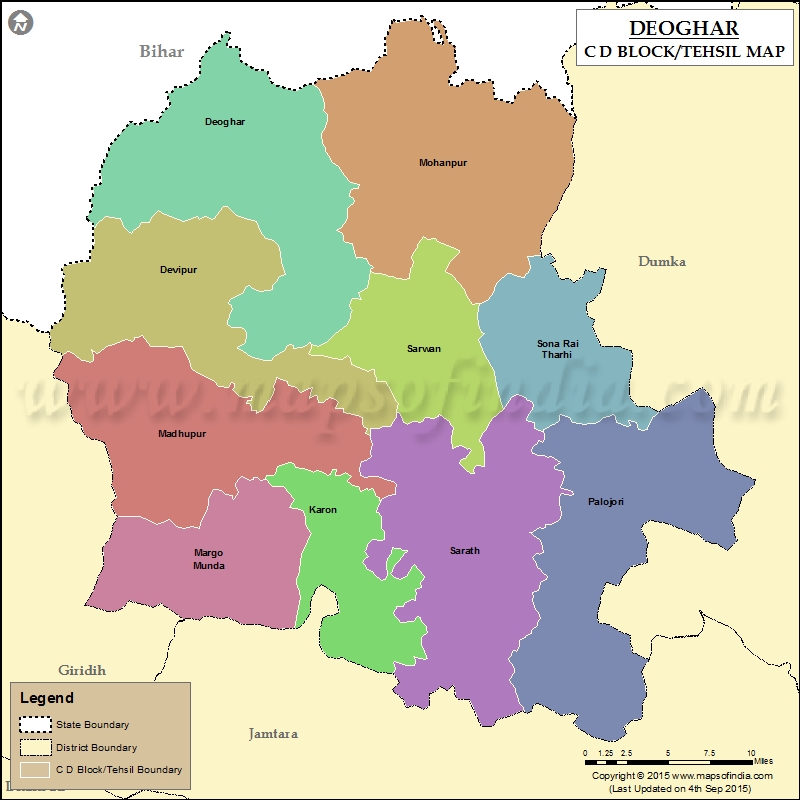
Two subdivisions form the area: Deoghar alongside Madhupur. Ten community development blocks make up its structure - Deoghar, Karon, Madhupur, Mohanpur, Palojori, Sarath, Devipur, Margomunda, Sarwan, and Sonaraithari included. Within it lie three state assembly segments named Madhupur, Sarath, and Deoghar. While Madhupur together with Deoghar belongs to the Godda parliamentary zone, Sarath connects instead to Dumka’s national seat.
Among well-known learning centers in the area are the Indira Gandhi National Open University Regional Centre, followed by Ramakrishna Mission Vidyapith. Not far behind stands Deoghar Utkarsh College, while St. Francis School also holds recognition. Each supports advanced study opportunities locally through varied academic paths
Despite progress, development funds still flow into the region via the Backward Regions Grant Fund Programme (BRGF), highlighting persistent gaps in infrastructure, health care, and social services. Progress unfolds slowly, yet digital governance efforts now shape how assistance moves - direct transfers bypass layers, reaching remote households scattered across ten administrative blocks. While systems evolve, outcomes depend on coordination between village councils and state frameworks, where updated processes replace older methods without fanfare.
List of Taluk in Deoghar District | ||
|---|---|---|
| Tehsil/Taluk Name | Total : Rural+Urban Population (2001) in Number | Tehsil/Taluk Name |
| Deoghar | 256,063 | 814113 |
| Devipur | 84,658 | 815552 |
| Karon | 119,497 | N.A |
| Madhupur | 167,773 | 815353 |
| Margo Munda | N.A | 815353 |
| Mohanpur | 143,479 | 814157 |
| Palojori | 128,032 | 814146 |
| Sarath | 136,950 | 814149 |
| Sarwan | 128,938 | 814150 |
| Sona Rai Tharhi | N.A | 814150 |
| Facts of Deoghar District | |
|---|---|
| Official Name | Deoghar |
| Region | Anga |
| Division | Santhal Parganas |
| Area (km2) | 119 |
| Population | 203,123 |
FAQs
Q1: How many villages are there in the district?
2,662 villages.
Q2: What is the population of the district?
2,219,146 (2011 census).
Q3: What is this district famous for?
Known as the "Cultural Capital of Jharkhand" and is a premier Hindu pilgrimage destination, specifically for its unique dual status as a Jyotirlinga and a Shakti Peetha.
Last Updated on : May 11, 2026
