
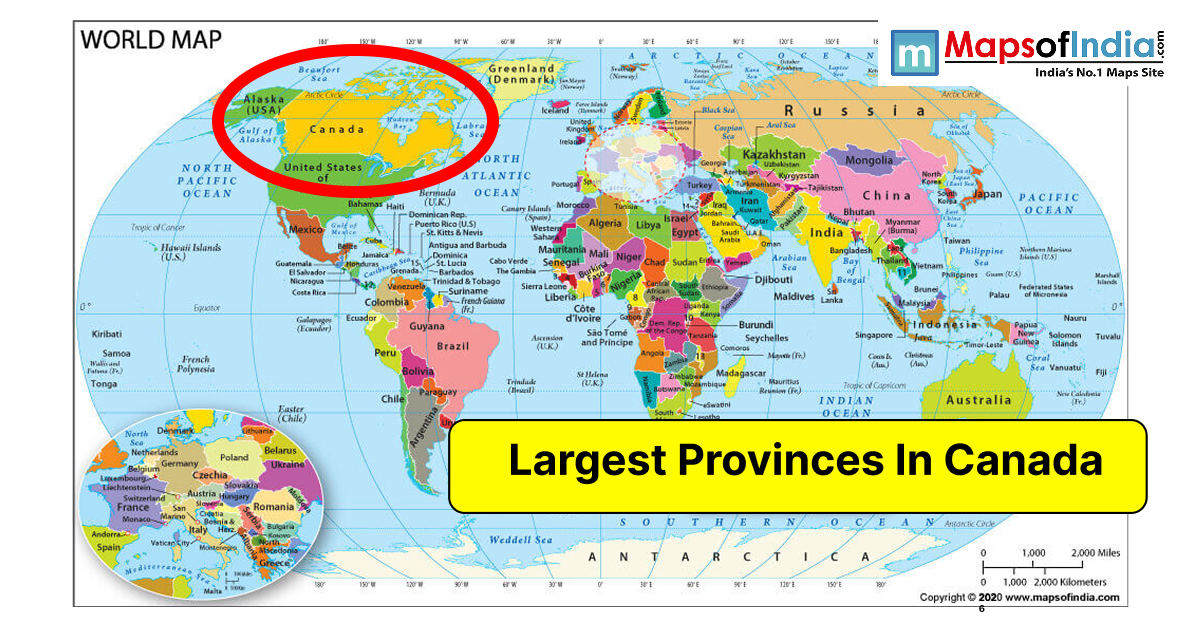
Canada’s spectacular scenery, massive wilderness and enormous size are world-renowned. Canada is the second-largest country in the world in land mass, extending from the Atlantic Ocean to the Pacific Ocean and north to the Arctic Ocean. This vast country can be broken down into ten provinces and three territories, all of which are uniquely Canadian, culturally, economically and geographically.
Of these provinces, some are remarkable for their size. There are forests, mountain ranges, prairies, and thousands of lakes, all in these big areas! An examination of the largest provinces in Canada can be an interesting study of the geography of Canada and the role that these provinces play in the economy, culture and environment of Canada.
Quebec: Canada’s Largest Province
Quebec is Canada’s biggest province (1.54 million sq km). The province of Quebec is a big province in eastern Canada, having a long history, a rich French culture and a rich French heritage.
The province’s topography is very varied. Much of the terrain is covered with forests, and there are countless lakes and rivers with fresh water. The northern part of Quebec includes desolate regions in the Arctic territory, and the southern part contains large cities like Montreal and Quebec City. These cities are significant cultural, educational and economic centres.
Quebec also has a reputation for being a leader in the generation of hydroelectric energy. It has a long history of rivers, which have facilitated some of the world’s vast hydroelectric schemes that supply cleaner energy for its citizens and companies. Quebec is one of the most influential provinces in Canada, due to its natural beauty, its uniqueness in terms of culture and identity, and its natural beauty.
Ontario: The Economic Heart of Canada
Following Quebec in size is Ontario, Canada’s second-largest province. On the national scene, Ontario is the largest province in Canada in both size, with an area of over one million square kilometres, and in population, as well as being an important contributor to the national economy.
The geography of Ontario ranges from urban areas to remote wilderness areas. Most of the province’s population is found in the southern part of the province, which is home to Toronto, Ottawa, Hamilton and London. The capital of Canada is Ottawa, and Toronto is the biggest city in Canada and a global hub of finance, technology, and commerce.
Outside the cities, Ontario has huge forests, thousands of lakes and areas of the Great Lakes coastline. Northern Ontario, especially, is renowned for its natural assets, namely the minerals, forests and fresh water resources. This economic power and natural wealth make Ontario one of the most significant provinces in the nation.
British Columbia: Mountains, Forests, and Pacific Coastlines
British Columbia, or as it’s often called, BC, is the third largest province in Canada. It covers an area of nearly 945,000 square kilometres along the western coastline of the country and has some beautiful natural features. The province is a land of rugged mountain ranges, rich forests, beautiful islands and an amazing Pacific coast. People come to BC for Vancouver, Victoria, Whistler and the Canadian Rockies.
British Columbia has one of the widest ranges of climates in Canada. The weather is relatively mild over the coastal regions, with hot summers and snowy winters in the interior regions. Tourism, forestry, mining, technology and international trade are among the industries that drive the province’s economy. It also has Pacific ports with high importance to link Canada with Asian markets.
Alberta: Energy Resources and Natural Wonders
Alberta is the 4th largest province in Canada and is known for its energy sector. Alberta is the largest of the Canadian provinces in area, with over 660,000 square kilometres, and is one of the country’s most economically important provinces because of its vast oil and natural gas resources.
From the prairies of the east, the province’s topography changes to the majestic Rocky Mountains in the west. For instance, some of the Alberta national parks in Canada, such as Banff and Jasper national parks, are among the most visited parks in the country.
Alberta also has a strong agricultural industry, and Alberta cities produce a variety of agricultural products. Edmonton is one of the fastest-growing cities in Canada, along with Calgary, and the two cities are important to the provincial economy.
Saskatchewan: The Breadbasket of Canada
Saskatchewan is the fifth-largest Canadian province and is referred to as “the farmers’ heartland”. The area of the province is almost 652,000KM², and the province is known for its agricultural productivity, large grasslands and agricultural practices.
Agriculture remains a vital part of Saskatchewan’s economy and is an important provincial producer of wheat, canola, barley, and other crops. It is also a world-class producer of potash used to produce fertilizers.
A great deal of land in Saskatchewan, but not as many people and not as violent and restrictive an area as it is elsewhere. The vast open fields and spectacular sunsets are hallmarks of the area.
Manitoba: The Land of Lakes
Manitoba is the sixth-largest province in Canada, with an area of about 648,000 km². Manitoba is located in the middle of the nation and connects with eastern and western Canada.
Fresh water is one of the characteristics of the province. Manitoba has over 100,000 lakes; it is said “Land of Lakes”. They provide water for tourism and recreation, fishing and the generation of hydroelectric power.
Winnipeg, the provincial capital, is a cultural and key transportation hub. Agriculture, manufacturing, mining and energy are key sectors of Manitoba’s economy. It is a land of varied landscapes such as forests, prairies, wetlands, and northern tundra areas.
The Importance of Canada’s Largest Provinces
The largest provinces in Canada are more than just expansive areas on a map. They are home to many of the nation’s most significant natural and cultural resources, as well as many of the nation’s major cities, transportation systems, and cultural sites. As a group, they are a key component of the Canadian economy and help maintain the environmental legacy of our country.
These provinces also demonstrate the wonders of Canada’s geography! There are many regions to discover in Canada, from Quebec’s vast forests to British Columbia’s coastal mountains, Saskatchewan’s agricultural plains to Manitoba’s freshwater lakes.
Conclusion
The two biggest provinces of Canada speak to the vast size and variety that make up Canada. Quebec is the biggest province by area, followed by Ontario, British Columbia, Alberta, Saskatchewan and Manitoba. The landscapes, industries, culture and history of each province add to the identity of Canada.
Not only do they provide the opportunity for the geographers and travellers to your country, Canada, out of my home country, but they can also show you one of the largest and most interesting countries in the world.