
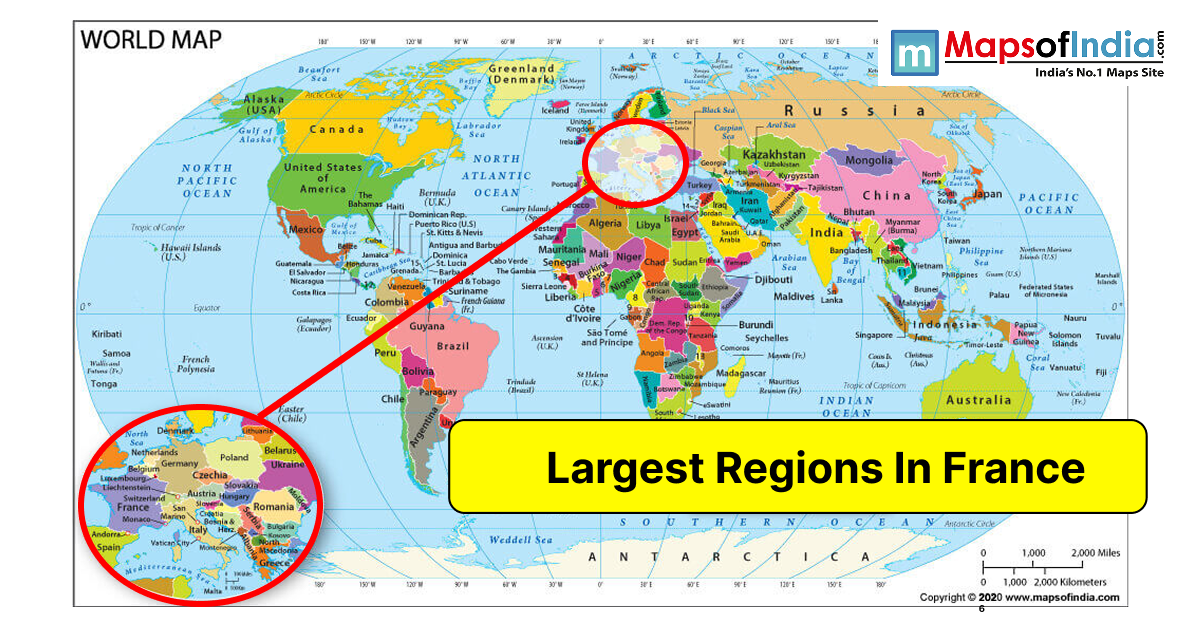
France is one of the most geographically interesting countries in Europe, and one of the most diverse. Each region throughout the nation has distinctive scenery, culture and history. Ten years later, in 2016, the political division of France was updated with more than half of the regions being cut; today, there are 13 instead of 22. In the present day, the areas have sizes, populations and economies that differ widely on this account.
This article delves into the question of which French regions are the largest on land and explains the uniqueness of each.
Understanding France’s Regional Structure
A Region is the highest level of French administrative division, below the national government. The regions are responsible for the economic development, transportation planning, educational infrastructure, and regional governance. Some areas are populated with dense urban areas, while others are expansively rural areas, mountains, forests and coastlines.
The following list is in decreasing order by area of the largest Metropolitan Regions of France:
Nouvelle-Aquitaine – The Largest Region in France
Area: Approximately 84,000 square kilometers
Nouvelle Aquitaine is the biggest of the regions in France, accounting for nearly a quarter of the country’s land area. It was formed from the merger of Aquitaine, Limousin and Poitou-Charentes in the 2016 regional reform, and is in the southwest of France.
The area is from the Atlantic Ocean east to the foot of the Pyrenees mountains by the Spanish border. It is known for its varied geology, consisting of sandy beaches, vineyards, forests and mountain scenery.
The Bordeaux wine region, a world-famous wine-producing area, is located in Nouvelle-Aquitaine. The region also boasts one of the largest forested regions in Europe, Landes Forest, and scenic seaside towns like Biarritz and La Rochelle. Being a very large region in France, Nouvelle-Aquitaine is also one of the most economically active regions, with agriculture, tourism and wine production being the main pillars.
Occitanie
Area: Approximately 72,700 square kilometers
Occitanie is the 2nd biggest region in France and represents a large part of the South of France. It is not a new creation but was created with the merger of the Lokidoc-Roussillon and Midi-Pyrénées regions.
It is an extraordinary geographical region, from Mediterranean beaches to the majestic mountains of the Pyrenees. Located in a strategic position, near Spain and the Mediterranean, it has influenced the culture and the economy of Occitanie over many centuries.
The capital city of Toulouse is famous as one of the leading aerospace cities in Europe, and Toulouse is also an important economic hub. The area also has a rich historical heritage, with its many Roman ruins, medieval towns and charming villages. These, along with the climate and the scenery, make the Occitanie region one of the most visited tourist areas in France.
Auvergne-Rhône-Alpes
Area: Approximately 69,700 square kilometers
Seated in the south-eastern part of France, Auvergne-Rhône-Alpes is the third-largest region of France and one of its economic hubs. It is the result of the union of the regions of Auvergne and Rhône-Alpes.
The area is well known for its mountainous scenery and recreational opportunities. It is the birthplace of Mont Blanc, the highest mountain of Western Europe, which is a favourite year-round for skiers, hikers and mountaineers.
The region is home to many large cities, including Lyon and Grenoble, which play a major role in the area’s economy, particularly in the fields of technology, manufacturing, research and innovation. These industries have contributed to Auvergne-Rhône-Alpes’ status as one of the most productive and prominent areas in France, along with its booming tourist industry.
Grand Est
Area: Approximately 57,400 square kilometers
Grand Est occupies the north-eastern region of France and is the result of a merger of the regions of Alsace, Champagne Ardenne and Lorraine.
It borders Belgium, the Netherlands, Germany and Switzerland, which are also integral parts of the region. This location has also influenced its culture, architecture, and traditions, creating a unique blend of French and German heritage.
One of the most renowned areas of the Grand Est is notably known in the world of champagne making for providing a part of the best-known sparkling wines in the world. Pulmonary centres are found in several important urban centres of the region, including the city of Strasbourg, where several major European institutions. Along with its charming villages, scenic vineyards and historical buildings, Grand Est is an important player in France’s economy and inter-border relations.
Bourgogne-Franche-Comté
Area: Approximately 47,800 square kilometers
Bourgogne-Franche-Comté is a region in eastern France, famous for its rolling countryside, historic towns, and world-famous wines. The region is formed from the historic territories of Burgundy and Franche-Comté, renowned for their traditional agricultural culture and innovative enterprises.
The region is famous for its vineyards, which produce some of the best wines in France, and is a destination for wine lovers from all over the world. In addition to its vineyards, Bourgogne-Franche-Comté is also renowned for its forests, lakes and scenic countryside, which makes it a favourite among nature lovers.
The standards and economy are not yet propelled by farming alone; manufacturing and technology are still important to the region’s economy. It has a unique character in France, both when it comes to its natural environment and cultural legacy.
Centre-Val de Loire
Area: Approximately 39,100 square kilometers
Located in the heart of France, Centre-Val de Loire is known as the “Garden of France”. Best known for the Loire Valley with its outstanding architectural heritage, UNESCO World Heritage Site and spectacular scenery.
It is a location that hosts some of the Country’s most stunning castles, including some Renaissance ones. Everyone’s dreaming of this architectural high art, which welcomes millions of people annually and gives a glimpse of France’s Royal history.
The region also enjoys fertile farmland where crops such as grains, fruits and wine can be grown, besides tourism. Centre-Val de Loire is one of the most noteworthy areas in France – it’s rich in culture, and is also a fabulous place to experience all the natural wonders that it has to offer.
Normandy
Area: Approximately 29,900 square kilometers
Normandy is situated in northwestern France, and it’s renowned for its rich history and beautiful scenery. For centuries, this area has been significant to the history of France and Europe.
Normandy is best known internationally as the location of the landings on D-Day during World War 2, which draw visitors to the historic beaches, museums and memorials. But it’s not all about World War 2 history in the region.
Further points of interest include the picturesque countryside, the dramatic coastal cliffs, apple orchards and dairy farms found throughout Normandy. The countryside is closely linked with products like Camembert cheese and cider. Normandy remains one of France’s most popular areas to visit, in large part thanks to its rich history, traditions and scenic beauty.
Why Region Size Matters
The administration and development of a region are affected by various factors related to its size. Some of the larger areas tend to be more diverse in terms of their environments, industries and populations. They can span a number of cultural identities and be aspects of many different economic sectors, involving sophisticated planning and governance.
Large areas also play an important role in agriculture, transport systems, the development of tourism, the protection of the environment and economic development. They have large areas of land which enable them to sustain a diversity of industries and important natural and cultural resources.
The French regional organization makes it possible to direct these large regions effectively and also preserves the uniqueness of both their local and traditional life forms.
Conclusion
The country’s largest regions highlight the amazing geographical and cultural diversity of France. Each region has its own distinct qualities, both within the multiple scenic characteristics of the territory and in the environment, which perfectly reflect its culture. Whether within the multiple scenic characteristics of the territory or in the environment which perfectly reflects its culture, each region has something unique.
Nouvelle-Aquitaine is the biggest region in France with more than 84,000 square kilometres among them. Nevertheless, each of the big French regions has some way of enriching the general economy, its history and the world.
Whether preparing for a trip or studying geography, knowledge of the largest areas of France offers insights into one of the most interesting European countries.