Question 1. Explain the concept of motivation.
Answer:The term motivation is derived from the Latin word ‘movere’ referring to movement of activity. Thus it pushes an individual (organism) into activity. It can be used to explain drives, needs, goals and incentives… Any behaviour is goal driven, demand persistent and often preferred or is in favour of one goal over the other. It is individuals internal force which energises and directs the behaviour.
Question 2. What are the biological bases of hunger and thirst needs?
Answer:Hunger: The stimuli of hunger include stomach contractions, which signify that the stomach is empty. A low concentration of glucose in the blood A low level of protein and the amount of fats stored in the body. The liver also responds to the lack of bodily fuel by sending nerve impulses to the brain. The aroma, taste or appearance of food may also result in a desire to eat. They all in combination act with external factors (such as taste, colour by observing other’s eating, and the smell of food, etc.) to the help one understands that she/he is hungry. Thirst:When we are deprived of water for a period of several hours, the mouth and throat become dry, which leads to dehydration of body tissues. Drinking water is necessary to wet a dry mouth. The processes within the body itself control thirst and drinking of water. Water must get into the tissues sufficiently to remove the dryness of mouth and throat. Motivation to drink water is mainly triggered by the conditions of the body. Loss of water from cells and reduction of blood volume. When Water is lost by bodily fluids, water leaves the interior of the cells. The anterior hypothalamus contains nerve cells called ‘osmoreceptors’, which generate nerve impulses in case of cell dehydration. These nerve impulses act as a signal for thirst and drinking. Ist View: The mechanism which explains the intake of water is responsible for stopping the intake of water. IInd View: The role of stimuli resulting from the intake of water in the stomach have something to do with stopping of drinking water. The precise physiological mechanisms underlying the thirst drive are yet to be understood.
Question 3. How do the needs for achievement, affiliation, and power influence the behaviour of adolescents ? Explain with examples.
Answer:Needs for achievement: It energies and directs behaviour as well as influences the perception of situations. During the formative years of social development, children acquire achievement motivation. They learn it from their parents, other role models, and socio-cultural influences. We are social being.We maintain some form of relationship with others. Nobody likes to remain alone all the time. Formation of group is an important feature of human life. It involves motivation for social contact. Need for affiliation seeking other human beings and wanting to be close to them both physically and psychologically is called affiliation. It involves motivation for social contact. It is aroused when individuals feel threatened or helpless and also when they are happy. People high on this need are motivated to seek the company of others and to maintain friendly relationships with other people. Need for poweris an ability of a person to produce intended effects on the behaviour and emotions of another person. The various goals of power motivation are to influence, control, persuade, lead and charm others.
Question 4.What is the basic idea behind Maslow’s hierarchy of needs? Explain with suitable examples.
Answer:Abraham Maslow, a humanist psychologist proposed a hierarchy of needs in which human needs are arranged in a sequence from primitive to human. They are interrelated in the sense that when one need is fulfilled, the next one takes on the mind. At the lowest level are the physiological needs followed by the other higher level needs as given below:
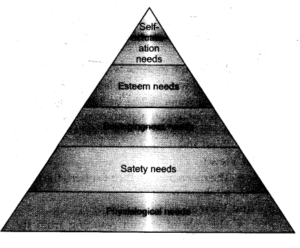
1. Physiological needs:These are needs which are basic for survival.They include such as hunger, thirst. 2. Safety needs:The need to be free from any possible threat-both real and imaginary. It is of both physical and psychological nature. 3. Belongingness:Needs to belong, to affiliate, to love and to be loved by others. One can’t live alone and needs other’s company. 4. Esteem needs:Individual strives for the need for self-esteem to develop a sense of self worth once his belongingness needs are fulfilled. 5. Self-actualisation:It means to attain the fullest developments of one’s potential. Such people are self-aware, socially responsible, creative, spontaneous, open to novelty and change, has a sense of humour and capacity for deep interpersonal relationships.
Question 5. Does physiological arousal precede or follow an emotional experience? Explain.
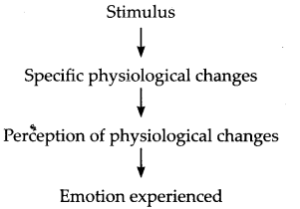
Answer: William James and Carl Lange argued that the perception about bodily changes, like rapid breathing, a pounding heart and running legs following an event, – brings forth emotional arousal. This theory of emotion holds that body’s reaction to a stimulus produces emotional reaction. The theory suggests that environmental stimuli elicit physiological responses from viscera (the internal organs like heart and lungs), which in turn, are associated with muscle movement. James-Lange theory argues that your perception about your bodily changes, like rapid breathing, a pounding heart, and running legs, following an event, brings forth emotional arousal. The theory can be expressed in the following hierarchy:
Canon and Bard contradicted to the James-Lange theory. According to this theory, felt emotion and the bodily reaction in emotion are independent of each other; both get triggered simultaneously. This theory of emotion holds that bodily changes and the experience of emotion occurs simultaneously. Theory claims that the entire process of emotion is governed by thalamus. Thalamus conveys the information simultaneously to the cerebral cortex and to the skeletal muscles and sympathetic nervous system. The cerebral cortex then determines the nature of the perceived stimulus. By referring to the past experiences. This determines the subjective experience of emotion. Simultaneously the sympathetic nervous system and the muscles provide physiological arousal and prepare the individual to take action. Following diagram shows the CANNON-BARD theory of emotion: