Mythology and history are so entangled in India that one may not easily distinguish one from the other. In fact, most cities here are not only the hubs of hospitality and trade but also the incarnations of ancient epics, gods, and sacred legends on earth. These cities were the backdrops of Ramayana, the Mahabharata, and other scriptures. Even today, a great number of people come to these cities seeking spiritual connection and cultural richness. These quite ancient stories are still being passed on by the places that are the source of such stories and which were the setting of the story of Indian civilization, from holy river banks to temple towns.
Varanasi, Uttar Pradesh
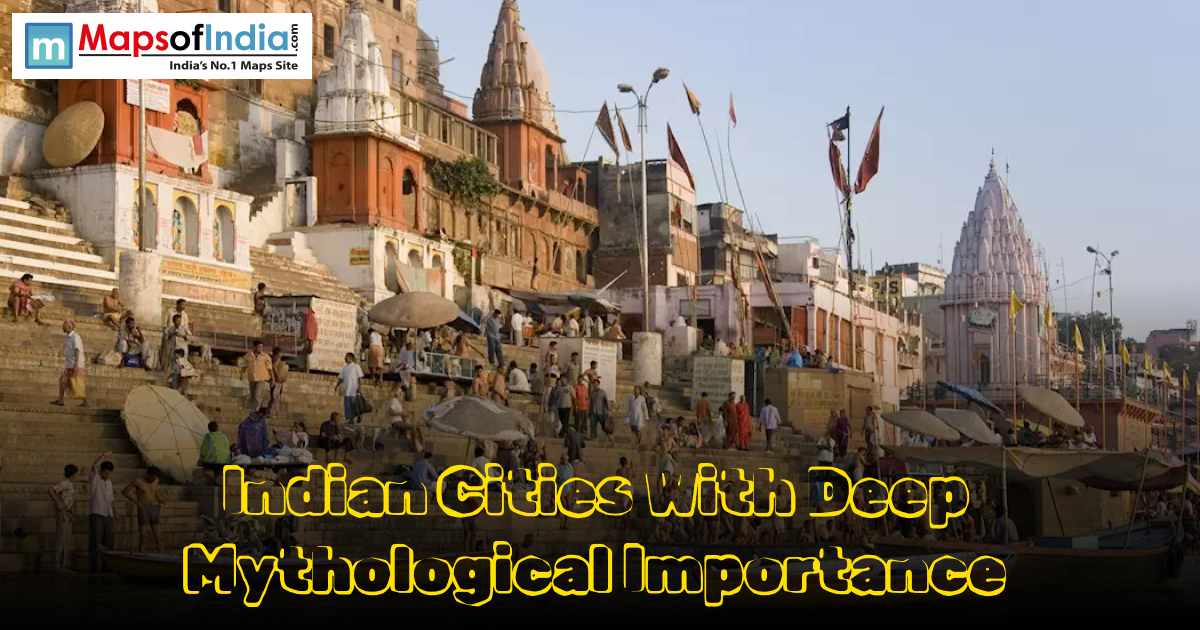
Down near the sacred Ganga in Uttar Pradesh lies Varanasi, known to some as Kashi. Thousands of years have passed, yet people keep living here with no gaps, just continuity. Hindus see it differently from ordinary spots; something about it feels older than time. Legends whisper that Shiva founded it when the world was new. Some believe it cuts the chain of coming back again. Down by the water, Dashashwamedh Ghat comes alive as dawn breaks with daily rites. A short walk away sits Kashi Vishwanath Temple, standing strong in worship for generations. Close by, too, rests Manikarnika Ghat, its fires never sleeping, flickering hour after hour. Each sunrise brings stillness woven into movement, grounding people in what feels larger than soil and bone. This place hums with presence, worn smooth by bare feet of wanderers drawn back again and again on their own.
Ayodhya, Uttar Pradesh
At the bank of the Sarayu River in the state of Uttar Pradesh is the city of Ayodhya. This place is closely tied to the incidents of his long period of exile and his final return home. The central focus is the Ram Janmabhoomi Temple, which is recognised as the most important one. One of the ancient Puranas has also mentioned it as a holy place related to Lord Vishnu. The legend that was born here continues to influence the lives of many, and the lessons of that legend have been passed on till the very end of the day.
Mathura and Vrindavan, Uttar Pradesh
On the banks of the Yamuna River and downstream from Delhi are Mathura and Vrindavan, two small towns intimately connected with the legends of Krishna. Vrindavan, which hosted his smiling face, flute melodies ringing in the air, experiences intertwined with leafy shrubs and pleasure. Temples stand there as silent witnesses: Banke Bihari sings with the chants of the early dawn; Janmabhoomi commemorates a prison cell converted into a shrine; Prem Mandir is faintly lit under intricately carved stone skies. Every turn here leads one through recollections. Even now, the stories of Krishna's eternal love hold the listeners enamoured as if they were divine resonances echoing through the ages.
Haridwar, Uttarakhand
Down south of the Himalayas, Haridwar rests in Uttarakhand, where the Ganga slips onto flat land. This city counts among the seven especially revered places in Hindu belief, known widely for hosting Kumbh Mela. An old tale says a splash of amrit, the immortal nectar, landed right here when the oceans were stirred. At dusk, crowds gather at Har Ki Pauri Ghat, drawn by chants and flames on water. Seen as an entrance to the river world, where mortals brush close to divine presence.
Ujjain, Madhya Pradesh
A city standing on the banks of the Kshipra River is Ujjain, located in Madhya Pradesh. Out of a total of only twelve holy Jyotirlingas, it is one that, even during the Simhastha Kumbh Mela times, draws a large number of people. Ancient records refer to it as the centre of the old Avanti kingdom, and it is also very famous for its learning. The place of Shiva worship is mainly at the Mahakaleshwar Temple, which has a strong influence of spirituality all around it. There was a time when their open sky star studies made the Ujjain residents scholars. Only Krishna's schooling through quiet lessons under the banyan trees led to him becoming a great person. Where myths come out through stone temples, the days go by as rhythms older than memory.
Madurai, Tamil Nadu
Old stories say Shiva shaped Madurai with his own hands. This place in South Tamil Nadu stands among India’s most ancient sites. Meenakshi, a form of Parvati, gives the city its soul. Her temple rises like poetry carved in stone, pure Dravidian craft. For more than two and a half millennia, Madurai has held deep roots in Tamil art, faith, and letters. Much like a breathing sanctuary where passion for the sacred dances alongside beauty in form.
Pushkar, Rajasthan
Pushkar has been situated near Ajmer in the Aravalli hills of Rajasthan. It is considered one of the most sacred cities of Hinduism and is said to have the only temple dedicated to Lord Brahma in the world. As per the story, a lotus fell from the hand of Brahma and gave rise to the holy Pushkar Lake. In addition, the place is also mentioned in the Mahabharata. The beautiful ghats and the temples of the town lure the pilgrims throughout the year. Just like a holy desert oasis where the God who created the universe is worshipped.
Dwarka, Gujarat
Dwarka is located on Gujarat's west coast. This town is deeply connected with the reign of Lord Krishna. Based on the legends, he founded a beautiful city there that was eventually taken by the sea. The Mahabharata and the Puranas provide accounts of this city's magnificence. Underwater ruins suggest that these places have emerged from the water. The things found below correspond to the descriptions in the ancient scriptures. The venerable Dwarkadhish Temple, which is a pilgrimage site today, stands firmly. The mythology is alive in its stones, while the underwater ruins tell the same stories as the ancient texts.
Why These Cities Are Different
These 10 cities epitomize the vast mythological depth of India quite profoundly. Varanasi, with its everlasting spiritual vibe and Ayodhya, as the link of Lord Rama, Krishna's location of play in Mathura and Shiva's house in Ujjain, such cities are full of sacred narratives that have influenced Indian faith and culture to date. They are not only the recorded sites but also the live hearts of worship, custom, and self-expression. Seeing them is not merely a tour, but the spiritual path through the ancient wisdom of India. These can also be called sacred chains that pull millions of hearts towards the magnificent mythological history of India.