


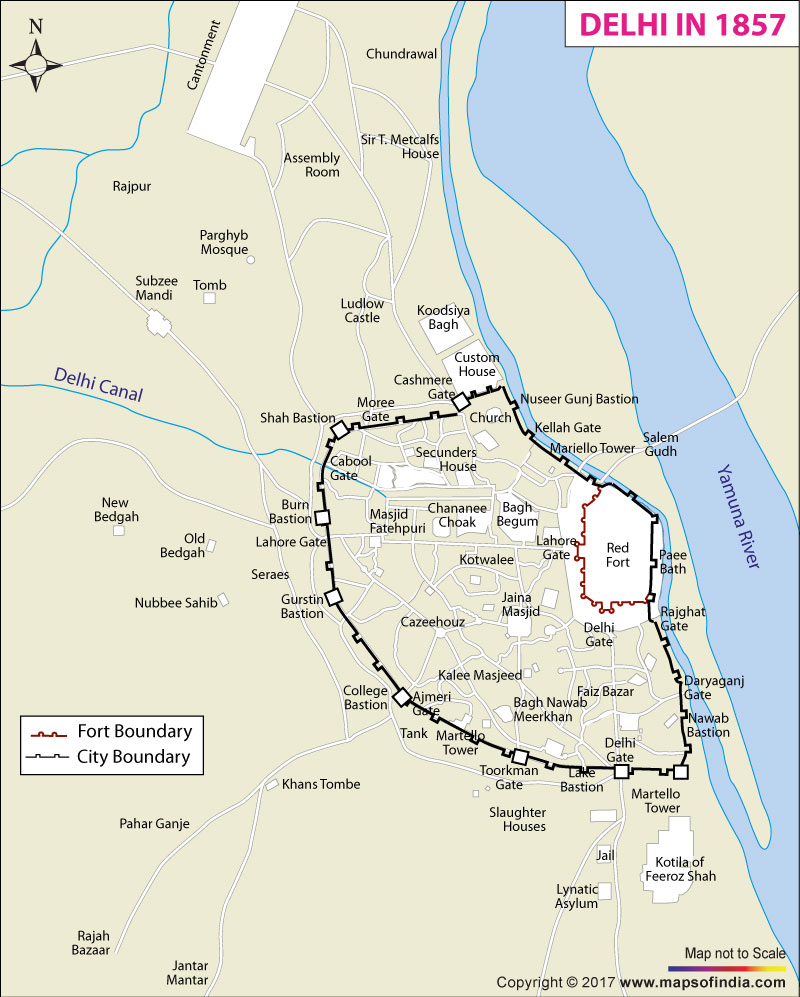



In the mid 17th century the Mughal Emperor Shahjahan built the seventh city of Delhi, on the banks of the river Yamuna, north of the previous settlement of the Delhi Sultanate of the 14th century. The notable landmarks which he built in this walled city, also called Shajahanabad, were the impressive Red Fort or Lal Qila and the Jama Masjid. The city was laid out in blocks with wide streets and a canal ran through the center of the tree lined main street called the Chananee Chowk. Today the city is called the Old Delhi and Chananee Chowk is now Chandni Chowk. The walled city had a number of gates or entry points -Ajmeri, Moree, Cashmere or Kashmiri, Toorkman, and Lahore (so called because it faced Lahore, now in Pakistan). Many of these gates are still standing.
In 1638 Shahjahan shifted the capital of the Mughal Empire from Agra to Delhi and it remained so for the later Mughals such as Aurangzeb and Bahadur Shah Zafar, though their power rapidly declined with the coming of the British. The British added various buildings to the city such as the Governor General's Agent Sir T Metcalf's house in the present Civil Lines, St James Church near Kashmiri gate, and the cantonment in the ridge on the outskirts of the walled city.
Landmarks of Old Delhi
The massive red sand stone building of the Red Fort took nine years to build and was completed in 1648. A two-kilometer long wall surrounded it. The Yamuna flowed next to the fort though the river has now moved eastwards. Red Fort is today a protected monument and the place from where the prime minister of independent India addresses the public.
Jama Masjid, the largest mosque in India, was built in 1656 and is set on a high platform on a low hill, close to the Red fort. Fatehpuri Masjid, built in 1650 by Shahjahan's wife, stands opposite to the Red Fort. The main street Chandni Chowk ran from the Lahore gate of the Red Fort to the Fatehpuri Masjid. The old wholesale markets of Daryaganj, Chawri Bazaar, and Khari Baoli were established within the walled city around 1840. The markets exist till today though the area is now very congested.
|
|
