







Mica is a non-metallic mineral. It occurs naturally and in igneous, metamorphic, and sedimentary regimes, It represents a group of 34 phyllosilicate minerals. There are several types of mica and they all have different appearances. While lepidolite is purple, rosy, or silver-grey, the biotite is dark green, brown, or black, phlogopite is yellowish-brown or green-white, and muscovite is transparent.
Among all these types, the muscovite and the phlogopite hold commercial value. They are a very good insulator of electricity and are thus used in the electrical industry in many ways. It is also used in toothpaste and cosmetic products.
Another surprising characteristic of mica is that it can be easily split into thin and flat sheets of varying thickness. It is also popular within India and around the world for its elasticity, toughness, flexibility, and transparency.
Mica Production in India
India has been a major producer and exporter of mica for over a century. Since ancient times mica has been used in India. It is used in many ayurvedic medicinal items and is known as Abhrak. Nowadays, it is widely used in the electrical industry for its insulating properties. Three types of mica are primarily found in India. They are Muscovite, Phlogopite, and Biotite. All of them are similar yet different from each other. But off lately, it is seeing a downfall in production due to a decrease in demand for mica.
Reserves/Resources of Mica in India
Andhra Pradesh, Jharkhand, Bihar, Maharashtra, Odisha, Telangana, and Rajasthan are the major states of India where the production of mica is undertaken. Apart from them, it can also be obtained from Gujarat, Haryana, Karnataka, Kerala, Tamil Nadu, and West Bengal.
According to data available with the National Mineral Inventory, India has total reserves/resources of 6,35,302 tonnes. Under this 1,14,433 are reserves and 5,20,869 tonnes are resources. Out of the total share of the country Andhra Pradesh has 41%, Rajasthan has 28%, Odisha has 17%, Maharashtra has 135, Bihar has 2%, and Jharkhand and Telangana have a very small share.
The table below shows the Reserves/Resources of Mica in different states of India as of 01.04.2015 (as per Indian Minerals Yearbook-2020: Part III):
| States | Total Reserves (in Kg) | Total Remaining Resources (in Kg) | Total Resources (Reserves + Remaining Resources) (in Kg) |
|---|---|---|---|
| All India | 114432777 | 520869364 | 635302141 |
| Andhra Pradesh | 80236085 | 177353126 | 257589211 |
| Bihar | - | 13074367 | 13074367 |
| Jharkhand | - | 1665130 | 1665130 |
| Maharashtra | - | 81036000 | 81036000 |
| Odisha | - | 105280000 | 105280000 |
| Rajasthan | 34196692 | 141875856 | 176072548 |
| Telangana | - | 584885 | 584885 |
Production of Mica in India
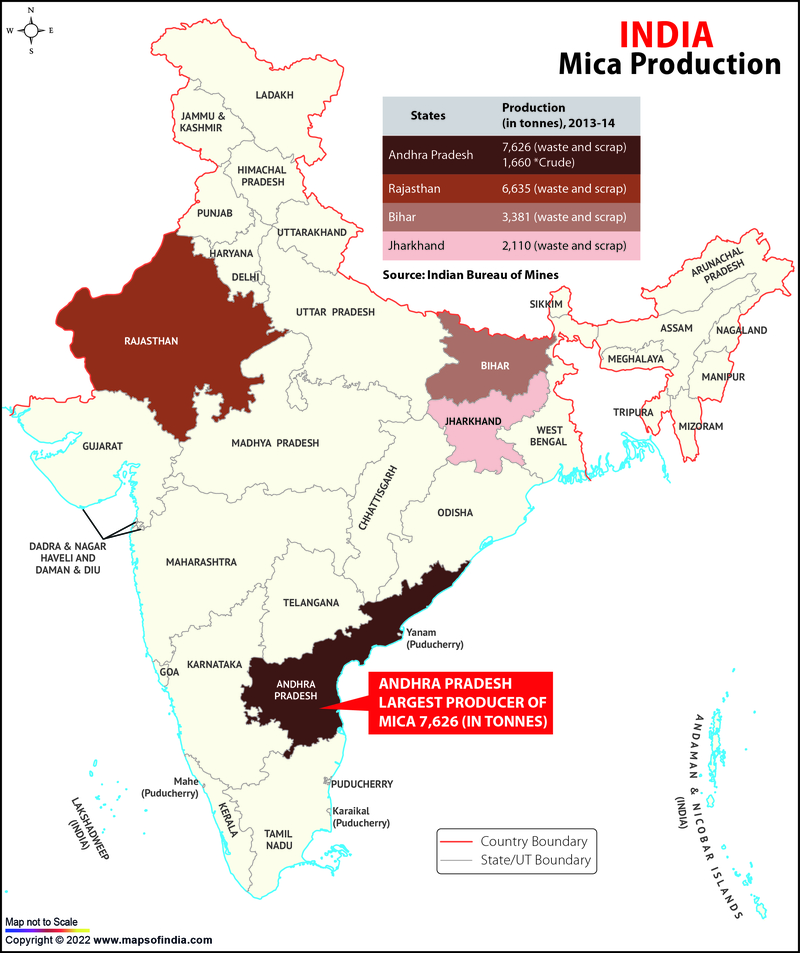
The largest state that produces mica in India is Andhra Pradesh. The best quality mica is found in the Nellore district. Other districts that produce mica here are Vishakhapatnam, West Godavari, and Krishna. Rajasthan is the second-largest producer of MIca. It has a 320 km long mica belt that is spread across Jaipur, Bhilwara, and around Udaipur. The third-largest producer of mica in India is Jharkhand. It has an approximately 150 km long and 32 km wide mica belt. These states are followed by Karnataka, Tamil Nadu, Kerala, Maharashtra, and West Bengal respectively.
Last Updated on : March 26, 2026
