




Introduction
Minerals are precious natural resources that are mostly found in the earth’s crust in the form of ore. Most of the raw materials that are used for purposes like construction, industries, etc are mostly minerals of various kinds. To define a mineral in chemistry definition it would be an element with a specific chemical composition and a well-defined atomic structure. Minerals are formed by inorganic processes and under favorable conditions. They can exist in various forms like crystalline or other physical forms.
India is one of the countries with the largest number of metallic and non-metallic minerals. We have 95 minerals that are produced in the country and 10 of these are metallic, 3 are atomic and 55 are other kinds of minerals with distinct properties. Here is a list of two types of minerals found in punjab.
Coal
Coal is found in the Salt Range in Punjab, specifically in the districts of Attock, Jhelum, Chakwal, Khushab, and Mianwali. The coal found here is of high quality and is bituminous. The high amount of carbon content in the coal makes it highly sought-after and a rich source of energy potential. The coal fields found in the region are of great importance in today's industrial age for Punjab and have been existing since colonial rule when the British extracted coal from these regions for their benefit.
It is important to note that the coal reserves found here are of lower quality than the ones found in the regions in Pakistan and they are also not as vast as the latter. The coal is mined and utilized for energy production and supports the local manufacturing industries in the region. An important concern concerning coal mining is the environmental impact which is a threat to sustainable development.
Bauxite is found in Punjab in the districts of Khushab and Chakwal. The bauxite which is found here is of high quality and has significant levels of aluminum content in them. The main regions where bauxite is found include Nilawahn to Khura in Khushab and near Saloi and Takwan in Chakwal. Bauxite deposits in the region are embedded in sedimentary rocks and are famous for their workable quality. Because of this, their demand in the market is comparatively higher than other minerals. Bauxite tour and its mining are one of the major contributing factors to the growth of the local aluminum industry in the region and it also contributes to the production of alumina and aluminum metal in the Punjab State.
Fine ClayFine Clay deposits in Punjab are found in the Salt Range and the Kala Chitta Range. These clays are brought to use in ceramics and brick-making industries. They are resistant to high temperatures and are rich in kaolinite. Find Clay is highly sought after in the Punjab manufacturing market because it is used in making high-quality bricks and tiles. Alluvial deposits are excavated and fine clay is taken out from these deposits with the help of big machines. Apart from making bricks and tiles, these clays are also brought to use in making sanitary ware and other ceramic products.
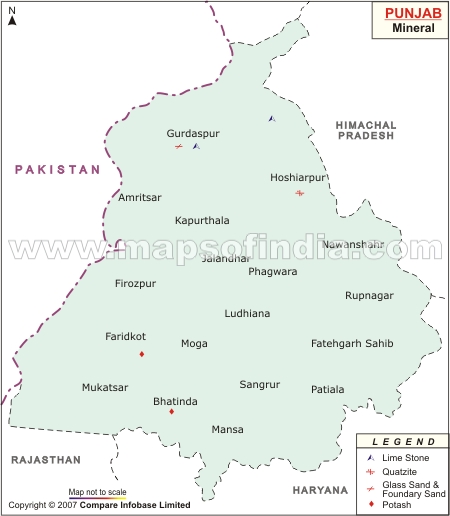
Silica SandSilica Sand is found in the Hoshiarpur district of Punjab. Silica deposits have a high-quality silica content which is used in industry for various purposes. The extraction of the sand is done by open pit mining and it is renowned for its purity and fine grain size. The glass manufacturing industry is one of the major industries which makes use of silica sand since it is their key ingredient in producing high-quality glass.
Apart from this, it is also used in foundries for molding and casting metals since they provide the necessary heat resistance and strength for these metals. Silica sand also finds its way to industries where silicon chips are produced for electronic industries. It would not be wrong to say that silica sand mining in Punjab is a major economic activity because it supports the local industries and generates employment opportunities for people on a large scale.
Quartzite is found in Punjab in the districts of Hoshiarpur and Ropar. It is a hard metamorphic rock which is formed from sandstone and is made up of mainly quartz. Quadsite is known for its durability and is resistant to weathering. This makes it an ideal mineral to be used in industrial applications. In Punjab, quartzite is used in the production of silicon chips, foundries for molding and casting, and in glass industries.
CelestiteCelestite is found in Punjab in the Salt Range, particularly in the districts of Chakwal and Khushba. The deposits of celestial diet are of high quality and are embedded in sedimentary rocks. It is a valuable mineral that is used as a flux in metallurgy and is a source of strontium salts. These cells are of great usage in various industrial applications for instance in the production of glass, ceramics, and fireworks. Celestite is usually white and has a faint blue tinge. There are many limited reserves of this mineral in India. Therefore, to ensure its sustainability and minimize the environmental impact of mining this mineral, the government has brought in various measures.
ChalkChalk is found in the salt range in Punjab and is brought to use mainly in the cement industry. It is used as a filler in the production of paints and plastic. It is also used as a soil conditioner to neutralize the acidic soils. Chalk is a soft porous white sedimentary rock that is made up of mainly calcium carbonate. It is formed under marine conditions by the accumulation of microscopic marine organism shells. The chalk deposits are usually found in layers or nodules and are extracted by quarrying. It is a technique where large blocks of rock are removed from the Earth. It is accompanied by other measures like land reclamation, dust control, and water management.
Apart from its usage in the cement industry, Chalk is also used in agriculture where it is used as a soil conditioner to neutralize acidic soils. This helps in improving the soil structure and helping the plant grow. It also helps to increase the PH of the soil which makes it more suitable for the crops that prefer neutral to slightly alkaline conditions to grow.
China clay is found in Punjab in the districts of Chakwal, Khushab, Mianwali, Attock, and D.G. Khan. This mineral is also famous as kaolin and is embedded in sedimentary rocks from where it is extracted via different measures. The clay is valuable and is sought for its property of being plastic and fine texture. Owing to this, it is brought to use in the ceramics industry to produce fine china, porcelain, and other ceramic products. The paper industry also brings it into use as a coating material and improves the paper quality. Apart from this china clay is also used in the production of rubber, paint, and plastics.
GypsumFound within the Salt Range of Punjab, gypsum appears as a gentle sulfate substance made up of calcium sulfate dihydrate. Through the slow drying of ancient seas, this material takes shape beneath the surface. Mainly applied in building processes, it contributes to items such as plaster cement and wall panels. Because farming plays a central role in Punjab’s economy, its presence benefits land quality - enhancing both nutrient balance and ground texture. A notable portion of local crop success ties back to this mineral's influence. Beyond structures and fields, it finds purpose across multiple sectors: medicine creation, plant nutrients, color coatings, and even precision forms used in dentistry and medical shaping.
Rock saltRock Salt is found in Punjab in the Khewra Salt Mine, from Jhelum to Mianwali. These mines are one of the oldest and largest salt mines in the world. Rock salt is also commonly known as halite. It is the naturally occurring mineral form of NaCl. The Khewra salt mines were discovered by Alexander the Great’s troops in 320 BC and since then the mines have been in use for centuries now. Rock salt found here is used in the production of high-quality Himalayan salt which is famous all around the world for its health benefits. There are other mining sites as well apart from the one mentioned above- Warcha (Khushab), Noorpur (Chakwal), and Kalabagh (Mianwali).
The salt range’s rock salt reserves are estimated to be around 25-30 million metric tons and the annual production is about 3 million tons. This all finds its use not just in the form of edible salt but also in chemical industries to produce soda ash, caustic soda, and other chemicals. Besides, it is also used in pharmaceuticals, decorative items, and de-icing roots and pavements during winter months.
Geography
From north to south, the Salt Range holds many of Punjab's key minerals. In places like Attock, Jhelum, and Chakwal - also Khushab and Mianwali - coal lies beneath the surface. Bauxite shows up between Nilawahn and Khura, both in Khushab, along with spots close to Saloi and Takwan within Chakwal. Clays of high quality rest across the Salt Range and stretch into Kala Chitta hills. Over in Hoshiarpur, silica sand waits under layers of earth. In Punjab, quartzite turns up around Hoshiarpur and Ropar. Moving westward, celestite shows in the Salt Range - Chakwal and Khushab hold deposits. Clay like china type spreads across several areas: Chakwal leads, then Khushab, Mianwali, Attock, and D.G. Khan follows. Salt comes out of rock form near Khewra, stretching from Jhelum into Mianwali territory. Some call these salt workings ancient; they rank among Earth's biggest such sites.
| Facts | |
|---|---|
| Mineral | Location and Uses |
| Coal | Found in Attock, Jhelum, Chakwal, Khushab, and Mianwali; used for energy production and local industries. |
| Bauxite | Found in Khushab and Chakwal; used in aluminum production. |
| Fine Clay | Found in Salt Range and Kala Chitta Range; used in ceramics and brick-making. |
| Silica Sand | Found in Hoshiarpur; used in glass manufacturing and foundries. |
| Quartzite | Found in Hoshiarpur and Ropar; used in glass, silicon chips, and foundries. |
| Celestite | Found in Chakwal and Khushab; used in glass, ceramics, and fireworks. |
| Gypsum | Found in the Salt Range; used in construction and agriculture. |
| Rock Salt | Found in Khewra, Warcha, Noorpur, and Kalabagh; used as edible salt and in chemical industries. |
FAQs
Q1: Which are the major minerals found in Punjab?
Punjab holds a range of minerals tucked beneath its soil - coal appears here, followed by bauxite where earth meets depth. Fine clay spreads through certain areas instead of sand. Silica Sand shows up in pockets others miss. Quartzite forms layers under older stone. Chalk rests in quiet beds far below farms. China clay hides where rain has worn the ground thin. Gypsum traces appear after dry seasons crack the surface. Celestite emerges near shifts in terrain. Sulfur lingers close to warm underground zones. Rock salt runs deep where ancient waters once flowed.
Q2: What role do minerals play in the Punjab economy?
Despite limited volume, minerals hold quiet importance in Punjab’s economic structure. Construction, energy production, pottery manufacturing, along with metal processing rely on these resources. Farming continues to lead the regional output. Coal deposits appear alongside bauxite reserves within the landscape. Fire-resistant earth materials occur naturally here too. Limestone formations support certain factory operations. Sandstone layers serve specific building needs. Silica sources feed into specialized industrial uses. These elements together shape part of the area’s productive capacity. Jobs emerge where extraction takes place. Development spreads unevenly across districts influenced by geology. Resource availability guides some investment patterns.
Last Updated on : May 08, 2026
