
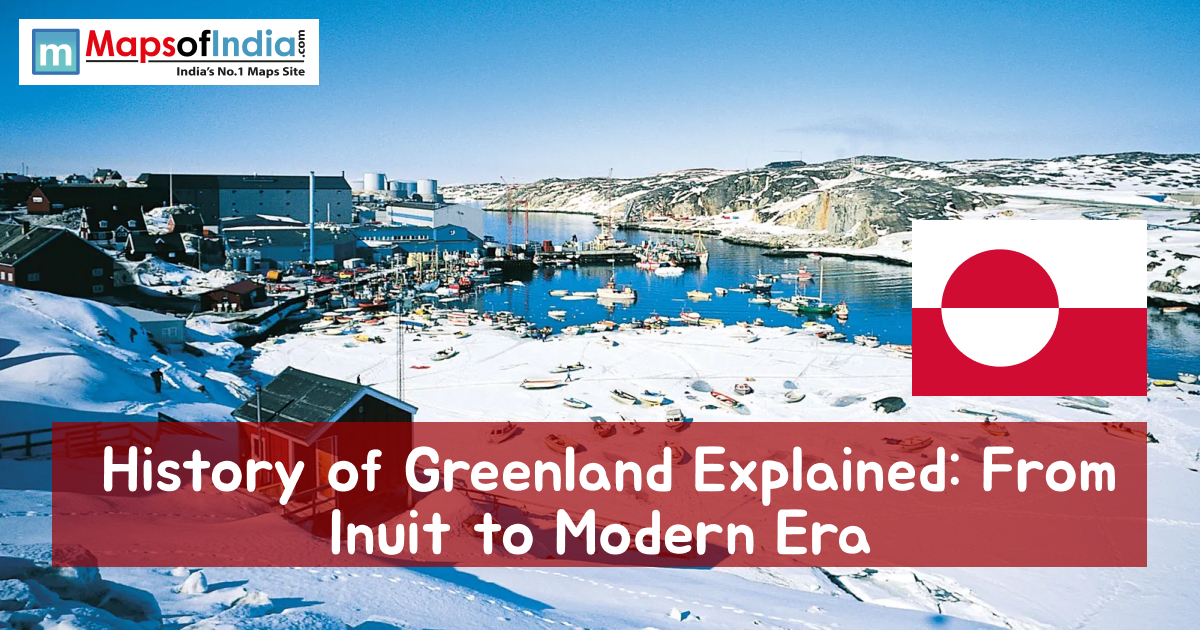
The largest Island in the world, Greenland, has a complicated history due to the extreme environment in the Arctic and Indigenous resiliency and centuries of foreign intervention and tensions. Greenland is large and has an icy climate, but over several thousand years, human societies have lived on this island, and they are becoming more significant in the world’s geopolitics, climate policy, and Arctic governance.
Early Human Settlement and Inuit Origins
People were first on the territory of Greenland over 4,000 years ago. According to archaeological findings, Paleo-Inuit communities of Saqqaq and Dorset migrated to Greenland in North America, and they adapted to the cold conditions, becoming hunters, fishers and toolmakers. These primitive people were subsisting on seals, whales, and fish, and they invented technologies that were adapted to Arctic life.
In the 13th century, the Thule people came to Alaska, introducing new technologies, including kayaks, dog sledges, and sophisticated hunting tools. The Thule culture later overtook the previous ones and formed the basis of the modern Inuit society. Inuits are the largest population group of Greenland nowadays, and their culture, language and lifestyle continue to dominate the identity of the island.
Norse Exploration and Viking Settlements
Greenland became part of European history in the late 10th century when Norse explorers from Iceland, led by Erik the Red, occupied some of the southern parts of Greenland. These Viking settlers formed farming settlements and engaged in trade with Iceland and mainland Europe. During many centuries, Norse Greenland was a part of the greater Scandinavian world.
But by the 15th century, the Norse settlements were dead. Historians think that a mixture of causes led to their downfall, which included the cooling of the climate during the Little Ice Age, economic isolation, lessening trade, and, presumably, conflicts with Inuit people. Their extinction is also one of the perennial historical mysteries of Greenland.
Colonial Era and Danish Rule
Having had little European contact for centuries, Greenland was the centre of the new interest in the 18th century. Its colonization started and matured with missionary activities and trade, where Denmark-Norway started gaining territory in Greenland. In 1814, Greenland became a colony of Denmark as a result of the split between Denmark and Norway.
During the colonial era, Denmark had dominated trade and governance, hence limiting foreign entry to the island. The communities of the Inuit were getting more and more adjusted to a cash economy, and the impact of the Europeans changed the traditional way of life. In Denmark, the introduction of education, healthcare and Christianity was accompanied by cultural disruption and economic dependency despite the colonial policies.
World War II and Strategic Importance
The geopolitical significance of Greenland was discovered in the course of World War II. In a way, when Nazi Germany occupied Denmark, Greenland was practically under the protection of the United States. This was achieved by placing American military bases to shield the North Atlantic shipping routes as well as safeguard the Arctic region.
It was a turning point of this period because Greenland entered global politics and military affairs. There was also the increased exposure of Greenlanders to the new economic opportunities and international influences that coincided with the arrival of the foreign forces, contributing to the social change.
Integration into Denmark and Modernization
In 1953, the status of Greenland was modified into an integral component of the Kingdom of Denmark as opposed to being a colony. Greenlanders were turned into the citizens of Denmark, and modernization programs were initiated to enhance infrastructure, housing, education and medical services. Though these activities improved the standards of living, they also brought social disturbances like urbanization which undermined the traditional hunting-based livelihoods.
The increasing rate of modernization increased the political awareness and urge to have more independence among the Greenlanders. There was an argument that decisions concerning Greenland were still being made in Copenhagen, yet there was not enough local input.
Home Rule and Self-Government
As a result of the increasing calls for self-determination, Greenland was granted Home Rule in 1979 by Denmark. This saw to it that Greenland had a parliament and government of its own and had control over the majority of issues within the country. The Danish government continued to have foreign affairs, defence and monetary policy.
In 2009, Greenland made another step towards autonomy, introducing Self-Government. In this setup, the control of legal systems, police and natural resources in Greenland was transferred to the control of Greenland. Kalaallisut (Greenlandic) was adopted as the official language, and it strengthened cultural identity and political autonomy.
Contemporary Greenland and Future Debates
Greenland is today under the Kingdom of Denmark and has much autonomy. Modern challenges that the island is confronted with are economic development, climate change and disputes on complete independence. The ice melt has made the world focus on Greenland and its environmental importance, as well as its possibility to access natural resources.
The strategic positioning has also brought new interests to Greenland, especially to the major powers that are interested in Arctic security and trade routes. Meanwhile, the leaders of Greenland are also focusing on sustainable development and the preservation of Inuit culture and traditions.
A History of Adaptation and Survival
The history of Greenland is an adjustment, survival, and change. Since the early Arctic hunters and Viking settlers, the island has been constantly changing in reaction to environmental and political pressures, through the present process of self-government during colonialism and the modern period. The history of the long past is so firmly rooted in land, people, and the ever-changing Arctic world that Greenland looks into the future.