

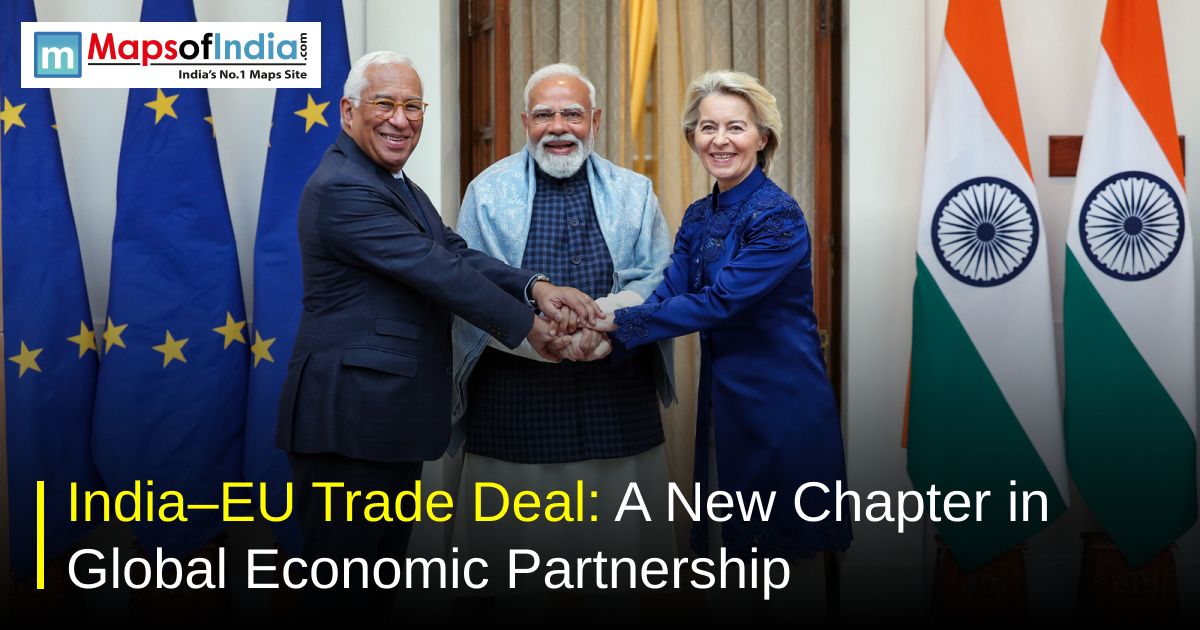
The dynamic process between India and the European Union is in a defining stage as the two parties are nearing a conclusion of a comprehensive trade agreement. The India-EU trade agreement is often referred to as one of the most ambitious bilateral economic agreements in recent years, and this is not a simple agreement regarding tariffs and market access. It represents a wider outlook of mutual development, strategic alignment and economic power on a global scale in a fast-changing world.
To India, the European Union is one of the most diverse and largest trading partners. To the EU, India is an emerging market with a high growth rate, youthful labour force, growing consumer base and increasingly relevant in the international supply chain. It is expected that the offered trade agreement can help open new opportunities in different fields, enhance economic collaboration, and establish the model of sustainable and balanced development.
Why the Trade Deal Matters
What the India-EU trade agreement is fundamentally trying to do is to lower trade barriers and ease the process of business across borders to be carried out by either business on either side. The European Union is characterized by high standards in the qualities, safety, and environmental protection, unlike India, whose manufacturing base is competitive, and services are on the rise. The agreement can assist in overcoming these differences by harmonizing the regulations and streamlining trade procedures that may contribute to smoother economic exchange.
There is also geopolitical meaning in this deal. With changing trends in global trade and reorganizational of the supply chain, India and the EU are seeking to diversify their economic relationships. By strengthening their relationship among themselves, they will be able to minimize their dependence on a few markets and establish a more robust trade network.
Key Sectors Set to Benefit
The India-EU trade agreement has a broad influence in various industries, and this is one of the brightest points.
Manufacturing and Industrial Goods
The Indian manufacturers will have improved access to the European markets, primarily in areas like automotive parts, engineering products, clothes and chemicals. The presence of lower tariffs and simplified customs can help Indian products to be more competitive in the EU, promoting exports and increasing domestic production.
Technology and Innovation
The European Union is at the forefront of high technologies, research, and innovation. A closer trade relationship can provide an opportunity for Indian startups and technology companies to cooperate with European companies, get financed, and even take part in research. Simultaneously, India’s digital-based economy and skilled labour pool allow European firms to tap into them.
Services and Professional Mobility
Services are crucial to the economy of India, especially in the areas of IT, finance, and consulting. The trade agreement may simplify the barriers to cross-border mobility of professionals, which will allow the supply of skilled Indian labour to work with European companies and the opposite. This sharing of knowledge has the potential to build business relationships and create inventions.
Agriculture and Food Products
India has a huge market of high-quality food and agricultural products for European exporters. To the Indian farmers and food processors, the deal has the potential to generate new export possibilities for Indian products like spices, processed foods and organic products. It will be important to balance the trade to the advantage of the two sides by ensuring fair standards and safety measures.
Challenges and Negotiation Hurdles
The India-EU trade agreement has had a few obstacles in spite of its potential. The difference in regulatory standards has also been one of the primary points. The stringent data protection regulations, environmental regulations and labour standards of the EU mandate have to be aligned closely with the domestic legislations and business practices of India.
Access to some products in the market is another delicate matter. As India accentuates more entry of its textiles, pharmaceuticals and services, the EU desires diminishing the obstacles on automobiles, wines and spirits. Striking the right balance such that their interests are not compromised to the detriment of the local industries is a complicated affair.
Sustainability and climate pledges have also been added to the current trade agreements. What is highlighted by the EU is the production of goods that are environmentally responsible, and that the supply chains must be ethical. This implies that the Indian exporters will have to conform to new standards of compliance. Although this may be a short-term challenge, long-term quality and sustainability are also promoted.
Economic Impact and Growth Potential
The successful introduction of the India-EU trade agreement can provide a great contribution to the trade volumes and the investment flows. High exports have the potential to boost the manufacturing industry in India, and they will create jobs, and the influence that European companies will be able to produce at reduced cost and have access to a rapidly growing consumer base.
Another huge opportunity lies in foreign direct investment. The existence of a solid and clear trade framework will help to attract European investors in the Indian Indian renewable energy sector, infrastructure, health, and digital services. Indian companies, on the other hand, are able to enter the European markets in the form of partnerships and acquisitions.
The deal can be especially transformative for small and medium-sized enterprises. The smaller businesses can be involved in international trade to promote entrepreneurship and the development of the region through simplified trade regulations and access to more information.
Strategic and Global Significance
In addition to the economic aspect, the India-EU trade agreement has strategic significance. Both partners are interested in the promotion of the system of international trade based on rules and in the popularization of democratic values. They can intensify their collaboration to improve their collaboration in the areas of climate action, digital governance, and global health.
This deal, in times of economic uncertainty and alliances, can be used as an indicator of handling open and fair trade. It makes India and the EU prominent in determining the future of international business.
Looking Ahead
The way to the completion of the India-EU trade agreement involves further discussions, compromise, and a mutual vision of long-term cooperation. Although it could be time-consuming, the possible gains are high. In the case of businesses, workers, and consumers on both sides, the agreement is guaranteed to give new opportunities, choice, and even enhance economic connections.
Partnerships such as this have become important as the world turns into a very interconnected place, and there is an importance of working together rather than competing. The India-EU trade agreement is not merely concerned with increasing the trade numbers, but a robust, inclusive, and progressive economic relationship that would be resilient enough to follow the demands of the future.
In case it is successfully adopted, the agreement can be considered a landmark in the process of further integration of India into the world and the attempts of the European Union to spread its influence in emerging markets. Through them, they will be able to demonstrate to the world how different economies can unite in achieving mutual prosperity in the dynamic global environment.