

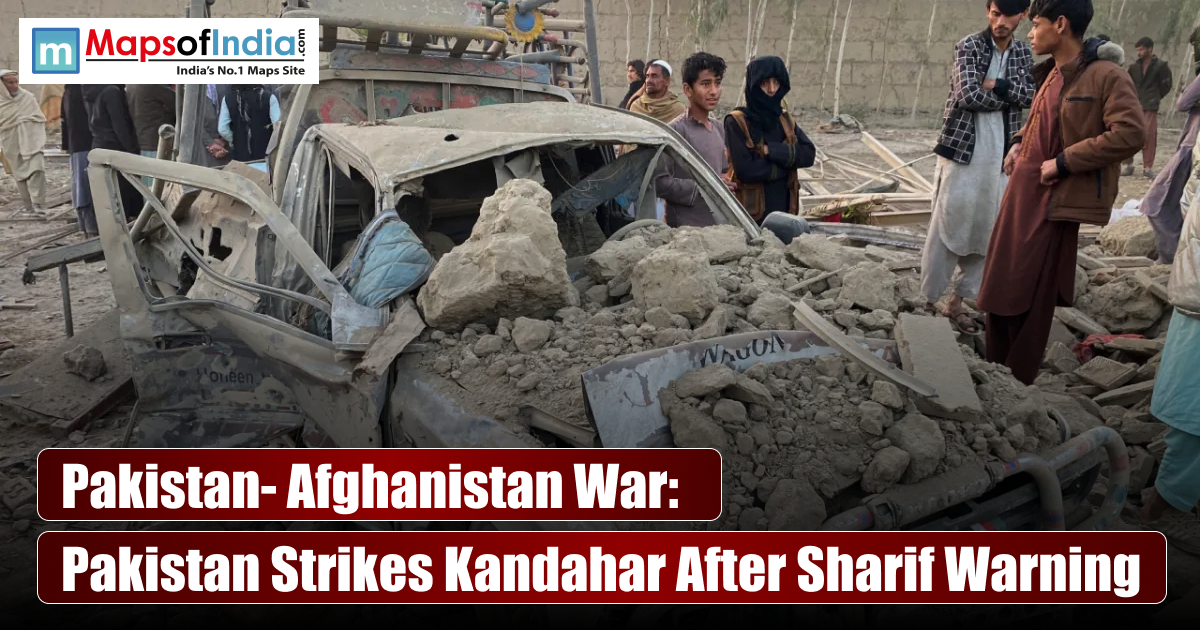
The situation between Pakistan and Afghanistan has taken a sharp turn following the renewed attacks in the Kandahar region by the Pakistani forces, shortly after the Pakistani Prime Minister, Shehbaz Sharif, warned the Taliban government at length. The fast-emerging state of affairs has dragged the bilateral relationships to the lowest echelons of the last few years, which have increased the risk of a lasting cross-border trouble in the area.
What Happened in Kandahar?
The recent wave of strikes in Pakistan, according to the Pakistani officials, was aimed at alleged militant hideouts and logistical bases in Kandahar province. Islamabad says the move was part of a wider counter-terror operation to counter groups that are accused of recent attacks on the Pakistani security forces.
The escalation came after Sharif gave a televised speech where he threatened that no country would be able to conduct cross-border terrorism and Pakistan would act decisively against any form of threats to its sovereignty. A couple of hours after that warning, aerial and perhaps artillery fire was reported in southern Afghanistan.
Afghanese leaders, through the Taliban government in Kabul, denounced the attacks and accused Pakistan of going against the territorial integrity of Afghanistan. Taliban officials have not admitted to offering safe haven to anti-Pakistan militant groups and termed the claims of Islamabad as unfounded.
Why Did Pakistan Launch Fresh Strikes?
The crux of the conflict is that, over the years, Pakistan has been accusing the Tehrik-i-Taliban Pakistan (TTP) of being run on Afghan soil. The TTP has been attributed to numerous attacks within Pakistan, such as attacks on military installations and police divisions in Khyber Pakhtunkhwa and Balochistan.
Islamabad also believes that, although they have engaged in numerous diplomatic talks, Kabul has not been able to destroy TTP networks. According to the Pakistani officials, the recent strikes were precision hits and intelligence-led to ensure they were directed to militant infrastructure and not to civilian framework.
On the contrary, the Afghan officials claim that Pakistan is making TTP a pretext to pressure them militarily. They claim that the cross-border airstrikes cannot be warranted by the internal security problems in Pakistan.
The Significance of Kandahar
Kandahar is not a mere province in Afghanistan. It has profound symbolism and strategy. Kandahar is one of the political and military strongholds and was historically considered to be the motherland of the Taliban movement.
Attacking Kandahar is a statement in itself. According to analysts, by launching the attack, Pakistan is sending a message that it is ready to go beyond skirmishing along the borders and be able to strike sensitive places politically within the Taliban government.
A second issue that is brought about by the move is that the conflict will no longer be contained in the controversial border areas along the Durand Line but will extend further into the Afghan territory.
Sharif’s Stern Warning
The tone of the comments of Prime Minister Shehbaz Sharif was a significant change. He pointed out in his address that continuing to be patient was not indefinite and that any country that financed anti-Pakistani militants would not be spared.
The speech is seen to have prepared the political groundwork for the subsequent strikes. It is observed that Sharif put the question in a different light as one of national sovereignty and national security instead of a diplomatic dispute.
The publicity of the warning given by Islamabad before the strikes could have been a form of demonstrating commitment at home and abroad.
Diplomatic Fallout
The rekindled animosity is set to topple already shaky diplomatic lines between Islamabad and Kabul. The border tensions, the refugee trafficking and the disruption of trade have worsened the mistrust between the countries since the Taliban returned to power in 2021.
Close attention is paid by regional players to the situation. The long term instability between Pakistan and Afghanistan may have implications on the trade routes, the connectivity projects in the region and the general security situation in South Asia and Central Asia.
Both parties have been encouraged to be more restrained and go back to the negotiation table by international observers. But as rhetoric is building up and military action is being taken, there seems to be no imminent de-escalation.
Humanitarian Concerns
Other than the geopolitical implications, there is the human cost of the conflict, which is a significant issue. Airstrikes and cross-border shelling have the potential to disorient civilian life, destroy infrastructure, and elicit displacement.
The state of Afghanistan is already struggling with serious economic difficulties and humanitarian pressure. Any prolonged war would deteriorate the situation of civilians in provinces such as Kandahar.
Pakistan is not an exception, as it has internal security and economic pressures. The increasing military activities would put pressure on the resources and increase the security risk within its borders.
Is This a Full-Scale War?
Although news outlets were reporting about the use of the term war, analysts warn that this has not yet escalated to the point of an officially declared war between the two states. Rather, it is a major increase in cross-border military interaction.
But the number and severity of strikes, along with the rising stingingness of political speech, point to the fact that the struggle is approaching a more dangerous stage.
The cycle of escalation may be quickened in case of retaliatory strikes or other attacks that are more militant.
What Happens Next?
There are a number of possible scenarios:
- Diplomatic De-escalation: A back-on-track negotiation may cool tensions to avoid more strikes.
- Re-targeted Limited Strikes: Pakistan can restart a limited operation in case it thinks that there are still militant threats to operate.
- Wider Military Engagement: The war might extend if Afghanistan goes directly against them.
The next few days will be important. A lot is left to be desired on whether the two governments would pursue restraint or remain on a confrontational route.
Final Thoughts
The new attacks in Kandahar are a grave turning point in the Pakistani-Afghanistan relations. The situation arose due to historic claims of cross-border militancy, coupled with ongoing acute tensions on the border and exacerbated by a stern warning by Prime Minister Shehbaz Sharif. The situation reveals the precarious nature of the situation in the region.
The stakes are high, not only to Islamabad and Kabul, but to the rest of the region as events unfold. There is a chance of a measured diplomatic reaction that will avoid escalation. However, errors at both extremes can cause a long period of instability.
In the meantime, the world opens its eyes, as tensions are simmering, hoping that there will be dialogue rather than escalation.