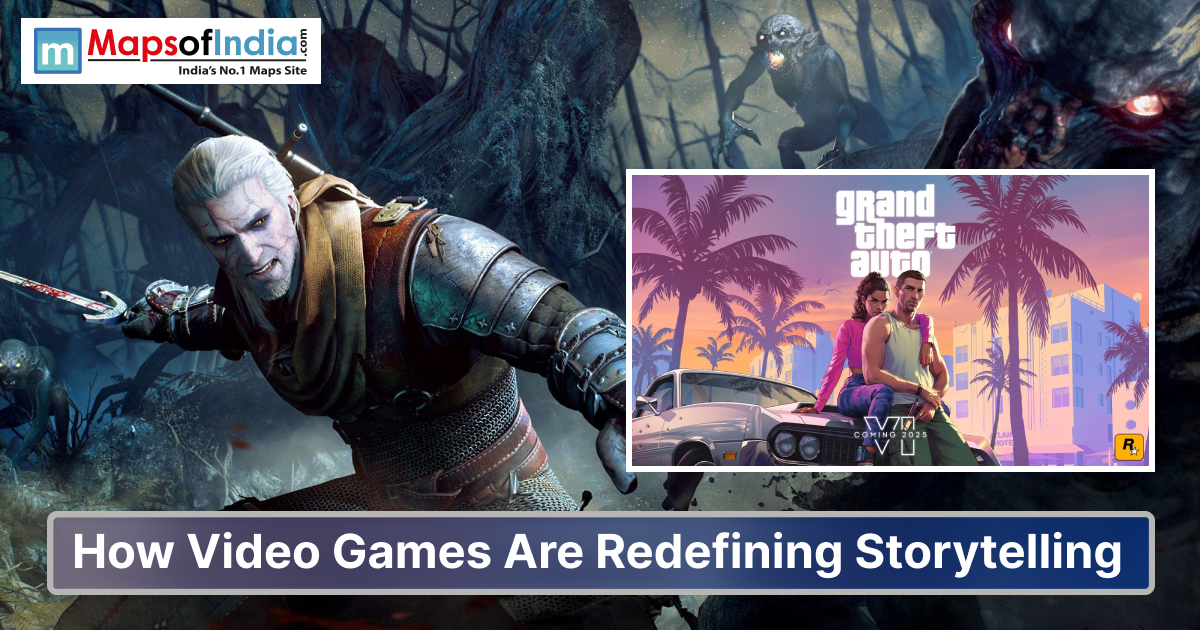
In regard to the various forms of storytelling, individuals consider films, books and so on. Yet, most individuals do not perceive video games as a form of Storytelling. If we check our past, it has constantly been at the core of human culture. From oral folklore to novels and cinema stories define the way we perceive the world. With the onset of the digital era, video games have become an effective tool for storytelling. Unlike books or cinema games are interactive forms of entertainment that enable the player to become a part of the story. This interactivity has led to new methods of storytelling and has rewritten the rules of how people consume stories.
The Shift From Passive To Interactive Narratives
Classic narrative is passive. It is read or watched without affecting the result. Video games, on the other hand, put the player in the middle. Decisions have consequences, and actions determine the direction of the story. This change has enhanced narrative immersion. Games such as Mass Effect or The Witcher 3 are famous for having branching stories in which player choices produce distinct results. This customization enhances emotional involvement and ensures each game is unique.
Constructing Worlds Through Gameplay
One of the greatest strengths of video games is world-building. Unlike movies that display a narrow view, games permit players to see and interact with expansive worlds. Games such as The Legend of Zelda: Breath of the Wild or Red Dead Redemption 2 are open worlds in which every aspect serves to enrich the narrative. Landscapes, characters and even secret objects all serve the narrative. This approach to environmental storytelling promotes exploring and deepening the relationship between player and world.
Character Development in Games
Strong characters make a difference in effective storytelling. Video games enable players not only to see characters change but to be able to influence that change. Role-playing games allow players to define their characters' personalities by the decisions they make and actions they take. There are various games that, with good cinematography, also focus on good storytelling that gives a long-lasting impact on the audience that changing the feel they experience while watching the movies. There are different examples of this kind of video games, such as Life is Strange or The Last of Us emphasize how rich characters make stories emotionally resonant.
Emotional Impact And Player Agency
Games can create emotions in a way that's distinct. A film where the viewer sits at a distance, games require engagement. Players experience the burden of actions and decisions. In a game such as Undertale, for instance, the choice to kill or spare enemies impacts the narrative as well as the player's emotional response. The feeling of agency makes the emotional response stronger and thus makes games one of the strongest platforms for empathy.
Blending Narrative And Gameplay
One of the most difficult aspects of video game storytelling is balancing narrative with gameplay. Effective games blend them so that every action counts towards the narrative. In Bioshock, for example, the gameplay mechanics solidify the themes of control and freedom in the dystopian world. In the same way, in Journey, the mere act of movement is a metaphor for connection and life. These examples illustrate that storytelling in games is not necessarily about cutscenes or dialogue but about the playing of the game.
The Rise Of Nonlinear Storytelling
Nonlinear narrative is now a signature of most contemporary games. While movies with a linear format can present alternate path endings and viewpoints. Detroit: Become Human is a case in point where decision-making yields extremely varied results. Nonlinear narrative keeps the player hooked because he wants to see the effects of his choices. It also provides high replayability to games because players can have new stories every time they play.
Storytelling Through Multiplayer And Online Worlds
Storytelling is not exclusive to single-player games. Online and multiplayer games have produced new types of collaborative storytelling. Games such as World of Warcraft or Final Fantasy XIV enable players to co-author stories in huge virtual environments. Social interaction is incorporated into the narrative as players establish alliances, rivalries and friendships. This type of emergent storytelling is specific to gaming and highlights its capacity to form shared cultural experiences.
Technology And Immersive Narrative
Technological developments have furthered the reach of storytelling in games. Virtual reality VR and augmented reality AR have provided further immersive experiences where players are physically present in the narrative. Half-Life Life Alyx or VR narrative experiences demonstrate how VR can transform interaction. Equally, motion capture technology has furthered character realism, enhancing narratives to be more realistic. In recent times, we have seen a big leap in the progress of technology, and as this progress is going on, the lines between real life and other forms of storytelling will start to fade over time.
Games As Cultural Storytellers
Video games are not just games but cultural texts. They mirror social issues and compel players to think critically. Games such as Papers Please include themes of immigration and forms of bureaucracy, while games such as Hellblade Senua's Sacrifice deal with mental health. These narratives are more than escapist fantasies and are part of cultural discourse. They demonstrate that games can be as culturally relevant as literature or film.
The Future Of Narrative In Game-Playing
In the future, video games will further stretch the boundaries of storytelling. With the rise of Artificial intelligence, the way of playing games has changed over time. Players can interact differently with the characters of the game they are playing, and at the same time, it can be very realistic. Cross-platform integration might blur further boundaries as narratives flow from games to films to interactive media. Innovative potential is unlimited, which makes games one of the most innovative media of storytelling.
Final Reflections
Video games have turned storytelling from a passive narrative to an interactive experience. By virtue of branching narratives, emotional depth, immersive environments, and technological innovation, games have redefined how narratives are presented and experienced. They have demonstrated that storytelling is no longer limited to the book or movie screen but rather is something that can be lived through, influenced and experienced through players' decisions and actions. As a medium continues to improve, video games will be leading the charge in storytelling invention, determining how we will tell and experience stories in years to come.