Bidriware of Karnataka: The Black Metal Inlay Craft of Royal Elegance
Vidyut Vardhan December 16, 2025
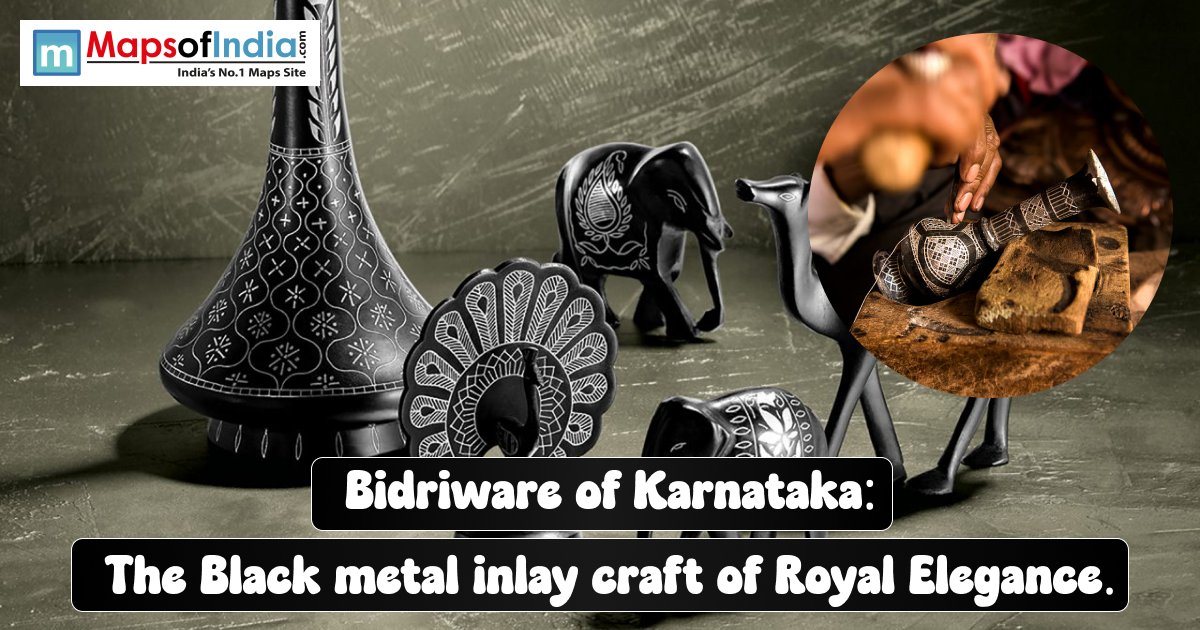
Bidriware is one of the most luxurious and sophisticated metal crafts of India, and is distinguished primarily by the sharp contrast of silver inlay on a pure black surface. Bidri is the place where this unique 14th-century art originates. The work is a representation of opulence, pride, and accuracy in one metal. The work is a perfect mixture of Persian inspiration and Indian ingenuity. Thus, it is able to turn a simple metal into a piece of timeless art. Every Bidriware item is a narration of convention and technique that is still bright after the passing of ages.
The Royal Origins of Bidriware
The beginnings of Bidriware are attributed to the Bahmani Sultanate that governed Bidar in the 14th century. Persian metalwork artisans came to India, where they blended their metalwork traditions with the local craftsmanship. This art, under the royal patronage, prospered and was made a delight of the kings and nobles. The complicated silver inlay and the black finish were the factors that stood for charm and riches. Thus, Bidriware became one of the most valuable possessions in the royal courts.
The Meaning Behind the Name
The term "Bidriware" is derived from Bidar, the town which is still considered the centre of this craft. The art form is very much dependent on the region, not only for its soil but also for its culture. Even now, the artisans of Bidar are practising the identical style which was handed to them by their forefathers. This link between art and location is what gives Bidriware not only genuineness but also a different identity.
The Unique Crafting Process
The making of Bidriware consists of a very complicated and lengthy procedure. The base metal is an alloy of zinc and copper. The object goes through the processes of casting, engraving, silver inlay, and finally blackening with the help of a special technique. The color black, usually very dark, comes from the mixture that contains the soil of Bidar Fort. This soil is even said to have special properties because of its high level of alkalinity, which, when combined with the metal, produces the deep black surface. The silver, apart from everything, stays bright, and thus the contrast between silver and black is the main feature of Bidriware.
The Role of the Blackening Technique
The blackening method is what makes Bidriware look the way it is recognized internationally. The object, after the inlay, is covered with a solution prepared from the soil of Bidar and Ammonium chloride. Upon application, the metal zinc reacts with the solution and becomes black while the silver is left intact. What results in this is an extremely beautiful and elegant contrast, which is the hallmark of this art. The method of oxidation, which is completely natural, is the reason Bidriware is distinct from the rest of metal arts in the world.
Designs That Reflect Heritage
The designs on Bidriware pieces combine Islamic geometric features with the Indian floral motifs. The most frequently depicted by the artisans flowers, creepers, leaves, and vine patterns are also known as "Asharfi" and "Phooljhadi." On some works of art, you may find the stars, birds, or calligraphy with the source being Islamic art. Each pattern used has some cultural meaning behind it, thus combining the properties of aesthetic beauty and symbolic depth. These motifs are at no time mere ornaments but the artisan's view of spiritual and natural harmony.
The Symbolism of Contrast
The contrast of black and silver in the Bidriware layer is the sign of something. It is the indicator of the coexistence of light and darkness, power and gentleness. The black core represents the lastingness, whereas the bright silver inlay brings refinement. This play of contrasts is on both artistic and philosophical levels and hence shows the way beauty can come from balance.
The Cultural Importance of Bidriware
Bidriware is more than just a pretty metal inlay. It is a symbol of racial harmony between Indian and Persian cultures in the Middle Ages. The art has been transferred from the artist families to the next generations, who see it not only as a way of making money but also as an inheritance. In fact, Bidriware is a kind of metal sculpture that portrays the diversity of India and the excellent skills of its people.
Challenges Faced by the Craft
Bidriware has been confronted with a variety of problems in the past several years. The shortage of raw materials, the decrease of traditional markets, and competition with machine-made products have led to the reduction of the artisans' income. The youth are always attracted to other jobs because of the lack of financial security. But the government programs and design interventions are gradually making young people interested in the craft again.
Efforts Toward Revival
Artisans of Bidri are supported by the initiatives and designers in their efforts to change old designs to modern ones. Buyers from the contemporary world are being attracted by such things as keychains, jewellery, and decorative articles for the house. Workshops, shows, and online platforms are opening the world to Bidriware. In addition, these measures give the artisans not only the opportunity to have a better income but also the possibility to keep their tradition alive in the present day.
Recognition and Heritage Status
The Geographical Indication (GI) tag was awarded to Bidriware in 2006, which is a formal acknowledgement of it as a craft that is distinctive to Bidar. The status is like a safety net for the craft and the people who make it. Besides, the GI tag is a guarantee that the heritage, cultural, and environmental aspects of the craft will be safeguarded for the times to come.
Learning the Craft
New generations are being taught the art of Bidriware through various means of instruction, which is part of an ongoing effort. The training centres in Bidar, as well as the design institutes all over India, are actively involved in hosting workshops for this skill. The young artists are coming up with new ideas and new shapes for their works, while at the same time still using the old methods. The combination of the old and new that is characteristic of the Bidi craft is what makes it not only still alive but also developing further.
A Living Legacy of Art and Heritage
Bidriware is not just the combination of metal and silver. It is about the people's roots, their never-give-up spirit and their pride. Everything that is manufactured here has shown the artisan's skill and the cultural exchange that has been there for a century. The artefact reminds us that when the art was produced in that era when that was not only meant for the sake of beauty but also as a means to show one's identity and devotion.