






About
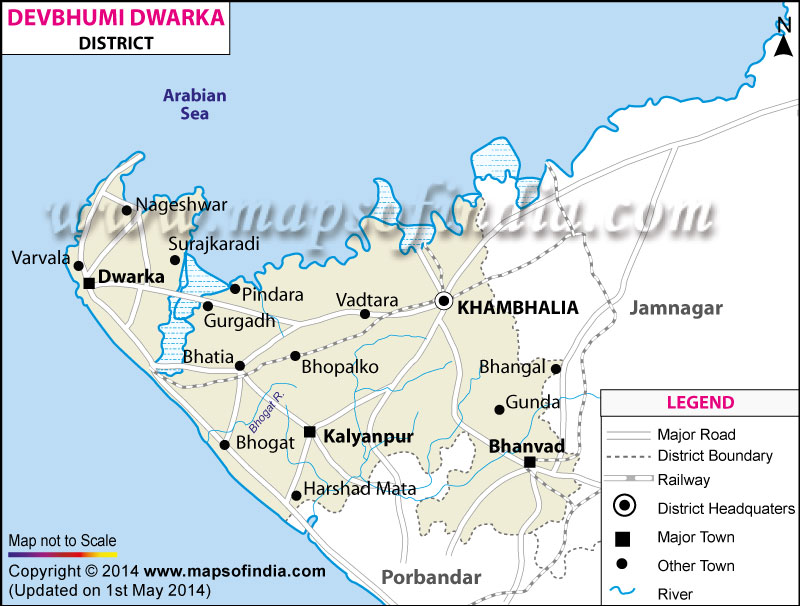
West of Gujarat lies Devbhumi Dwarka, a coastal stretch shaped in 2013 from Jamnagar. Along the Arabian Sea it rests, heavy with spiritual meaning across India. Dwarka, the sacred town tied to Lord Krishna, sits within this region. Pilgrims journey here - one of four revered Char Dham destinations. Created anew yet rooted deep in tradition, its presence lingers beyond maps.
History and Culture
The pre-history of this region is entrenched in the ancient Indian practices, myth and the sea trade routes. It is most evidently related with the mythical city of Dwarka which was supposedly created by Lord Krishna after abandoning Mathura. The Hindu account of Dwarka indicates that Dwarka was an urban center, the capital of the Krishna community and a prosperous one at the time of the Krishna era when it is reported to have been engulfed in the ocean. Some evidence in the form of archaeological discoveries near the coast has allowed the thought of old settlement in this region, but much of the account has a religious basis.
Traditionally, the area was under the different ruling dynasties of western India, such as the Mauryas, Guptas, and the further regional forces like the Maitrakas and the Chudasamas. It was a strategically located coastal state that became a center of sea-trade ties between Gujarat and the Middle East and the rest of the Indian Ocean world. In the medieval era, the region was put under the dominance of local Rajput Kings as well as the Sultanate of Gujarat and subsequently the Mughals.
During the early modern era, it was included in the princely states that were placed under indirect British rule until the independence of India in 1947. The region became part of the Indian Union and in due course of time became a part of Gujarat state after independence. The district was actually created in 2013 as an effort to enhance administrative effectiveness and area growth.
High above everyday life, this land holds deep sacred meaning in Hindu tradition. Home to the Dwarkadhish Temple, spiritual energy pulses through daily rituals and gatherings here. Because it stands among the revered Char Dham destinations, people journey from every corner of India to visit. When Janmashtami arrives - honoring Krishna’s arrival on earth - devotion fills the air alongside vibrant celebration.
The fishing communities have lived in generations along the Arabian sea and a variety of coastal traditions and local communities shape the culture. Folk music, devotional songs and the rituals in the temples, make a significant role in everyday life. The main language is Gujarati, and the customs of the place are a combination of religious knowledge and territorial belongingness.
Cultural landscape is added with traditional clothing, food, and crafts. Religion has a powerful impact and makes vegetarian food prevail, and easy but tasty cuisine is usual. In rural areas, local art forms and handicrafts remain uncommercialized.
Economy
This coastal region is influenced by pilgrimage tourism, fishing, agricultural and small-scale industries, to form the economy of this region. Religious tourism is one of the greatest sources, which is devoted to the holy town of Dwarka. The Dwarkadhish Temple is visited by thousands of pilgrims all year round, particularly during such festivals as Janmashtami. The constant inflow of tourists sustains the local industries including hotels, restaurants, transport services, and retail shops and therefore tourism is a big economic generator.
Another major sector of the local economy is fishing since the district has a long coastline along the Arabian Sea. The coastal communities are relying on marine resources as their means of living. The fish processing, storage, and trade activity generate incomes, and the ports and landing centers assist with the commercial fishing activity. Not only does this sector keep households afloat in the area, it links the region to other markets both locally and outside the state of Gujarat.
Agriculture plays a supportive role especially in rural regions. Groundnut, wheat, bajra, and pulses are crops which are usually cultivated based on rainfall seasons as well as the soil conditions. Nevertheless, the semi-arid climate and saline coastal climate makes agriculture not as predominant as in other areas in the state of Gujarat. Animal husbandry, such as the rearing of cattle, and dairies, increases rural incomes.
The industrial development is not so extensive but contains small-scale and medium-enterprises, especially working in such sectors as the production of salt, handicraft, and local production. There are salt pans along the coastal belt that help in salt production which is a key economic activity in a few regions of the district.
The infrastructure and connectivity have changed over the years in assisting trade and movement of goods and people. The region is connected to the big cities by roads, and development via tourism has improved civic amenities. The economic growth has also been achieved through government efforts in developing the coastal areas, fisheries, and the welfare of rural people.
Tourism
The main attractions that contribute to tourism in this coastal district are its massive religious importance, scenic shoreline and cultural heritage. It has become one of the greatest pilgrimage sites in India with thousands of visitors coming year round. The Dwarkadhish Temple, which is dedicated to Lord Krishna is the spiritual center of tourism. Being considered to be one of the Char Dham pilgrimage sites, it enjoys a special place in Hindu faith and attracts the followers of all parts of the county particularly on occasions such as the Janmashtami festivals.
The other religious landmark is Nageshwar Jyotirlinga, which is one of the twelve Jyotirlingas of Lord Shiva. This temple contributes to the religious conspicuities of the district, and frequently appears in pilgrimage tours, with Dwarka. Bet Dwarka is thought to be the primordial home of Krishna; this place is also available by boat owing to spiritual and aesthetic benefits.
There are also beautiful coastal sceneries in the district surrounding the Arabian Sea. There is Dwarka Beach and Shivrajpur Beach where one can relax and sightsee. Its popularity as a tourist attraction has led to the recognition of Shivrajpur Beach as a clean and environmentally friendly place.
Besides pilgrimage sites and beaches, fairs, festivals and traditional ways of doing things are some of the ways of experiencing the local culture. The presence of markets in the area of temples selling religious products, handicrafts, and local products contributes to the experience of a visitor.
Demographics
The population is mostly Hindu due to the great attachment that the district has with pilgrimage places like Dwarkadhish Temple. Smaller communities of Muslims, Jains, and others, also make a part of the social and cultural diversity that the area implies. What people believe shapes daily routines more when they visit places tied to spiritual journeys. These moments often bring old customs into sharper focus.
Most people here speak Gujarati. It shows up everywhere - offices, schools, daily talk. Besides that, Hindi holds strong too, mostly because visitors have shaped parts of life. Along the shore, small communities stick to their own versions of speech.This speech pattern indicates local identity and contacts with visitors.
Major part of the population lives in the rural region or areas where livelihoods are associated with fishing, farming and trading in low-scale. Cities such as Dwarka and Khambhalia are significant business, governmental, and pilgrimage places. Pilgrims and service oriented activities have moderately served to increase urban growth.
The literacy level is not that high as that of more urbanized areas of Gujarat, yet it is getting better because of access to schools and government efforts. The literacy of men is higher than that of women, albeit, the difference is fading.
Sex ratio is relatively equal, which indicates a stable demographics.
Administration
This coastal district has a sound administrative structure that aims at effective governance especially in the management of pilgrimage activities, coastal resources and development of the rural areas. It operates within the Government of Gujarat whereby the District Collector is the principal administrative officer. The Collector is the one in charge of upholding law and order, establishing government policies and development programs as well as revenue administration.
The district is administratively subdivided to cover a number of so called talukas which include; Dwarka, Okhamandal, Kalyanpur and also Bhanvad, with Khambhalia being the district headquarters. Taluka officials are available at the taluka level, including Mamlatdars in charge of land records, revenue collection and the local government. The division assists in decentralizing the administration and makes sure that services are accessed by the coastal and interior regions.
Governance at the grassroots level is done via the Panchayati Raj system. Gram Panchayats govern the administration of villages, and their primary focus is on basic needs of the village like provision of water, sanitation, rural infrastructure and welfare programmes. Bigger development activities are organized by Taluka Panchayats and the District Panchayat especially activities such as fisheries, agriculture and rural development, etc.
The municipalities run urban administration in such towns like Dwarka and Khambhalia to manage civic amenities such as waste management, roads, and public amenities. Such urban authorities are significant to manage the demands of the residents and also that of the high number of pilgrims who visit the district.
Any dubious activities within the district are prevented by the district police under the supervision of the Superintendent of Police (SP) who ensures that there is law and order, particularly during the time of major religious events and seasonal tourism.
| Facts of Devbhumi Dwarka District | |
|---|---|
| Official Name | Devbhumi Dwarka |
| Region | Saurashtra |
| Area (km2) | 4051 |
| Population | 752,484 |
FAQs
Q1: When was Devbhumi Dwarka district formed?
In 2013 the district was formed out of the territory which was a part of Jamnagar district. That led to improved local administration and development.
Q2: Why do so many go to Dwarkadhish Temple?
Devotees see in this temple what sets out Lord Krishna’s kingdom. We have one of the Char Dham pilgrimage sites here which is a full year round affair.
Q3: What is special about Bet Dwarka?
Bet Dwara is known to be the site of Lord Krishna’s residence. Access to the island is via ferry and also tourists can enjoy the spiritual and natural beauty there.
Q4: What is the role of fishing in the community?
Fishing is what mainly supports coastal communities. In many families it is a primary source of income which they also put into fish processing and seafood trade.
Q5: Is Devbhumi Dwarka a great destination for families?
Yes. The district is a mix of temples, beaches and cultural sites which in turn will appeal to families and pilgrims the same as the holiday makers.
Q6: How long of a stay is what you require for Devbhumi Dwarka?
A few days which are usually two to three is what you need to see the main temples, beaches and nearby points of interest.
Q7: Why should I visit Devbhumi Dwarka?
Devbhumi Dwarka is a mix of spiritual and historical sites, also of coastal beauty and local culture. For pilgrimage or just sightseeing the district has something for all travelers.
Last Updated on : May 12, 2026
