

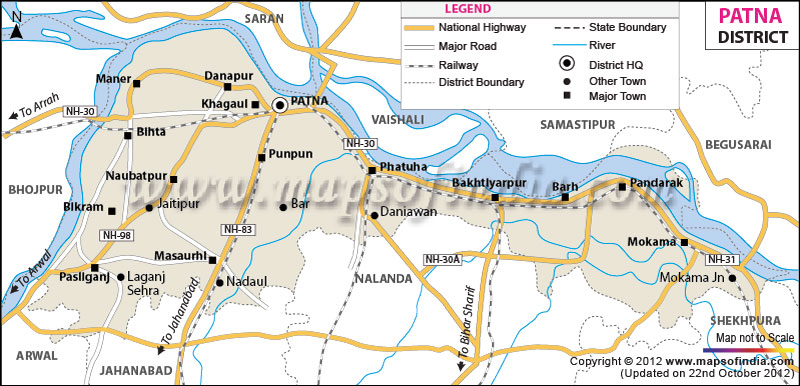





About
Patna is one of the earliest continuously populated regions in the world with a historical name of Pataliputra, which was the capital of the great empires, such as the Maurya and Gupta dynasties. It has a great religious significance particularly to the Sikhs because it is a location where Takht Sri Patna Sahib, the birthplace of Guru Gobind Singh, is situated. The Ganga River is flowing through the city and contributes significantly to the cultural and spiritual life of people.
It also boasts of educational and cultural institutions, such as Patna University, among the oldest universities in the country. Patna is the administrative center, the cultural and modern centre of Bihar which has maintained its ancient heritage.
History and Culture
Back then, Patna went by the name Pataliputra, stretching deep into ancient eras. Under Maurya and Gupta rule, power gathered here. Culture thrived - slow, steady - in what became a heartland of early Indian life. Leaders rose, empires shifted, yet its role rarely dimmed through centuries. It was in the rule of Chandragupta Maurya and Ashoka that it was made one of the most significant cities in the world as an administrative, trading and learning hub. Greek ambassador Megasthenes, who visited the city, referred to it as being a highly organized and prosperous city.
The region further prospered under various masters in the medieval era such as the Delhi Sultanate and the Mughal empire. Its strategic positioning based on its location along the Ganga river enabled it to be a major trade and communication center. During the colonial era, the British advanced the city by coming up with administrative orders, learning institutions, and infrastructure, which defined its contemporary identity.
The region's history and traditions have a strong foundation on its culture. Its religious diversity and harmony are one of the most important elements of its culture. It is also a significant location of Sikhism as Takht Sri Patna Sahib, the birthplace of Guru Gobind Singh, draws worshippers all around the world. The Hindu traditions are also greatly practiced more so when it comes to the festivals like Chhath Puja where the people congregate at the river sides to offer their utmost respect and devotion to the Sun God.
The art and architecture also contribute to the cultural identity of the region. Colonial-era engineering is evident in historical buildings like Golghar, and institutions like the Bihar Museum have many cultural objects that demonstrate the rich history in the area. Conservative art, such as influences of local handicrafts and Madhubani style crafts, accentuate the creative aspect of the artisans.
The area is also reputed in scholarly and intellectual matters. Patna University was started in British rule and has been a hub of higher education and has participated in the scholastic growth of eastern India. Literature, music, and local folk traditions maintain themselves, and they reflect everyday life, social values and historical memories.
The other significant aspect of life is food culture wherein the Bihari tradition of litti-chokha, sattu preparations, and sweets are an integral part of local identity. These dishes are not too complicated but full of nutrients and taste, and are usually associated with farming and the time of the year.
Economy
Agriculture, trade, services, and administrative activities form the main economic activity in Patna district. Agriculture provides a significant source of livelihood to a significant number of the population because the fertile plains of the Ganga River basin include rice, wheat, maize and pulses which are major crops. Besides agricultural production, there are other economic sectors such as dairy production and agro-based small industries that are part of the rural economy.
The district is a large trade and commercial center in the region as well. Its positioning and connectivity through its road, rail, and river transportation systems have greatly contributed to the transportation of cargo and passengers. The markets around are vibrant as they engage in trading agricultural produce, textile and daily products by connecting the rural producers to urban consumers.
The service sector is an important source of economic development. There has been an increase in education and healthcare services over time and institutions like Patna University have led to the development of skills and employment. The other services are banking, retail, transportation and communication services, which have been increasing in number and portray further urbanization and demand for modern facilities.
The government and administration activities constitute a major component of the economy since the district is the capital district of Bihar. Many of them work in the public administration, civil services and associated areas. Infrastructural facilities, such as roads, housing, and utilities, have facilitated the activities of the economy.
Tourism
Tourists, both local and international, are attracted to the region because it is closely associated with ancient history, particularly as the location where the capital of the empires known as powerful, such as the Mauryas and Guptas was based. It is a major tourist attraction site in regard to the ancient history of India because of this historical meaning.
Takht Sri Patna Sahib, birth site of Guru Gobind Singh and one of the five Takhts of Sikhism is among the most powerful religious sites. It is a very spiritual site of thousands of pilgrims annually. Another attraction is the banks of the Ganga River, where during certain festivals such as the Chhath Puja the whole lot of devotees gather there and perform rituals in the name of the Sun god.
The region has historical landmarks that enhance tourism in the area. Golghar, a big granary constructed during British rule, provides panoramic views of the surrounding region and represents an example of colonial architecture. Museums like the Bihar Museum and the Patna Museum contain ancient artifacts, sculptures and other historical relics which represent the rich heritage of the region.
Demographics
The population of Patna district is varied and expanding, as it is the reflection of its past significance as well as the capital area of Bihar. This is based on its currently recorded census where it is reported to be among the most densely populated districts in the state but owing to high urbanization and movement of people in the rural areas. It is a mixed population, consisting of urban and rural populations although a good percentage is concentrated in the urban population.
The demographic profile depicts an equal distribution between various age groups with the majority number of youth. This young generation forms part of the labor force and it also has a significant contribution to economic and social growth of the district. Meanwhile, the elderly residents are increasing, which evidences the fact that healthcare and living conditions improve over time.
The district literacy rates are above the state average, which is mainly because of the existence of educational institutions like Patna University and other schools and colleges. It is through education that there has been awareness creation, improved chances of employment and social change that occurs gradually. Nevertheless, there are still inequalities that prevail within the city and rural regions and among various groups of people.
The district is a multicultural community where individuals of different languages, religions, and social statuses co-exist. The most popular language is Hindi, and there are other local dialects including Magahi, and Bhojpuri. Such language diversity mirrors the larger cultural landscape in the region. The people predominantly practicing Hinduism and Islam, a smaller set of Sikhs, Christians, and others add to the ensemble of the social fabric of the population.
Urbanization has also been very influential on the demographics with more people moving to the city to seek education, employment and other living standards. This has seen residential areas grow, the infrastructure demand grow and lifestyle changing. Meanwhile, thousands of individuals in the rural locations still rely on agricultural activities and their traditional jobs.
Patna is characterized by dynamic demographics as a result of migration, education, and economic growth. Though issues like population pressure, inequality, and infrastructure needs persist, the district is changing and a multi-cultural and dynamic population is contributing towards it.
Administration
Patna district has a properly organized system of administration that is at the center of operating the district and the whole state since it is the capital area of Bihar. The government is led by a District Magistrate (DM) or Deputy Commissioner who is charged with the responsibility of enforcing laws and order, law policy implementation and the facilitation of development. The DM liaises with the different departments in order to make sure that there is good governance and delivery of services to the people.
This district is further subdivided into a number of administrative units that are further subdivided into blocks and panchayats in the rural district, and municipal units in urban areas. These sections aid in decentralizing the management structure as well as enhancing administration effectiveness. In rural areas, local governance is done with the help of Panchayati Raj institutions, consisting of Gram Panchayat, Panchayat Samitis, and Zila Parishad. These agencies do the liaison of local development, essential services and community care.
Running things in the city falls to local bodies like councils and corporate-style setups. Overseeing daily operations sits mainly with the Patna Municipal Corporation. Water supply, cleaning streets, trash collection, fixing roads, plus keeping people healthy - all land on its shoulders. People choose leaders directly - the Mayor and representatives from neighborhoods - who team up with hired managers to keep systems moving.
The police is in charge of law and order in the district under the overseeing body of the Senior Superintendent of Police (SSP). The police service is in charge of keeping the people safe, prevention and law enforcement. Different police stations and outposts are set all over the district in order to ensure security and act in case of emergencies.
The district is also represented in the state and the national legislatures. Legislative Assembly (MLAs) represent various constituencies in the state level, where the Members of Parliament (MPs) represent the district in the national level. These leaders are important in deciding the law and in terms of representing the grievances of the public.
Some of the government departments that assist in the administrative functions are health, education, agriculture, and public works. Associations, such as Patna University also play an indirect role in terms of facilitating education and human resource development.
| Facts of Patna District | |
|---|---|
| Official Name | Patna |
| Location | Bihar |
| Area (km2) | 3202 |
| Population | 5,838,465 |
FAQs
Q1: How many villages are there in the district?
1,395.
Q2: What is the population of the district?
5,838,465
Q3: What is this district famous for?
Pataliputra, Takht Sri Patna Sahib, Ganga River, Patna University, Chhath Puja, Golghar, Bihar Museum, Bihari cuisine, handicrafts, capital of Bihar.
Last Updated on : June 24, 2026
