|
||||||||||
 | ||||||||||
|





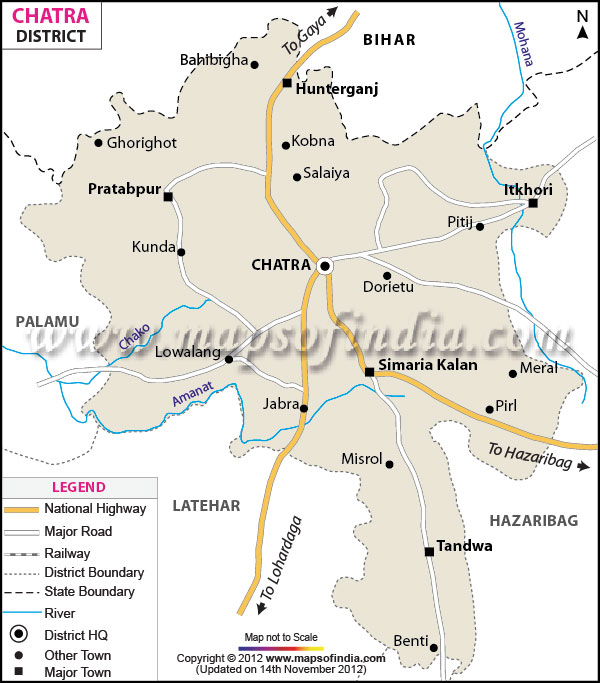
| *Chatra District Map highlights the National Highways, Major Roads, District Headquarter, etc. |
About
Located within North Chotanagpur division, Chatra district belongs to Jharkhand state. Its central offices are in Chatra town. Before becoming independent, this land formed part of Hazaribagh district’s Chatra sub-division. Sitting on the Hazaribag plateau, it touches Gaya district of Bihar up north. To the west lies Palamu; further south appears Latehar. On the eastern edge stretch Koderma and Hazaribagh districts. Total expanse measures 3,706 square kilometres
Hills shape the terrain, along with a rolling plateau rising roughly 450 metres above sea level. At its highest points stand Kalua Hill and Lahabar Hill. In scattered areas across the south, deposits of Gondwana rocks appear. Flowing through this region are several rivers - Yamuna, Barki, Chako, Damodar, Garhi among them. Occasionally, rain totals reach 1,250 mm each year across the region - primarily between June and September. Around 25°C defines the yearly average warmth, though readings shift dramatically: heat peaks at 46°C under summer sun, yet dip near freezing when winter arrives
Most of the region lies under tree cover, making up sixty point four per cent of its land. Rich in biodiversity, it hosts numerous healing herbs alongside kendu foliage, bamboo stands, sal trees, teak, and various wood types. Water cascades appear throughout, such as Goa Falls located six kilometres distant, followed by Keridah eight kilometres out, then Maludah also at eight, ending with Bichkiliya situated eleven. Twenty five kilometres from here, thermal waters emerge prominently at a place called Balbal Duari
History and Culture
History marks this area by deep roots in ancient times. Under Ashoka’s reign near 232 BC, it is thought the woodland territories called "Atavi" accepted dominance from the Magadha realm. Some accounts suggest that Samudra Gupta, moving across Chotanagpur, launched his opening strike on southern Kaushal within the Mahanadi basin. Contact emerged with the Delhi Sultanate once the Tughlaq era unfolded. Arrival of the British followed much later, recorded first in 1769 AD. By quiet turns, power shifted through centuries here
Early in May of 1660, Daud Khan, serving as Bihar's Mughal administrator beneath Emperor Aurangzeb, seized Kothi near Pokhri Fort prior to moving against the hilltop fortress called Kunda Fort. Though built upon steep terrain with strong fortifications, it fell by the beginning of June; complete ruin came shortly afterward, within forty-eight hours. In 1734, after defeating defiant landholders at Tikari, Aliwardi Khan advanced through Kunda and attacked Chatra Fort, leaving nothing standing. Amid the unrest spreading through Chotanagpur during 1857, fighting at Chatra gained significance as insurgents met British soldiers in battle. Later, acknowledgment followed certain actions considered remarkably courageous. Standing among those recognized after combat were Lieutenant J. C. C. Daunt and Sergeant D. Dynon. Each was awarded the most prestigious British honor for bravery.
Known for shaping social reforms, Raja Ram Mohan Roy served as Sirishtedar in the district office around 1805–06, staying sometimes here, at times in Ramgarh during his tenure. Although historically grouped within broader regions, this place emerged as a distinct administrative unit solely from 1991 onward. Among those active in India’s independence efforts, individuals like Babu Ram Narayan Singh - nicknamed Chotanagpur Kesri - and Babu Shaligram Singh gained recognition locally. In 1942, amid the Quit India movement, one notable episode happened when Jai Prakash Narayan escaped Hazaribagh Central Jail with five others; their flight began late on November 9, hidden by Diwali darkness
After Daud Khan took control of Kothi and Kunda past the year 1660, work started on a mosque meant for royalty, placed in Awwal Mohalla at the central township. Found in Gudri Bazar Mohalla is a site linked to the Udasi tradition within Sikh faith. Within its walls rests an old version of the holy Guru Granth Sahib, held in steady regard. Though rooted in Sikh practice, admiration flows toward it from Hindus as well. Respect surrounds it broadly, crossing lines often unseen. Across the region, harmony between Hindus, Muslims, and Sikhs defines daily living. Such mutual respect stands as a quiet emblem of oneness within variety here
Most speak Magahi, Nagpuri, or Khortha here - often mixed rather than kept apart. Holi, Diwali, Dussehra, along with Ramnavami, happen each year; Basant Panchmi also appears on calendars. Eid-ul-Fitr follows lunar sightings; Bakrid arrives later, while Muharram, Shab-e-Barat hold weight for many. Tribal customs feature Karma, which draws others in too - not only those born into it. Manda rises at certain seasons, Sarhul marks greenery's return, Jani Shikar recalls old ways. Among village paths, folk music appears - woven into weddings, festivals, or moments rooted in tradition. As hands weave baskets, platters rise from dried foliage; purpose blends with story in every piece made. Songs travel softly through routine hours, while clay takes form beside them. Not separate from use, these crafts hold memory like soil holds rain. Rhythm shapes both work and culture, one shaping the other without force
Economy
Farming shapes daily life across the region, while income also comes from woodland resources; close to ninety out of every hundred people earn a living through crop cultivation. Rice appears most often in fields, followed by wheat alongside various pulses. Across broad stretches of land, terrain consists largely of reddish, acidic laterite formations.
One third of the district’s economic output stems from farming activities, while most of its terrain serves cultivation purposes. Due to such dependence, shifts in weather patterns or commodity values carry substantial impact. In addition to crops, people gather natural materials - kendu leaves, bamboo, sal seeds, and similar goods - from forests to support household earnings. When harvest periods yield little, movement toward cities in adjacent regions becomes typical for many families seeking alternate work
Beneath tree-covered slopes lies a region rich in underground resources. Scattered throughout various zones, coal and mica emerge alongside lesser-known deposits, their presence adding slight economic support via limited mining efforts. During 2006, national authorities classified this area among India’s 250 least developed regions. One of twenty-one in Jharkhand benefiting from targeted financial aid, it draws assistance under the BRGF initiative meant for lagging areas
Given the large forested areas in the region, the 2006 law acknowledging land and survival claims of tribal and woodland residents becomes significant. Still, execution varies across locations; tensions often arise where infrastructure efforts meet ancestral entitlements. While several programs targeting village uplift and work options have launched, outcomes differ - especially those meant to move households beyond seasonal farming, offering alternate earnings, mainly for younger individuals and females. Despite intentions, real-world impact stays inconsistent.
Tourism
Located at the edge of Jharkhand, this region draws visitors due to its scenic landscapes. Waterfalls appear between rocky slopes, offering quiet beauty throughout the year. Picnic areas are scattered near streams where trees grow thick and tall. Fountains rise in open spaces surrounded by local plant life found only in these hills. Travellers arrive from distant cities drawn by natural variety preserved here. Wildlife moves through forests protected for decades without disruption
Located at the Itkhori block headquarters stands a renowned shrine dedicated to Bhadrakali. Within it rests a black stone figure of the Buddhist Tara, silent witness to centuries gone by. Nearby lies an engraved record dating back to the reign of King Mahendrapal Deva. Worship flows across traditions - Hindu, Jain, yet also Buddhist - all sharing this sacred ground. Figures such as Sheetalnath, tenth among Jain teachers, find presence here, along with Mallinath and Parshvanath. Visitors arrive steadily, drawn not by spectacle but custom - ritual hair-cutting rites unfold beside quiet prayer. Over time, layers of belief have settled into the soil like silt after flood. Deity forms shift; Kali appears under the name Jagdamba, then again as Bhagwati. This place speaks without sound through stones shaped long ago
Near the headquarters town, multiple waterfalls draw visitors who enjoy outdoor settings. Goa Falls, Keridah Falls, and Maludah Falls sit less than eight kilometres away; Bichkiliya appears just beyond at eleven. At twenty-five kilometres, Balbal Duari offers warm waters from underground sources - an uncommon feature across nearby regions. Trees stretch overhead in dense layers, hills rise in isolated clusters, rivers carve paths through flat elevated land, forming terrain ideal for walking trails, nature-based travel, and watching animals move freely. Should roads, shelters, and access points improve gradually, growth into one of Jharkhand’s key green tourism zones seems likely under steady planning.
Demographics
One out of every thousand residents added between 2001 and 2011 was slightly more likely to be male than female. Females made up just under half of the recorded inhabitants as per the 2011 headcount. For each thousand men counted, there were 953 women present in the region. Growth among males over that decade edged higher compared to gains seen among females. Hindu traditions shaped life for roughly eight in ten people living there. Islam found presence across more than one-tenth of the populace. The overall rise in numbers over ten years neared one-third from the prior count. A little more than five hundred thousand listed individuals identified as male. Just below that figure accounted for those identifying as female. Faith distribution showed a clear majority aligned with one belief system.
Hindi serves as the main language here, spoken by 92.11 percent of residents. With every square kilometre housing 280 individuals, space remains limited. By 2026, numbers may reach 12,71,789 - split into 6,52,036 men and 6,19,753 women. Though small in number, tribal communities preserve unique traditions, often using dialects like Sadri. Legal recognition arrived via the Forest Rights Act, shaping how ancestral ties to woodland areas are viewed. Education levels show only 64.4 percent literate based on 2011 figures - a noticeable shortfall, particularly within tribes representing nearly 26.7 percent of people.
Administration
From an administrative standpoint, the area splits into two parts: Chatra and Simaria. Contained within it are 12 sub-districts, alongside 2 urban centers and a total of 1,471 rural settlements. Official work proceeds in Hindi across the region. Among the development units listed are Kunda, Lawalong, Gidhour, Pathalgada, Mayurhand, and Kanhachatti. One finds Chatra, Simaria, Pratappur, Huntergunj, Itkhori, and Tandwa serving similar roles. Each block functions under this structured setup without deviation
Two assembly segments lie within the area - Chatra and Simaria - each falling under the larger parliamentary zone known as Chatra Lok Sabha. Leading the district’s executive work is a Deputy Commissioner, drawn from the national administrative cadre, responsible for civil governance, land records, and growth initiatives. Each subdivision operates under a designated official whose role includes coordination across departments. At village-level execution, appointed officers guide progress on social support programs and infrastructure tasks through local units.
Within the main town, medical care appears through hospitals, clinics, and animal health services. Schools at every level stand present, alongside institutions granting undergraduate degrees. Public life finds space in venues meant for gatherings, performances, or film screenings. Facilities supporting daily needs emerge quietly across the area, shaped by function rather than design
| CHATRA DISTRICT PROFILE | |
|---|---|
| COUNTRY | INDIA |
| STATE | JHARKHAND |
| AREA | 3,706 sq km |
| DISTRICT HEADQUARTERS | North Chotanagpur |
| ASSEMBLY SEATS | 2 |
| POPULATION | |
| Total | 1042304 |
| Males | 534209 |
| Females | 508095 |
| Density/km2 | 275 |
| Sex Ratio | 951 |
| LITERACY RATE (% age) | |
| Male | 71.85 |
| Females | 51.91 |
| Facts of Chatra District | |
|---|---|
| Official Name | Chatra |
| Location | Jharkhand |
| Area (km2) | 3,706 |
| Population | 1,042,886 |
FAQs
Q1: How many villages are there in the district?
1,474 revenue villages.
Q2: What is the population of the district?
1,042,886
Q3: What is this district famous for?
It is famous as the "Gateway of Jharkhand" for its scenic waterfalls like Tamasin and historical religious sites such as the Bhadrakali Temple.
Last Updated on : May 11, 2026
