

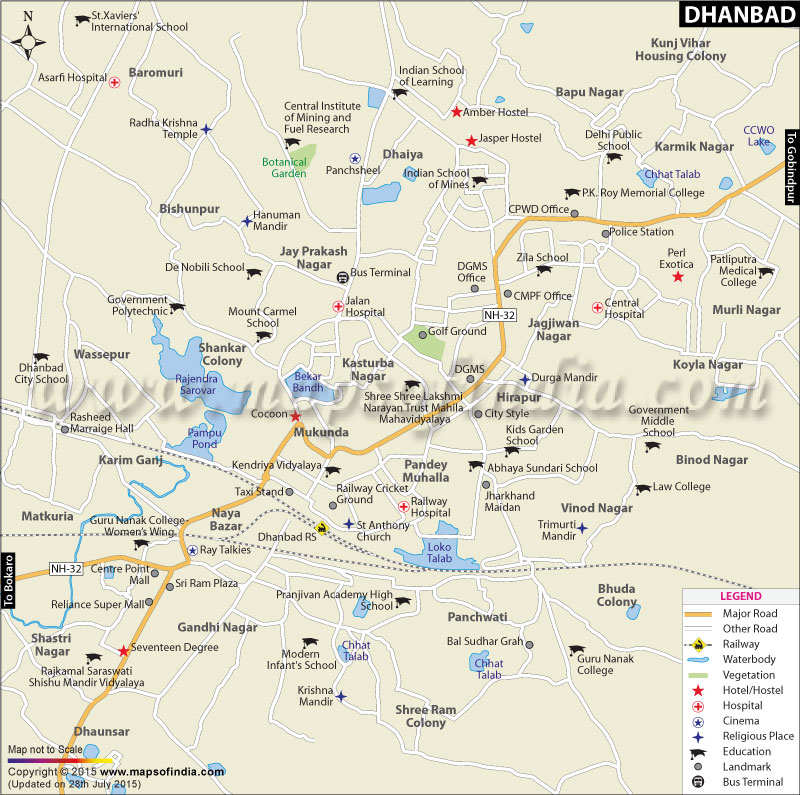



About
One among twenty-four districts in Jharkhand, India, Dhanbad holds its administrative center within the district's main city. To its northern edge, Giridih forms a boundary; southern limits touch West Bengal. On the eastern side lies Jamtara, while Bokaro borders from the western direction.
Flowing eastward, the Damodar stands as the key river in the region. Originating in Palamu, it moves between Ranchi and Hazaribag highlands while receiving waters from Bokaro, Konar, along with Barakar. Across the area, its course spans nearly 77 kilometres before meeting Barakar close to Chirkunda at the eastern edge. On this stretch, the Panchet Dam occupies around six kilometres of the channel, producing 40,000 kilowatts via water movement. Forming the northern limit here, the Barakar covers an equivalent distance inside boundaries.
History and Culture
Long before modern boundaries took shape, Dhanbad fell within Manbhum, a territory shaped by early communities known as the Mundari or Kolarian people emerging from southern regions of undivided Bihar. Far back in time, records drawn from Hieun Tsang's journey through these lands during the 600s reveal traces of Sasanka’s dominant rule stretching across the area and adjacent zones. Under colonial administration, Manbhum stood among the more prominent divisions in eastern parts of India
Named after Raja Man Singh, Manbhum traces back to land granted by Emperor Akbar post a decisive battle. Due to immense size and scattered settlements, division became necessary - Birbhum, Manbhum, then Singhbhum emerged separately. From 1928 records on Manbhum's survey work came an absence: stone carvings unseen, metal tablets missing. Even palm-leaf manuscripts or token currency surfaced nowhere across inspection phases
Twenty-fourth October nineteen fifty-six marks when Dhanbad emerged from Manbhum, shaped by the States Reorganisation Commission's guidance. Leadership came through journalist Satish Chandra, whose role helped define its early course. While Bihar held administrative control between nineteen fifty-six and fourteenth November two thousand, a shift followed just one day later. Fifteenth November two thousand brought inclusion into Jharkhand, a new entity born that morning. Half a century as a standalone district reached recognition in two thousand six, noted without ceremony but clear significance.
One finds many backgrounds present, including Bengalis, Biharis, and indigenous groups. Alongside them reside Gujaratis, Punjabis, Tamils, Malayalis, Telugus, Marwaris, and Rajasthanis - settled for generations. Because of such depth in population roots, multiple tongues echo through neighborhoods. This blend shapes daily life, seen clearly in speech patterns across areas. Such variety gives the region its distinct social texture. A richness in heritage emerges naturally, reflected in how people communicate every day.
Aromatic dishes define the area’s long-standing kitchen practices, shaped across generations by varied cultural threads. Notably, Litti paired with Chokha stands out - simple fare that settles well after eating, preserved carefully through local habits. Mughal-era cooking methods appear clearly within daily meal patterns here, adding depth without overpowering. On occasions such as Chhath Puja, Durga Puja, Diwali, Eid, and Rath Yatra, streets fill steadily - not just with ritual, but shared presence. Together, these moments reveal a place where belief systems coexist quietly, each marking time in its own rhythm.
Economy
Despite its modest size, the area leads the state in economic output, earning recognition as Jharkhand's primary financial hub. Manufacturing activity continues to grow here, drawing increasing industrial interest. Among India’s railway divisions, Dhanbad ranks first in income generation. This performance stands out within the national rail network
Two public sector units manage most coal extraction in the area - Bharat Coking Coal Limited and Eastern Coalfields Limited, each a subsidiary of Coal India Limited. In addition to them, IISCO and TISCO carry out coal removal activities locally. More than one hundred mining sites exist within the region, accompanied by several processing facilities for coal. Operations run here by long-standing entities such as Tata Steel, IISCO, and BCCL underline industrial presence. Known widely for energy infrastructure, the district hosts major power stations; among these, Maithon and Panchet serve hydropower needs. Thermal electricity comes through efforts led by Tata Power alongside Damodar Valley Corporation.
Paddy dominates farming here, followed by wheat along with oilseeds. Thanks to updated methods in cultivation, harvest volumes have risen steadily over time. Industry thrives across the region, its backbone formed through manufacturing such as firebricks, glassware, and cement. Ceramics appear alongside iron, steel, and machinery as key outputs from factory zones. Among notable enterprises stand Bharat Coking Coal Limited; their operations feed substantial income into regional accounts annually. So do Tata Iron and Steel Company, plus the Indian Iron and Steel Company, each playing a central role in economic flow
Financial growth arrived when coal reserves were uncovered here; however, violence followed through organized crime groups tied to mining operations. Wasseypur stands out as a location deeply scarred by ongoing clashes between rival factions. Although its economy plays an influential role within the larger administrative zone, official records from 2006 labeled it among India’s least developed 250 zones. Support now flows into the area via national assistance designated for underdeveloped territories.
Tourism
Though best recognized for industry and mineral extraction, nature sites appear here alongside places of worship and historic value. Surprisingly varied tourism options exist within what seems at first glance a purely productive landscape. Not only factories but also trails, temples, and old structures shape the area's identity. Where machinery dominates the skyline, forests and ancient landmarks still find space below. Even in zones marked by heavy economic activity, cultural remnants remain visible across the terrain.
A visit to the district remains incomplete without seeing Topchanchi Lake. Formed in 1915 through excavation along the Parasnath Hills’ edges, this manmade body once supplied most of Jharia's water needs prior to dam development. Thick green woods frame the area, rising beside the hills, drawing families on weekend outings. Bird enthusiasts find quiet fascination here; two kilometers stretch across which feathered life - common and rare alike - comes into view. Within that span lies the Topchancchi Wildlife Sanctuary, covering nearly nine square kilometers where nature thrives undisturbed.
Stretching 15,712 feet with a height of 165 feet, Maithon Dam serves mainly to manage flood levels along the Barakar River. Though built for water regulation, it houses an underground power facility - pioneering such design across South East Asia - with capacity reaching 60,000 kW. Among structures managed by the Damodar Valley Corporation, none hold more stored water than this one. Fishing occurs here regularly; boats move on the surface while pathways lead toward a deer park and a haven for birds nearby. A short distance away stands the Kalyaneshwari Temple, honoring Mata Kalyaneshwari in quiet reverence.
Panchet Dam lies within the central part of the region, constructed across the Damodar River, standing as a key structure in Jharkhand. Named after the nearby Panchet Hills, its scenic backdrop draws many who seek quiet observation. Though distant by fourteen kilometres from the rail hub, Bhatinda Falls emerges through thick green cover and uneven landforms. Referred to sometimes as Moonidih Waterfall, it appeals especially to those drawn to walking trails and natural settings
Among quiet lanes, Panra bears a legacy tied to the Pandavas - its identity shaped by stories of their stay. Housing several ancient shrines, one stands apart: Pandeshwar Mahadev Temple. In another corner, Gopalpur emerges through tales carved in stone, marked by a pillar and colossal figure said to echo Ashoka’s rule. Far beyond myth, curiosity leads some toward Dhanbad's museums - the Indian School of Mines and ISM Heritage collections - noted for insights into coal’s journey underground. Where past meets evidence, fragments remain quietly displayed
Demographics
Among those living here, roughly 26.8 lakh individuals reside across the area. Males account for nearly 14.1 lakh, representing 52 percent. Females number close to 12.8 lakh, forming 48 percent of residents. Spread unevenly, every square kilometre holds around 1,316 people on average. This places the region among Jharkhand's most crowded districts. Over ten years, inhabitants have grown by a twelfth of its prior total. Growth patterns differ: women saw their numbers rise faster, increasing 0.4 percentage points above men when comparing rates. Though both groups expanded, females advanced at 14.3 percent compared to males
Among districts in Jharkhand, this one records the fewest females per thousand males - only 908. When looking at general caste groups, the number drops further, to 896. In contrast, those classified under Scheduled Caste show a higher proportion: 932. Industrial activity shapes these figures significantly. Men have moved here for generations, drawn by jobs underground and near extraction sites. Most come from regions beyond, especially Bihar and West Bengal. Over time, such movement reshapes population patterns quietly. Gender balance shifts follow as consequence
Among those who live here are members of varied faiths and backgrounds, such as Santal and Munda tribes, together with individuals from numerous other groups. Not far behind in size, it stands at position thirty-nine among Indian cities by population, also claiming thirty-third place among urban areas exceeding one million residents. Highest in the nation for access to 4G networks - a recent Opensignal report confirms - marking strong digital reach across built-up zones
Administration
Among the area's divisions are Jharia, followed by Baghmara, then Nirsa, Govindpur appearing later, Baliapur included too, alongside Tundi, Topchanchi listed at last. Within these lie 181 local councils where governance occurs across 1,348 settlements scattered throughout. Present conditions place it inside a zone marked for particular attention due to unrest observed nearby
Administration rests with a Deputy Commissioner, typically drawn from the Indian Administrative Service, guiding overall governance. Oversight across subdivisions falls under Sub-Divisional Officers managing separate zones. Implementation of rural progress initiatives comes through Block Development Officers operating close to communities. Among notable locations, Dhanbad hosted events during the 34th National Games. Sporting facilities have expanded here, particularly for cricket. Venues such as Tata Steel Stadium in Digwadih support regional play. Nehru Stadium at Jealgora serves local competitions. Matches in the Ranji Trophy series take place at Railway Stadium. That same ground once welcomed international women’s teams. Infrastructure growth reflects sustained activity beyond routine needs
Through the district two key National Highways - NH-2 along with NH-32 - linking it firmly by road to nearby states and large towns. Connected via rail at Garhwa Road, the area reaches places like Delhi and Kolkata through routine train operations. Urban hubs including Ranchi, Gaya, Varanasi, and Patna stay within reach due to consistent bus routes operating daily. Projects funded under BRGF remain active, led by local authorities aiming to strengthen village-level facilities in transport, medical care, and learning systems. Despite natural resource advantages, progress in community well-being lags - efforts now focus on aligning economic output with human development outcomes.
| Facts of Dhanbad District | |
|---|---|
| Official Name | Dhanbad |
| Location | Bihar |
| Area (km2) | 2,040 |
| Population | 2, 684,487 |
FAQs
Q1: How many villages are there in the district?
1,222 villages.
Q2: What is the population of the district?
2, 684,487
Q3: What is this district famous for?
It is famously known as the "Coal Capital of India" for its vast coal mining industry and the presence of IIT (ISM) Dhanbad.
Last Updated on : May 11, 2026
| Find Distance from Dhanbad to other Indian Cities | |||
