|
||||||||||
 | ||||||||||
|





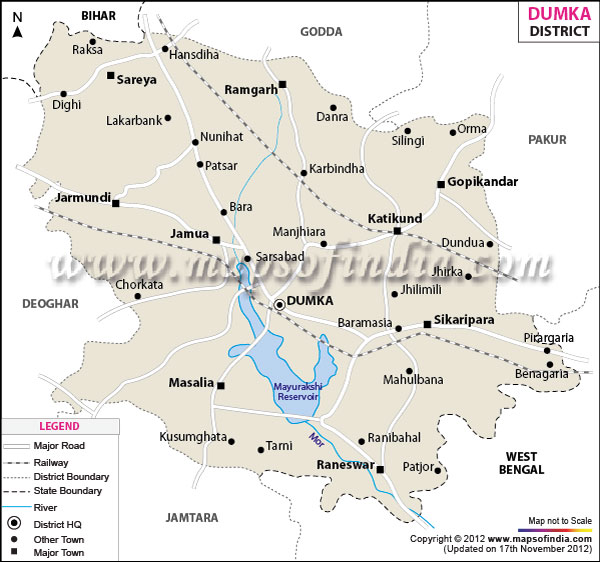
| *Dumka District Map highlights the National Highways, Major Roads, District Headquarter, etc. |
About
Deep in northeast Jharkhand, Dumka stands apart - its soul tied closely to forests, faith, and age-old tribal ways. Though called the state’s cultural heart, it thrives without factories or urban rush. Instead, rhythms here follow harvests, river flows, and rituals passed through generations. Santhal Pargana wraps around it, reinforcing roots in community life and ancestral practice. Hills thick with trees frame villages where tradition shapes daily routines. Spiritual sites dot the land, visited often but never turned into spectacles. Modern noise fades; what remains is lived experience, slow and steady. Festivals rise with seasons, marked quietly, woven into farming cycles. History does not shout here - it lingers in speech, soil, and shared memory. Hills roll across the area, shaping how people live around Dumka. Though the town holds key government functions, many nearby areas remain quiet and countryside-like. Growth has come slowly - schools opened first, then clinics followed, along with more roads connecting places. Forests line the edges of fields where crops grow between small rivers.
History and Culture
Before colonial officials arrived, Dumka's character grew quietly through the lives of native groups in Santhal Pargana - particularly the Santhals, who wove their habits into the soil over time. Thick woods covered broad stretches back then, broken only by low tribespeople’s dwellings nestled among slopes, hollows, and sunlit gaps. Life moved without written laws; instead, it bent around weather patterns and earth cycles. Crops were raised alongside hunting trips and collecting goods from trees, all held together by tight social bonds within hamlets. Shifts in seasons set the timing for sowing seeds, holding ceremonies, celebrating events, yet memory lived mainly in speech - not books or records - with tunes and tales passed mouth to ear across decades.
In the colonial era, Dumka rose in significance due to the Santhal revolt of 1855–56 - a notable early resistance by indigenous people opposing British rule. Initiated by Sidho Murmu and Kanho Murmu, together with Chand and Bhairav, the uprising formed in response to harsh treatment by landlords, lenders, and imperial structures eroding native ways. Many Santhals joined, seeking release from domination and interference in their lives. Despite being crushed by colonial forces, the struggle carved a lasting mark on India's past, still honored today throughout Jharkhand with deep respect and feeling.
Later, the creation of the Santhal Pargana as an administrative unit acknowledged the area's unique history and identity.
Deep in Jharkhand, Dumka stands out for its cultural depth. Village routines there carry strong echoes of age-old practices. Music pulses through daily existence, not just special moments. Marriages often unfold with rhythm-heavy performances rooted in tradition. Festivals light up with movement, sound, and color tied closely to seasonal cycles. Language lives loudly in Santhali lyrics sung by elders and youth alike. Rhythms rise from drums like the madal, steady and unyielding. Community bonds tighten around shared rituals shaped over generations. Customs pass down without needing written rules. Dance steps follow heartbeat-like beats from instruments such as the dhamsa. Life moves in patterns older than memory.
Faith shapes much of how people in Dumka see themselves. Not far inside the region stands Baba Basukinath Dham, a key shrine dedicated to Lord Shiva in Jharkhand. People who follow Hindu traditions arrive from various corners of India. During Shravan, considered sacred, visitors flood the site. With pitchers on their shoulders, they bring Ganges water through long journeys. The streets shift under waves of these travelers.
Most meals in Dumka build on ingredients grown nearby or gathered from forests.
Rooted in tribal customs, the way people eat here follows rhythms of farming life. What appears on plates usually depends on what ripens during specific times of year. Stews simmer with greens pulled fresh from fields. Flatbreads rise slowly over clay ovens made by hand. Millets stand at the center just as much as rice does. Seasonal mushrooms or tender shoots sometimes find their place beside lentils boiled until soft. Herbs collected near streams flavor many everyday preparations. Simplicity shapes each dish - yet every bite holds deep ties to land and cycle.
Economy
Farming shapes daily life across much of Dumka district, where fields stretch wide under skies that bring needed rain. Life in villages centers on growing food, tending animals, gathering from forests, and local barter. Rice fills the largest share of farmland, though corn, beans, grains, oils, and greens appear too, each in its own place.
Government Sector
Working in education, health care, or public safety means many residents find jobs across government-run facilities. Because Dumka holds a central role in Jharkhand’s governance structure, its official buildings and services shape much of what happens economically nearby. Despite limited private industry, state-backed roles remain steady sources of income for families throughout the region.
Public Sector
Years pass, yet government-run banks keep backing national progress. Transport networks grow, quietly lifting regional economies. Rural programs stretch into distant villages, sparking shifts. Health services reach more people, stabilizing communities. Schools open, minds sharpen - jobs follow. Big roads rise alongside new skills. Growth ties back to these steady investments.
Services Sector
Steady growth marks Dumka's service industry, driven by retail hubs, travel demand, moving people and goods, places to stay, learning support spaces, medical care access. During peak times, pilgrims visiting Baba Basukinath Dham lift business - lodging spots fill, storefronts see more buyers, eateries get busy, vehicle drivers find extra trips.
Still, small shops and handmade goods shape much of the area's income flow. Workers who move to big urban centers add value when money travels home with them. Local farming trades hold steady alongside roadside stalls where people exchange crops. Cash arriving from distant jobs helps families cover daily needs. Village commerce stays active even as some residents seek work elsewhere.
Tourism
Known for sacred sites, forested hills, and deep-rooted indigenous traditions, Dumka stands out within Jharkhand’s cultural landscape. Among its landmarks lies Baba Basukinath Dham, a revered sanctuary honoring Lord Shiva. Pilgrims journey here in large numbers annually, drawn particularly by the observances held throughout Shravan. From distant regions, visitors converge on the site to pray, engaging in age-old ceremonial practices. As devotion peaks, hymns echo through lanes once quiet, sustained by steady streams of faithful travelers.
Along the Mayurakshi River lies Massanjore Dam, a notable site within the region. Green hills wrap around it, with still water stretching between patches of woodland. Tranquility settles heavily where urban noise fades into silence. Open spaces unfold under gentle winds, drawing those who seek unbroken horizons. Scenery holds attention without effort, shaped by earth, water, and tree lines. Visitors arrive in family units or small clusters, drawn less by event than presence. Time slows near the banks, framed by upstream flow and distant slopes. Peace arrives quietly, carried on reflections across the surface.
The Maluti temples, found close to Dumka, stand out due to intricate terracotta work combined with lasting historical importance. Artistic expressions here trace back through centuries, preserving spiritual meaning alongside regional identity. Despite limited attention, curious travelers arrive drawn by distinct forms rooted in the past. Structures shaped long ago still speak quietly today.
Away from temples and viewpoints, Dumka reveals itself through thick woods, flowing streams, gentle slopes, because of nearby hamlets rooted in tribal ways. A visit here unfolds as quiet days pass beside fields, where routines follow seasons rather than schedules. Distance from busy cities allows rhythms to stay unhurried, since customs grow from land, shared stories, daily work. Nature does not serve spectacle; it forms part of living, tied tightly to how people gather, build, speak, remember. What stands out is not charm or novelty, but presence - how a place holds time without resisting change.
Demographics
Some 13 lakh people live in Dumka district, based on the 2011 census data. Rural and tribal communities make up much of this group, where farming still shapes daily life. Though cities grow slowly, most rely on land-based work. Livelihoods tie closely to seasonal changes. Farming stays central, despite shifts elsewhere. Among those living in the area, many belong to tribal groups - Santhal people stand out in shaping daily customs and shared traditions. While most communicate in Hindi, it is not unusual to hear Santhali or Bengali alongside local speech forms. Besides basic reading skills, nearly two out of three residents in Dumka can write and understand texts. Progress has come slowly - driven by new classrooms, expanded college options, yet shaped also by policy efforts over recent years.
Administration
Among the regions managed through local government units, Dumka district stands organized into multiple blocks and subunits. Housing key offices, the town of Dumka acts as the central hub for district operations. Located within Jharkhand, it holds notable significance in regional administration. Though quiet in appearance, its role shapes planning and public services across surrounding areas.
Among the key areas in the region are Dumka, followed by Jama and connected closely to Jarmundi. Nearby lies Masalia, while Ramgarh appears further west. Gopikandar sits apart yet linked through rural routes. Kathikund emerges in the east, not far from Saraiyahat. Ending the list is Shikaripara, positioned toward the southern edge.
Across its countryside and wooded areas lie over two thousand five hundred settlements. Governance at ground level sees strong involvement from traditional village councils, shaping initiatives in social progress, learning opportunities, instead of relying solely on central directives.
| DUMKA DISTRICT PROFILE | |
|---|---|
| COUNTRY | INDIA |
| STATE | JHARKHAND |
| AREA | 3,761 sq km |
| DISTRICT HEADQUARTERS | Dumka |
| ASSEMBLY SEATS | 4 |
| POPULATION | |
| Total | 1321096 |
| Male | 669240 |
| Females | 651856 |
| Density/km2 | 300 |
| Sex Ratio | 974 |
| LITERACY RATE (% age) | |
| Male | 75.17 |
| Females | 49.6 |
| LANGUAGE | HINDI, SANTHALI |
FAQs
Q1: How many villages are there in the district?
Dumka District is home to over 2500 Villages across administrative blocks.
Q2: What is the population of the district?
The population of the district is approx. 1.2 million.
Q3: What is this district famous for?
It is famous for the tribal heritage, Baba Basukinath Dham, the Santhal rebellion history, natural landscapes, and cultural traditions of the Santhal Pargana region.
Last Updated on : May 11, 2026
