|
||||||||||
 | ||||||||||
|





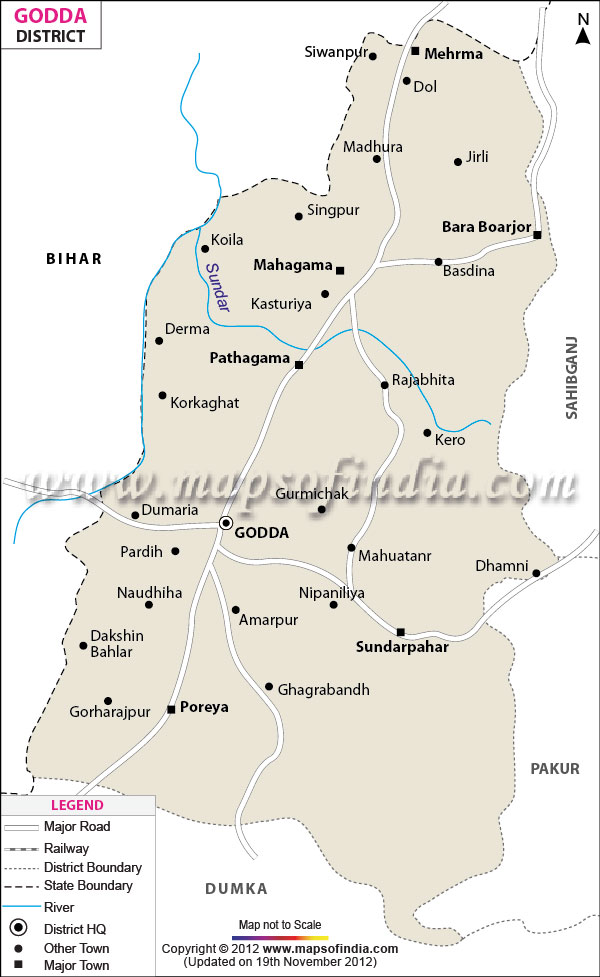
| *Godda District Map highlights the National Highways, Major Roads, District Headquarter, etc. |
About
Home to vast farmlands, Godda sits in northeast Jharkhand where tradition meets slow but steady change. Within the Santhal Pargana zone, it carries echoes of tribal roots alongside quiet shifts in how people earn their living. Around Godda town, government offices cluster alongside classrooms and clinics, forming the core of district operations. Though smaller than bustling factory hubs, gradual growth appears in widened roads, shops, new bus routes, and medical centers built step by step. Among India’s eastern districts, Godda stands out through quiet hills and winding river paths. Temples appear beside fields where farming shapes daily life. While cities rush forward, this place holds stillness like an old rhythm. Rural views stretch far under open skies. Where others build upward, here the land breathes wide and slow. Nowhere is the balance quite so visible as in Godda, where farming traditions hold strong amid new roads and factories. Change arrives slowly - through steel plants rising near rice fields, yet rituals remain unshaken.
History and Culture
Godda district’s past unfolds alongside that of the Santhal Pargana, a territory marked by deep-rooted tribal presence, village-centered practices, yet defiance during British control. Well prior to structured governance taking hold, native populations occupied these lands, relying heavily on woodlands, flowing waterways, besides farming plots. Instead of outside influence, it was the Santhals - among others - who defined local character, using rituals, speech patterns, songs, along with collective living styles.
Back then, dense woods stretched across most of Godda, broken only by small tribal villages tucked within. Survival came through crops grown in cleared patches, animals raised nearby, game hunted in thickets, yet also gathering what the forest offered. Daily routines shifted with rains arriving, grains ripening, ceremonies marking time's passage. Knowledge traveled without writing - instead, melodies carried tales forward, voices linking grandparents to grandchildren.
Beginning in the colonial era, the area gained importance as unrest grew among local communities facing harsh treatment. Not unlike places nearby within Santhal Pargana, Godda felt the force of the 1855–56 uprising guided by Sidho and Kanho Murmu. Outrage sparked from unfair demands made by landowners, lenders, along with distant administrative control that weakened native customs. While authorities crushed the revolt over time, its memory shaped how people saw themselves. Even now, it stands remembered - not just locally - as an act of bold defiance rooted in tribal pride throughout Jharkhand.
Godda grew slowly into a center for farming and governance. Under colonial rule, new rules about who owned land and how taxes were gathered shifted life for many people - especially those from tribal farming families. Even so, old ways of living together in villages held firm across the countryside.
Among cultural features, Godda shows how tribal roots mix with wider Jharkhand customs. Rooted deeply in daily practice, Santhali ways shape song, movement, yearly events, and shared routines. During times like harvests or local meetings, dancing still stands out as a way people show who they are. Often heard at festive moments, sounds from the madal and hand-played percussion form strong beats that pull neighbors into common space.
Festivals matter deeply here. Right after crops come in, people mark Sohrai - a key event for tribal communities tied to honoring livestock, giving thanks, and hoping for good yields. Spring's beginning finds its voice through Sarhul, a celebration rooted in reverence for trees and earth. While these traditions run strong, urban centers and rural pockets alike light up during Chhath Puja, Durga Puja, Holi, Diwali, and Eid. Each year, they bring rhythm to life across settlements big and small.
Economy
Farming forms the backbone of Godda’s economy, yet shifts have emerged as energy projects grow in influence across the region. While fields remain central to survival for many, new currents stir within the local job landscape. Rural households often tie their income to crops, whether through tilling soil or supporting related trades. Power initiatives now play a role alongside traditional harvests, slowly altering how people earn. Life outside towns still turns largely around planting seasons and monsoon rhythms.
Across the region, paddy dominates farming activity; other crops like maize, wheat, pulses, oilseeds, and vegetables appear when soil and weather allow. In Godda, rains during the monsoon shape most agricultural outcomes - farming techniques passed down through generations remain common. Rural livelihoods shift with planting and harvest times, affecting work availability throughout the year.
Farm animals contribute significantly to family incomes. While cattle and goats provide steady returns, poultry farming adds extra revenue streams - especially beneficial for those managing smaller plots. Dairy operations further boost financial stability across many rural households. In village marketplaces held each week, economic life pulses through trade: crops change hands alongside livestock, homemade items, and materials gathered from nearby woods.
Government Sector
Stability draws many toward roles in public service, where pay comes on time. From classrooms to clinics, work unfolds under district oversight. Police stations operate alongside welfare offices, each part of a wider system. Local councils function as another piece of this structure. Though varied in duty, these positions share one trait - predictable earnings month after month.
Public Sector
Though often overlooked, state-run banks help sustain local economies. Where rural development offices operate, progress tends to follow. Healthcare access expands when public clinics open in villages. Electricity distribution improves once power boards extend grids. Transport networks grow more reliable with government-backed routes. Housing initiatives give families stability where it is most needed. Jobs emerge through publicly funded work projects. Irrigation schemes revive farmland during dry seasons. Schools supported by public funds shape future opportunities. Each of these efforts ties back to the broader economic movement.
Services Sector
Gradually, the service industry is taking root across Godda town and its neighboring towns. Shops selling goods, tutoring centers, clinics, eateries, transport operators, schools, phone fix-it stalls, inns - these now offer work to many residents. With better roads and links, tiny enterprises find more room to grow. Growth creeps forward, fed by easier access and rising demand.
Nowhere has change been more visible than in how electricity generation expanded locally. Because of new plants going up, economic movement picked up speed across particular zones. Where construction happens, jobs follow - alongside better routes for travel and clearer channels to connect.
Tourism
Among lesser-known destinations, Godda stands out through modest charm rather than size. Though absent from mainstream travel maps, it draws nearby travelers seeking spiritual sites. Hills roll gently across the terrain, shaping much of what people notice first. Rivers weave between settlements, adding rhythm to daily life. Rural scenery remains unspoiled, appealing quietly without fanfare. Places of worship dot the area, visited often during festivals. Nature here does not shout - instead, it lingers in background details. Local culture thrives in routines, not performances. Visitors come less for spectacle, more for presence. What lacks in infrastructure finds balance in stillness.
Found among the region's key sacred locations, Yogini Shaktipeeth stands as a place rooted in spiritual practice and community belief. Though visited regularly, crowds grow noticeably during festival times and ceremonial dates. Among the rolling hills and dense woods, quiet riverside paths draw those who prefer calm over city noise. Where forest meets valley, glimpses of village life unfold slowly, shaped by long-held ways. Far from paved roads, daily routines follow rhythms older than memory. These spaces speak without words, revealing culture through gesture, craft, and silence.
Festivals like Sohrai light up Godda’s villages with rhythm and color. When Chhath Puja arrives, open fields near rivers fill with quiet devotion and song. Markets shift their usual pace during Durga Puja, taking on a festive pulse. Community life surfaces strongly at these times, shaped by shared rituals rather than grand displays. Cultural expression flows through dance, sound, and gathering - simple but deep.
Demographics
Some 13 lakh individuals inhabit Godda district, as recorded in the 2011 Census. Most reside outside urban centers, relying largely on farming for livelihood. Among those living here, many belong to tribal groups - Santhal people stand out - with customs shaping how life unfolds across the area. While most urban areas operate in Hindi, village exchanges often flow in Santhali or local speech forms. In daily routines, language shifts quietly between households, depending on heritage. Cultural rhythms pulse differently where ancestral practices remain central. Communication patterns mirror this mix, shaped less by policy than by generations of quiet continuity. Starting at roughly 56–57%, Godda's literacy level shows slow but steady gains through time. Learning options grow wider now, thanks to schools and colleges reaching further into villages along with city zones. Government-backed education efforts contribute as well, helping shape progress across different regions.
Administration
Among the regions organized for local management and growth, Godda district stands with multiple subunits guiding its structure. Heading this setup is Godda town, functioning as both capital and core hub where decisions take shape. Among the main administrative divisions are Godda, followed by Mahagama, then Pathargama shaping local governance. Meherma appears alongside Basantrai in official records, while Boarijor stands distinct within the structure. Sundarpahari forms part of this framework, just as Thakurgangti does in parallel. Poraiyahat completes the list, positioned at the edge of the network.
Spread out over countryside and partly wooded areas, the region includes over two thousand small settlements. Governance at ground level sees active involvement from traditional village councils, which help manage public services, schooling, progress initiatives, and support systems. Among the key goals is strengthening farming alongside boosting remote regions. Focus shifts toward clinics where access remains limited. Schools receive attention through gradual upgrades. Roads and utilities see updates in overlooked areas. Programs target support for indigenous communities. Priorities reflect needs voiced over time.
| GODDA DISTRICT PROFILE | |
|---|---|
| COUNTRY | INDIA |
| STATE | JHARKHAND |
| AREA | 2100 sq km |
| DISTRICT HEADQUARTERS | GODDA |
| ASSEMBLY SEATS | 3 |
| Population | 1313551 |
| Language | Hindi |
| LITERACY RATE (% age) | |
| Male | 69.56 |
| Females | 44.9 |
FAQs
Q1: How many villages are there in the district?
Over two thousand villages lie scattered throughout the blocks of Godda district.
Q2: What is the population of the district?
Some thirteen hundred thousand people live in Godda district as per the 2011 census count.
Q3: What is this district famous for?
Famous for tribal roots, Godda thrives on farming while holding tight to Santali customs. Power projects now rise where fields once ruled alone. Its role in Jharkhand's energy scene keeps expanding steadily.
Last Updated on : May 11, 2026
