|
||||||||||
 | ||||||||||
|





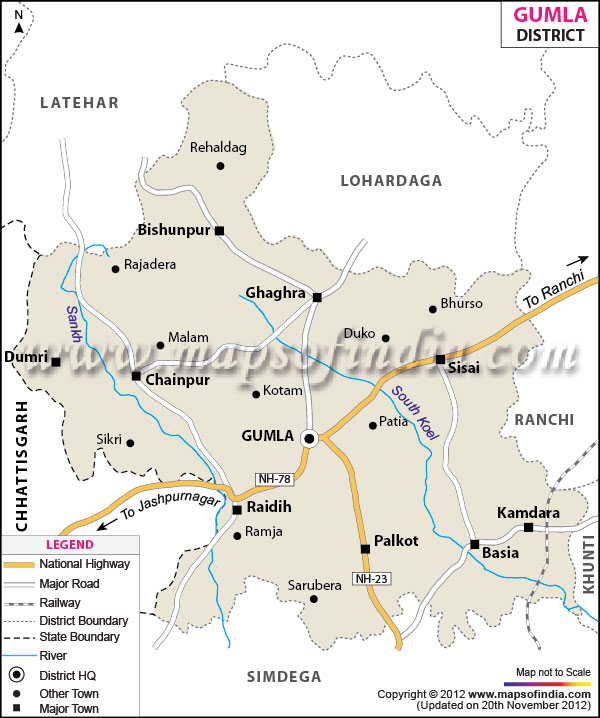
| *Gumla District Map highlights the National Highways, Major Roads, District Headquarter, etc. |
About
Gumla is located in southwest Jharkhand. Perched across the Chota Nagpur Plateau, it has gentle slopes, green woods, winding streams, and rich lowlands - elements that guide how people live here. Instead of factories or urban sprawl, what stands out is village rhythm: shared values matter more than speed, older ways hold weight, connection to land runs wide.
Gumla town, where the district administration sits, works as both a governance hub and marketplace for the area. Growth here came slowly - schools opened first, then clinics followed, shops spread through lanes, government buildings rose block by block. Outside its edges though, rural stretches stay tied tightly to farming rhythms, daily life echoing in hamlets marked by thatched roofs and communal fields. Among these villages live distinct tribal populations - the Oraon, the Munda, plus smaller clusters of native lineages - each holding fast to ancestral speech, rituals passed down generations, ways of being woven into land and season alike.
For generations, Gumla stood at the heart of uprisings led by tribal groups, alongside smaller regional powers shaping identity across Chota Nagpur.
History and Culture
Deep within India's eastern landscape lies Gumla, shaped by centuries of tribal presence among the hills and woodlands of Chota Nagpur. Not ruled by distant powers but rooted in earth and custom, its early society centered around Oraon and Munda families whose lives unfolded across dense groves and quiet clearings. Where maps once showed wilderness, communities thrived - drawing food from fields, strength from livestock, wisdom from trees. Seasons dictated labor; monsoon rains signaled sowing while harvests brought shared effort under open skies. Away from written records, knowledge traveled through spoken tales, sung verses echoing at night near fires. Ritual marked time - not clocks - and meaning grew in dance, song, and gathered circles beneath banyan shade. These threads held culture together long before roads reached inward.
Under British rule, shifts in land control reshaped Gumla and surrounding areas throughout the colonial era. Because their ancestral claims faced erosion, tribal groups pushed back with determination. Linked closely to broader uprisings in nineteenth-century Jharkhand, this zone saw sustained defiance. Even today, the memory of Birsa Munda - fighter, reformer, symbol - holds weight here. Resistance to oppression defined his path; preserving cultural roots drove his mission. Across villages, stories of his stand echo without fading.
As dusk settles at festival time, villagers gather under open skies. Drums pulse while flutes weave between voices raised in song. Movement becomes memory - steps passed down tell stories older than towns. Unity shows not in speeches but in synchronized footfalls on dusty ground. Spirit lives in rhythm, not ritual alone. History moves best when carried by dancers.
The Karma festival strengthens social ties, marking hopes for well-being and balance. Cattle matter deeply during Sohraj, which follows the harvest season. Beyond tribal traditions, religious events like Chhath Puja, Holi, Diwali, Durga Puja, Eid, and Christmas unfold across communities. Cultural variety shows clearly through these shared celebrations.
Most daily meals in Gumla center on rice, though millets and pulses appear just as often. From surrounding fields come leafy greens, forest herbs, alongside homegrown produce - all shaping routine cooking. Seasonal availability guides what ends up in pots, with ingredients usually collected by hand from nearby land. Rooted more in habit than spectacle, eating here follows rhythms passed through generations.
Economy
Farming shapes daily life across much of Gumla district, where land and trees support homes more than industries do. Rural households depend heavily on what they grow or gather, making natural assets central to survival here. While paddy fields stretch wide during monsoon seasons, smaller plots host maize when rains fade. Soil quality guides choices - some patches yield wheat; others favor pulses or oil-rich seeds instead. Even vegetable patches appear where water lingers past dry spells. Trade happens quietly through village markets, linking farm output to nearby towns. Deep within these woodlands lies a quiet engine of livelihood. From the roots up, people gather what feeds homes and fuels small markets. What grows in shade often finds its way to roadside stalls. For tribal groups, the forest acts less like a resource and more like a steady hand - offering without announcement, sustaining beyond seasons.
Government Sector
Most people look to public service roles when seeking steady work. From teaching in classrooms to managing local offices, positions open up across many fields. Stability draws applicants - knowing a paycheck arrives each month matters greatly. Whether working at clinics, schools, or within law enforcement, duties support community needs directly. Welfare programs also rely on staff who handle outreach and assistance tasks. These roles continue attracting interest due to reliable conditions they offer.
Public Sector
State-run banks, transit networks, hospitals, schools, and countryside support bodies help economies grow. Little by little, better roads, power access, water for farming, and community aid programs lift daily life in remote regions.
Services Sector
With growth seen across its service-based activities, Gumla's economy now relies more on small-scale trade and public services. From roadside stalls to private tuition classes, daily operations support both residents and nearby villages. Running alongside farming, transport networks move people and materials regularly between rural areas and the main town. Medical clinics, schools, and guesthouses have become common features along busy streets. Instead of large industries, it is these smaller enterprises that shape how business functions today. Trading happens mainly within Gumla marketplaces, where farm produce meets consumer demand for essentials. Household goods flow into the area, exchanged through informal vendors and established storefronts alike.
Tourism
Gumla stands out because of lush greenery, cascading falls, places of worship, alongside traditions shaped by indigenous communities. With thick woods, flowing streams, elevated terrain, along with peaceful views, it forms part of Jharkhand’s more striking countryside scenes.
Anjan Dham stands out among Gumla’s spiritual locations, tied through belief to Anjani - the mother of Lord Hanuman - by countless devotees. Though quiet at times, its pathways fill steadily each year as people arrive drawn by faith. Festivals shift the atmosphere entirely; crowds swell noticeably when celebrations begin. Among the region's highlights is Sadni Falls, tucked within dense woods and rugged landforms. Lush greenery frames the cascade, lending it a quiet charm that draws many visitors each year. Those who enjoy open spaces find themselves returning here frequently - drawn by both views and stillness alike. Though remote, foot traffic remains steady throughout seasons when weather permits travel.
Among its features are rivers, hills, and stretches of woodland - spaces where eco-travel finds room to grow. Moving beyond scenery, life unfolds in tribal settlements and country gatherings, places where old ways remain part of daily rhythm. These corners invite those who seek more than sightseeing, drawing attention to how people live when untouched by urban pace.
Festivals in villages, along with seasonal events and temples, deepen Gumla’s draw for visitors - each revealing layers of its cultural soul. Spiritual life flows through these moments, shaping how people see the region. Moments of celebration become quiet windows into tradition. Identity emerges not in grand statements, but in rhythm: prayer, harvest, dance. What draws attention is not spectacle, but continuity.
Demographics
Back then, around a decade ago, Gumla was home to nearly one million people, according to official data. Shaped largely by ancestry, life there leaned heavily on tribal lines - especially Oraon and Munda backgrounds standing clear. Even as years passed, figures remained fixed to that earlier count. Visibility came not through accident but consistency, seen widely in rural settlements and open land. Out beyond cities, where farming ties deep into forest work, daily routines take form slowly, built over generations. Across these areas, Hindi reaches far. Still, languages such as Kurukh, Mundari, and Nagpuri - plus many small community dialects - remain active. Roughly two-thirds of residents can now read and write. Growth in learning has been gradual in Gumla, helped by nearby schools, colleges, and programs backed by state efforts.
Administration
Split into multiple administrative units, Gumla district organizes its governance through a network of blocks and sub-divisions. At the heart of these operations lies Gumla town, which hosts the central offices and functions as the core hub for management. Among the main administrative divisions are Gumla, followed by Raidih, then Chainpur nestled nearby. Sisai appears next on the list, alongside Palkot situated slightly to the east. Basia comes into view moving further out, while Kamdara lies apart in quieter terrain. Bharno connects central points, Ghaghra holds a position near southern edges, Bishunpur rests close to forested zones, and finally Dumri marks one end of the grouping.
Across plateaus, forests, and farmland lie over nine hundred villages within the region. Governance at the grassroots level draws heavily on Panchayati Raj systems - shaping how services reach communities, guiding growth in rural sectors, supporting schooling efforts, while also managing social support programs. With a focus on tribal welfare, the administration advances healthcare access alongside improved road networks. While education receives steady attention, farming support grows through targeted policies. Forest preservation moves forward under updated guidelines, shaping rural development efforts. Priorities shift slightly each year, yet core goals remain fixed in place.
| GUMLA DISTRICT PROFILE | |
|---|---|
| COUNTRY | INDIA |
| STATE | JHARKHAND |
| AREA | 5,327 sq km |
| DISTRICT HEADQUARTERS | Gumla |
| ASSEMBLY SEATS | |
| Population | 1025213 |
| Language | Hindi, Sadri, Kurukh, Kharia |
| LITERACY RATE (% age) | |
| Male | 76.87 |
| Females | 56.97 |
FAQs
Q1: How many villages are there in the district?
There are 952 villages in the district.
Q2: What is the population of the district?
There are 1025213 people living in the Gumla district according to the 2011 census.
Q3: What is this district famous for?
The district is famous for its tribal heritage, waterfalls, natural beauty including forests, Anjam Dham. The Chota Nagpur region is known for its rich cultural traditions.
Last Updated on : May 11, 2026
