|
||||||||||
 | ||||||||||
|





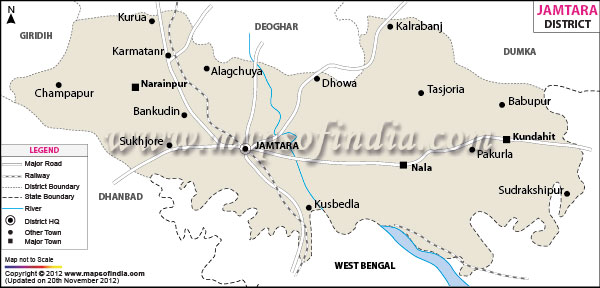
| *Jamtara District Map highlights the National Highways, Major Roads, District Headquarter, etc. |
About
Jharkhand has several districts, which are culturally rich and historically significant and Jamtara is one such district that is well recognised. The administrative headquarters to Jamtara district is in the north-eastern region of the state. The district's tribal background, agricultural economy, increasingly developed infrastructure and administrative significance have created a unique identity for the district in the years that have passed. Students, researchers, tourists and administrators often search for Jamtara district map to find out details about geographical layout, ways to transport, villages and development blocks in the district.
Although the district is mainly rural, cybercrime related incidents in some parts of the district have put it on the national agenda in recent years. But this is not the only aspect of identity; it also involves tribal heritage, folk traditions, educational development and natural beauty. The map for the Jamtara district is also significant for state government's planning and land-usage management and developmental activities.
History and Culture
Jamtara is closely related to the land of Santhal Pargana that has historically been occupied by tribal communities including Santhal, Mahali, Munda, etc. Subsequently, the region saw a series of tribal revolt and opposition to exploitative land revenue systems and oppressive government policies during the colonial rule of the British. After 1855, the Santhal Rebellion left its impact on the entire Santhal Sahari Khand area in terms of the resistance.
The region was sparsely developed historically largely because of limited infrastructure, though dense forests also existed. But, the advent of railway facilities in the colonial period brought the ease of trade and communication. Mihijam gained significant fame with its rail-related businesses and schools. The Jamtara district map may show railway settlements and other conventional rural settlements that grew up around farming areas as a result of the importance of these areas.
The district also epitomizes a harmonious relationship with respect to language and culture among different groups. Happily spoken Hindi, Santhali, Bengali and Angika. Bengali influence is particularly noticeable in border regions as well as in towns like Mihijam. Jamtara district map shows the cultural settlement distribution in various blocks.
The folk art and local crafts, in addition to the everyday life of agriculture, are also important in the rural area. Forests and nature are very closely related, forest knowledge plays a strong role in tribal rituals and social values. Important in the communities remain the marriage ceremonies, the harvest festivals as well as the village fairs.
In addition to the Hindu, Islamic and Christian religions practiced in the district, there are also religious practices of tribes. Shrines are seen all across the district - temples, village shrines and sacred groves. The Jamtara district map is always used for cultural research for analysing the patterns of settlement and population distribution of tribals.
Economy
The district of Jamtara's economy is basically agrarian with agriculture as a primary livelihood for majority of the population. Paddy is the main crop with maize/wheat cultivation, as well as pulses and oilseeds undertaken in several blocks. Small holdings involving animal husbandry and poultry farming provide rural people with income. The Jamtara district map serves as popular reference map in agricultural planning because of its information of agricultural means, fertile plains, and irrigation areas.
Government Sector -
The administration, welfare programmes, education, rural development and health services provided by the government hold a prominent position in the economy of the district. Vast number of the residents working in administrative offices of district level. The livelihoods are created by the government schools, anganwadi centres, health centres, and rural employment scheme which is present all over the district.
A host of schemes, such as MGNREGA, rural housing and tribal welfare schemes have enhanced employment and infrastructure. Recent years have seen a significant development in roads, power lines and water supply developments. A district map of Jamtara is used frequently as a tool of monitoring by administrative units, villages, development blocks and any public infrastructure works.
Public Sector -
In a typical rural setting with limited public sector development in Jamtara, the public sector has a role to play in development within the region. Economic stability is provided by public banking institutions, railway etc. and cooperative organisations. Jamtara and Mihijam have become connected with railways, which has encouraged local trade and movement of goods.
Agricultural Marketing Centres (AMC) and Public Distribution Systems (PDS) are the systems which uplift the rural economic system. The Jamtara district map helps decision makers to locate isolated villages and enhance public services delivery. There has also been improved access to banking services in rural areas, through financial inclusion programmes funded by the government.
Services Sector -
Services have now expanded relatively in Jamtara town and Mihijam. Local residents earn a living from retail trade, transport services, education and healthcare and communication services. Small hotels, food outlets, mobile service centres, and market establishments have grown, because of better connections.
District has also seen a spreading of digital infrastructure and Internet connectivity. Mobile and Internet technology has become a hot commodity in the countryside, and has also come upon the district with unwelcome publicity during the cybercrime events originating from at least some pockets of the country. Since then, the administration has placed a greater emphasis on programmes of digital awareness and cyber education.
Tourism
The basis of the tourism of Jamtara district is nature, religion, culture and countryside beauty. It is also not considered among the most commercialised tourist destinations of Jharkhand, but the district has a number of attractions which are attractive to tourists who want to get a peaceful environment and holding the culture. Mihijam is one of the important attractions which emerged as a railway town and a educational centre on historical way. For its peacefulness and antique institutions, the town is known for. In Jamtara district map, Mihijam is identified as an important city and transportation center in the district.
The temple of Chanchala Devi is a revered religious place which attracts pilgrims from surrounding areas. Spiritual life of tribal and non-tribal communities is revealed from the trails originating from the district and leading to various local temples and village shrines. The estuary of the Ajay river winds through some parts of the district augmenting the natural beauty as well as the geographical and agricultural life. Rural lands around green eclipses are beautiful sights during rainy season. Jamtara district map will provide the basis for planning river journeys, road communications and related local communities.
Folk culture lovers flock to the village fairs and tribal festival to enjoy indigenous culture, folk music and local cuisine. The festival of Karam and Sohrai are enacted with the traditional dances of the district which gives a picture of rich tribal identity of the district.
The district is also suitable for those who like forested areas and countryside trips. The tourism facilities are still relatively few, albeit, local authorities have shown more interest in promoting cultural and heritage tourism. A map of Jamtara district can be useful to consider lesser-known locations, and plan trips within the district. A number of other districts adjoining Jamtara - Deoghar and Dumka also drive foot traffic to the district. The district is further strengthened by its operating railway, making it accessible to travellers.
Demographics
According to Census of India (CI 2011) the population in Jamtara district was approximately 791,042. The district is moderately populated and has a predominantly rural population. Tribes have a large proportion of the people.
The literacy rate of the district stands at around 64.59 per cent. There is a significant disparity in literacy rates, in favour of boys, but educational awareness has been steadily rising over the years. The government's work and the growth programmes of the schools have contributed to educational development in the rural areas. The District map of Jamtara is utilized in several occasions to give the information on Literacy distribution and settlements of Jamtara district.
The district sees an extensive distribution of Hindi with language being used in administration as its main language. Santhali is widely used within tribal population and Bengali is also used extensively in border areas and urban areas like Mihijam. In some rural areas, the use of local languages, Angika and other regional varieties, is facilitating.
The district's social setting is rather heterogeneous having a mix of scheduled tribes, SC and other communities. The Santhals are a sizable group of tribesmen. The district is predominantly rural where the majority of families have agriculture their main occupation. The Jamtara district map continues to be used as an important reference document for censusing and analyzing and planning welfare programmes. Distribution of population by villages/blocks is both tribal concentration and the degree of agriculture dependency.
Administration
The principal tehsils/blocks are Jamtara, Nala, Narayanpur, Karmatanr Vidyasagar, Kundhit and Fatehpur. These administrative units are responsible for rural development and revenues; public welfare schemes, and local government. This is the map for Jamtara district that is used as much as by administrative authorities for block boundary information, road information, panchayat and public information of the district.
There are over 1100 census-reliant inhabited villages in the district; some sources report a total of over 1200. Panchayati Raj plays a major part in regulating the governance and implementation in the village level in terms of development schemes. The Jamtara district map helps the government departments during Disaster Management, election planning, census work and infrastructure development.
The State and Central government programmes continue to develop the transport and communication system. Jamtara and Mihijam railway station are two important station of the district being connected to other most important urban centres of both Jharkhand and West Bengal. The Jamtara district map proves to be very relevant to administrative planning and to better upgrading geographical records, which is increasingly required.
| JAMTARA DISTRICT PROFILE | |
|---|---|
| COUNTRY | INDIA |
| STATE | JHARKHAND |
| AREA | 1,802 sq km |
| DISTRICT HEADQUARTERS | Jamtara |
| ASSEMBLY SEATS | 3 |
| POPULATION | |
| Total | 790207 |
| Male | 403450 |
| Females | 386757 |
| Density/km2 | 439 |
| Sex Ratio | 959 |
| LITERACY RATE (% age) | |
| Male | 76.85 |
| Females | 50.08 |
FAQs
Q1: How many villages are there in the district?
Jamtara district has more than 1,100 inhabited villages across its administrative blocks.
Q2: What is the population of the district?
According to the 2011 Census, Jamtara district has a population of approximately 791,042 people.
Q3: What is this district famous for?
Jamtara district is famous for its tribal culture, Santhal heritage, agriculture, and its recent association with cybercrime-related activities.
Last Updated on : May 11, 2026
