|
||||||||||
 | ||||||||||
|





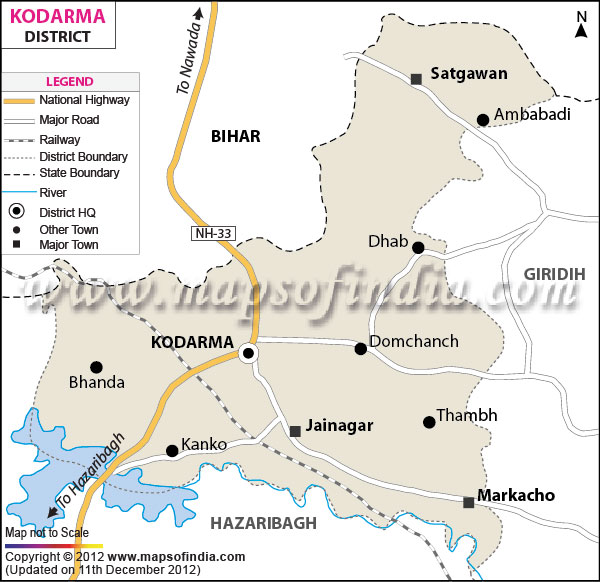
| *Koderma District Map highlights the National Highways, Major Roads, District Headquarter, etc. |
About
Hidden far north in Jharkhand, Koderma holds layers of old stories, vast natural resources, along with traditions shaping who people are today. Called the “gateway of Jharkhand” by many, it marks where the state meets Bihar, forming the upper part of North Chotanagpur Division. Though distant - about 165 kilometres from Ranchi - it covers 1,655.61 square kilometres of rolling plateaus, thick woods, and rich land shaped by rivers.
Koderma gained fame far beyond India because it pulled ruby mica from deep underground, its mines feeding demand in distant nations. For decades, nearly every bit of mica leaving India came through this one quiet place. Because of that grip on supply, folks started calling it the heartland of Indian mica - its name stamped onto maps where few such towns appear. At the center, Koderma town runs things, handling duties others might overlook. Down south, the Barakar moves slow, cutting across from left to right under open skies. Up north, the Sakri takes a different path, winding diagonally through fields and hills.
History and Culture
Hidden among the hills, Koderma mirrors the tale of Chotanagpur in more ways than one. Thick forests once sealed off this land, offering shelter to tribes resisting Aryan expansion across centuries. While ancient Indian empires rolled forward, these parts stayed untouched by classical Hindu influence. Yet threads linking it to wider historical currents stretch far back.
From somewhere around 273 to 232 BC, this land might have belonged to Ashoka's vast Magadha realm; signs suggest it stayed linked to distant corners of India back then. When Mauryan strength faded, a force under Kalinga’s ruler Kharavela marched across Jharkhand. Onward into later times, Samudragupta likely moved troops here while heading toward the Deccan. After Gupta rule crumbled, tradition holds that the Chotanagpur kingdom began forming by the 400s AD. Phanimukut took leadership then - named king - as the starting point of the Nagvanshi line emerged.
Among prominent zamindars settled under British systems stood Koderma, Gadi Palganj, plus Ledo Gadi as key estate names.
Most folks around here stood strong during India’s fight for freedom. When independence came, Koderma stayed inside Bihar - until the new state of Jharkhand took shape in late 2000, giving the area a government of its own.
When blossoms break on the Sal tree, folks mark Sarhul - spring's quiet salute. Music lifts at Karma time, when harvest thanks rise between dance and devotion. Winter brings Tusu Parab alive through song-filled walks under cold light. Folks outside tribal groups celebrate Chhath Puja, Diwali, Holi, alongside Eid with matching energy, helping unity spread through the area.
Economy
For years, Koderma’s economy leaned heavily on minerals and farming. Under the trees of the wildlife sanctuary lies much of the region’s mica stash - it also spreads through Dhab, Dhodhakola, Khalagthambi, Dibour, and Bandarchua. Mining that shiny rock once drove local business, feeding countless homes across generations. But after the 1980s, stricter green rules plus fading near-surface deposits slowed digging work a lot.
In Koderma, the biggest organized workplace is still run by the government. Running key national and local programs like MGNREGS, PM Awas Yojana, and support plans for tribal communities falls under the responsibility of local officials. Education and health needs reach residents through many government-run schools, PHCs, and CHCs spread across the area. An honor arrived on 7 January 2023 when President Draupadi Murmu gave Koderma’s administration the Digital India Award. That day marked it as the sole district in Jharkhand to earn such recognition, thanks to efforts bringing digital knowledge to ordinary citizens, particularly young people. Progress here now leans more heavily on tools powered by technology inside administrative routines. One thing stands clear - how work gets done locally has started shifting shape quietly but steadily.
Roads, power in villages, irrigation - government spending shows up clearly here. Along a major national highway, Koderma matters when it comes to moving supplies across regions. One village, Kanjhatand in Jarga Panchayat, earned the President's Award through Jal Shakti Abhiyan’s ‘Catch the Rain’ campaign. Not far away, Arkosa in Markacho became known for cutting out single-use plastic entirely. Recognition like this points to local efforts backed by public support rising into the national spotlight. This is Koderma District
Out here, the service industry keeps moving forward, held up by shops selling goods, movement of people and items, money handling, and phone networks. For tribal families, gathering small forest produce adds extra cash now and then.
Tourism
Hidden beyond dense trees and gentle slopes, Koderma stays quiet. There is no reason for it to shout. When someone takes time to look closely, the earth begins telling stories - old marks cut deep into stone caves appear first, then sacred spots shaped soft by countless touches over years show up next, finally woodlands wrap around each hillside so close they seem to rise and fall with breath.
Before words were ever set on paper, folks arrived at this place, carving belief into rock. These traces remain. Upright. Waiting to be seen.
Just past the town line, the Barakar River opens wide - this is where Tilaiya Dam begins. Weekdays here stay quiet, kept by herons and gusts that move through without stopping. Come Saturday, people start arriving, stepping out of vehicles in small groups, pulled like tides toward the stretch of still water. The land rises beyond the dam, one hill after another wearing different greens, folded together. Out on the water, wooden boats glide slow, tracing soft lines over a mirror that holds up another sky. Only after the rains let go do the riverside trees seem to relax - thick with leaves, soaked in quiet. Folks arrive by road from corners of Jharkhand and Bihar once streets feel too loud. Truth is, they can’t name the reason. Just something here lets air fill your lungs again.
Deep in the north part of the district, Koderma Wildlife Sanctuary breathes at its own pace. Shadows slip between trees much like leopards - there one moment, vanished the next. Dawn finds deer stepping carefully into open patches. After rainfall, wild boars root around, turning dirt with grunts buried in damp ground. Birdsong rules the treetops, while anyone who tracks a call with steady binoculars tends to catch something worth seeing.
Some folks still miss this place entirely. Yet whispers grow, like secrets passed hand to hand.
Open sores on the landscape, the pits remain - where mica used to be pulled free in shimmering bits. Noise filled these places before: engines roaring, soil swirling, workers moving day after day, hands trained by years of knowing stone. Silence now. Hollowed out, unused, their edges worn like old scars. Around them, the ridges keep memory in their slopes. History hides here not in carvings or monuments, rather removed - lifted from below, gone with what was taken.
Demographics
About 716,259 folks called Koderma home during the 2011 count. Among them stood 367,222 males alongside 349,037 females. With close to 950 females sharing space for each thousand males, the balance mirrors trends seen nearby. Spread out evenly, the population would place nearly 282 souls on every square kilometer - crowded? Not quite. Empty? Far from it.
Close to forty percent more people lived here in 2011 than ten years earlier - quite a shift for such a compact area. Though small on the map, the place saw steady growth during that decade.
Around 85 percent of folks here follow Hinduism. Nearly every person uses Hindi daily - more than 94 percent do. Yet soundscapes shift when Khortha drifts through conversations across Jharkhand. In villages and among tribes, Santali hums alongside Mundari; Sadri, sometimes named Nagpuri, stays rooted too. These voices don’t vanish - they persist beneath the surface.
Back in 2011, close to forty percent of the area wore forest like a coat - quite a sight given how often machines tore through rock since the old days. Trees held their ground, even when diggers didn’t stop.
Slow progress marks how the area handles reading skills today. Not strong in past times, true, yet pushing to include girls in classrooms has helped shift things. Reaching remote village groups also played a part. Change creeps forward - steady, quiet, noticeable only if you look close enough since around twelve years back.
Administration
Koderma gets its leadership from a Deputy Commissioner, someone serving through the IAS. Split across one sub-division, it holds six blocks shaping growth - Chandwara sits alongside Domchanch, while Markachho joins Jainagar, Satgawan, and Koderma itself.
Scattered across the land sit 717 villages - 577 where people live, 140 silent and empty - with 105 local councils managing them. Represented nationally through one seat in parliament, Kodarma shares its Lok Sabha spot with Giridih and Hazaribagh regions. At the state level, it stands alone with a single legislative assembly segment named after itself. Construction hums along on a fresh rail route stretching from Rajgir into Koderma, likely to reshape movement and spark growth once done. Years back, in 2018, the government planted an institution called Capital University among homes of Chitragupta Nagar - a quiet leap forward for learning here.
| KODARMA DISTRICT PROFILE | |
|---|---|
| COUNTRY | INDIA |
| STATE | JHARKHAND |
| AREA | 1665.61 sq km |
| DISTRICT HEADQUARTERS | Koderma |
| ASSEMBLY SEATS | 1 |
| Population | 716259 |
| Language | Kortha |
| LITERACY RATE (% age) | |
| Male | 81.25 |
| Females | 54.77 |
FAQs
Q1: How many villages are there in the district?
Across six blocks, Koderma holds 717 villages. Of these, 577 stay lived in while 140 sit empty. Running things are 105 village councils shaping local oversight.
Q2: What is the population of the district?
About 716,259 people live in Koderma district.
Q3: What is this district famous for?
Among Indian districts, few have shaped global supply quite like this one. Mica extraction built its name, particularly the glittering ruby kind shipped far and wide. For decades, nearly every ounce passed through here first. Yet sound matters too - Jhumri Telaiya once lit up airwaves with listener mail flooding radio stations. Water finds form in the curves of Tilaiya Dam, tucked between low hills. Animals move quietly within protected forest stretches nearby. Dance pulses during local gatherings rooted deep in community ways. Industry hums beside landscapes that change with season and light.
Last Updated on : May 11, 2026
