






History
The town of Leh is located in northern India's Ladakh region. It is high in the Himalayas, wrapped around by icy desert and mountains. Leh's history is very old and closely linked to trade, religion, and politics, but today it is recognized for its beauty and Buddhist culture.
Leh was an important commercial route in antiquity. Between Tibet, China, India, and Central Asia, traders passed via this area. Leh's position made it a stopover for caravans transporting precious stones, wool, silk, and spices. Despite the harshness and aridity of the land, Leh was rich in ideas and culture due to these trading routes.
Before Buddhism arrived, the inhabitants of Ladakh practiced native tribal beliefs and the Bon religion. Before Buddhism, Tibet had an old religion system known as Bon. Many Bon rites and traditions are still apparent in modern Ladakhi culture. Over time, Tibetan influence grew in the region.
Buddhism emerged in Ladakh about the second century CE, although it gained importance between the eighth and tenth centuries. This occurred when Tibetan monarchs promoted the spread of Buddhism. Monks travelled the highlands and constructed monasteries. These monasteries became places of learning and worship. Buddhism slowly influenced the culture, art, and daily life of the inhabitants of Leh.
Before Buddhism arrived, the residents of Ladakh practiced native tribal beliefs and the Bon religion. Prior to Buddhism, Tibet had an old religion system known as Bon. Many Bon rites and traditions are still apparent in contemporary Ladakhi culture. Over time, Tibetan influence grew in the region.
During this period, Leh also developed into a significant religious hub. The significance of numerous monasteries, including Hemis, Thiksey, and Shey, increased. These monasteries were more than just places of worship. In addition, they served as libraries, classrooms, and venues for festivals and art. Monks advised rulers and had a significant social function.
Leh was frequently attacked due to its proximity to several powerful areas. Ladakh fought the Mughal Empire and other nearby kingdoms during the 17th century. Ladakh occasionally received assistance from the Mughals in order to defend itself. Ladakh was able to preserve its culture and religion despite the governmental upheavals that resulted from this.
Leh saw significant transformation in the 19th century. The Dogra general Zorawar Singh, who was employed by the Jammu lords, conquered the area in 1834. Following a number of conflicts, Ladakh was vanquished and incorporated into the princely state of Jammu & Kashmir. Leh was still a significant town even though it was no longer the capital of a separate kingdom.
Trade routes gradually deteriorated during Dogra authority. The traditional caravan system was diminished by new frontiers and contemporary transportation. Leh grew more difficult to live in, and the area was cut off for a long time. However, because external impact was minimal, its own culture endured.
Ladakh was included into India following its independence in 1947. Due to its location close to Pakistan's and China's borders, Leh has once again become important . The region became important for defense after the war between China and India in 1962.
Leh's tourism industry began to grow in the upcoming decades. People from all around India and the world started traveling as roads and airports got better. Both fresh opportunities and challenges resulted from this. Leh continues to strike a balance between its traditional culture and modern life.
Culture
The culture of the Leh region is distinct and linked to its terrain, religion, and history. Cold weather, arid soil, and lengthy winters affects life in this high mountain environment. As a result, individuals here form tight-knit groups and rely heavily on one another.
Buddhism is essential to Leh's culture. The majority of people follow Tibetan Buddhism, particularly the Gelug and Drukpa schools. Monasteries, commonly known as gompas, are found on mountain peaks and slopes. They are not simply places of worship, but also hubs of learning and community activity. Monks are respected and participate in key social gatherings.
An important aspect of Ladakhi culture is festivals. Hemis Festival, Losar (Ladakhi New Year), and Dosmoche are some of the most well-known celebrations. Monks perform masked dances known as cham dances at these celebrations. These dances narrate tales of good winning over evil. They share food, play music, and dress traditionally. Festivals are joyful and contribute to the carrying of customs.
Leh's traditional clothes are made to keep people warm. A goncha is a long woolen robe used by both men and women. Women frequently complement their clothing with silver jewelry and vibrant belts. The perak, a traditional headgear constructed of turquoise stones, is among the most well-known decorations. During festivals and weddings, clothing is proudly worn as a sign of social identity.
The food culture is simple and filling. Because farming is tough, residents depend on barley, wheat, and dairy products. Tsampa, a roasted barley flour-based dish, is popular. Butter tea, also known as gur gur chai, is popular and keeps people warm. Momos, thukpa, and skyu are also part of the daily menu. Food is commonly shared, showing warmth and hospitality.
Ladakhi culture is based on strong family and communal values. People help one another in farming, building homes, and attending festivals. Respect for elders is crucial, and traditional values are in youngsters from an early age. Polyandry was once popular in some locations to preserve family land intact, but it is no longer common.
Art and crafts are important cultural expressions. Thangka paintings depicting Buddhist gods and legends are created with care and devotion. Wood carving, metalwork, and weaving are all common. These crafts are linked to religious rituals and daily life. Celebrations and ceremonies include music and dance. Traditional instruments include drums, flutes, and cymbals. Songs are based in nature, love, and spiritual existence.
Language
Ladakhi, also known as Bhoti, is the primary language spoken in Leh. The majority of people in Leh town and the surrounding villages speak it on a daily basis. Ladakhi is closely linked to Tibetan and is a member of the Tibetic language family. Therefore , Ladakhi has grown its own particular form over time; many words, sounds, and sentence structures are similar to those of classical Tibetan.
At home, in marketplaces, and during regional celebrations, Ladakhi is typically spoken. In Leh, it plays a significant role in people's identities. In everyday life, the language is primarily spoken rather than written. Tibetan script is often used for writing, especially for religious and ancient texts. This script is used in a large number of ancient Buddhist writings and prayers in the area.
In addition to Ladakhi, Hindi and English are also commonly spoken in Leh. While English is used in workplaces, schools, and tourism-related jobs, Hindi is frequently used for contact with people from other parts of India. Many residents are able to switch between Ladakhi, Hindi, and little English with ease because Leh is a popular tourist destination.
You might also hear Urdu in various places, particularly among Muslim communities. Even though media, travel, and education have all had an impact on speech throughout time, Ladakhi is still widely spoken. Through stories, songs, and everyday discourse, elders ensure that children learn the language.
Geography
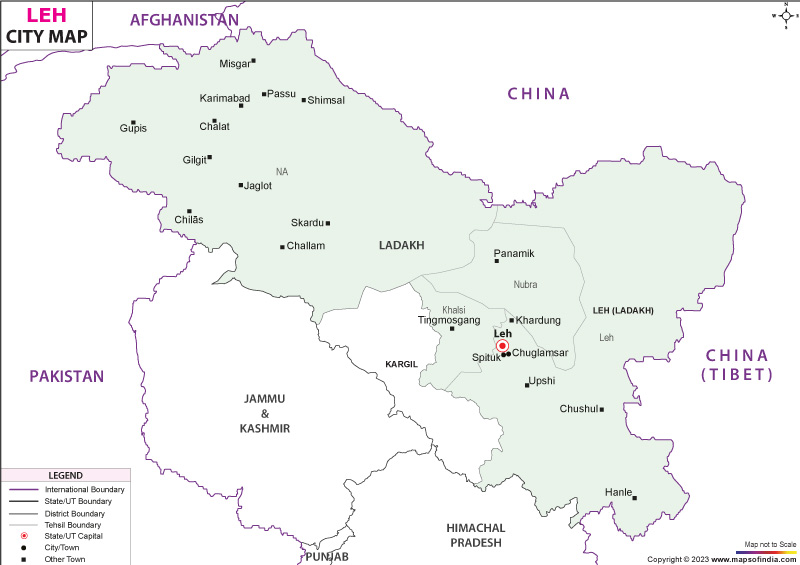
Leh is situated in the northern Indian Union Territory of Ladakh. The area is located in the high Himalayas, sandwiched between the Great Himalayan Range in the south and the Karakoram Range in the north.
It has particularly rough and dramatic scenery as a result of its location; it is primarily composed of broad valleys, rugged hills, and tall mountains. There is little natural flora, and the area appears arid and desolate. The majority of vegetation only grows around villages and riverbanks, and trees are rare.
The most important river in the area is the Indus. It helps farms and settlements as it passes through Leh. Water is still scarce, but it is also supplied by little streams from melting glaciers. The air is thin and oxygen levels are low because of the high altitude, which is around 3,500 meters above sea level.
The climate of Leh is a chilly desert. Due to the region's location in the Himalayan rain shadow, there is extremely little rainfall. Summers are brief and warm, with daytime highs often ranging from 15 to 25 degrees Celsius. Even in summer, nights can still be chilly. Winters are harsh and long. There are often strong gusts and abrupt weather shifts. Leh's climate and topography have formed its way of life, and its inhabitants have learned to coexist peacefully with the environment and its finite resources.
| Particular | Details |
|---|---|
| Official Name | Leh |
| Location | Leh District |
| Area | 9.15 sq. km |
| Population | 30,870 |
| Language | Bhoti |
FAQs
Q.1: What climate does Leh have?
Leh experiences a cool desert climate. Summers are brief and moderate, whereas winters are long and bitterly cold. Because of its rain-shadow location, it receives little rainfall
Q.2:What is the language spoken in Leh?
Ladakhi is the major language spoken in Leh. Hindi and English are also commonly understood, particularly in schools, offices, and tourism destinations. Some communities speak Urdu.
Q3: Why is Leh popular with tourists?
Leh is well-known for its gorgeous scenery, monasteries, mountain passes, and tranquil atmosphere. Trekking and bicycling are two popular adventure activities that attract many visitors each year
Last Updated on: May 08, 2026
