|
||||||||||
| ||||||||||
|





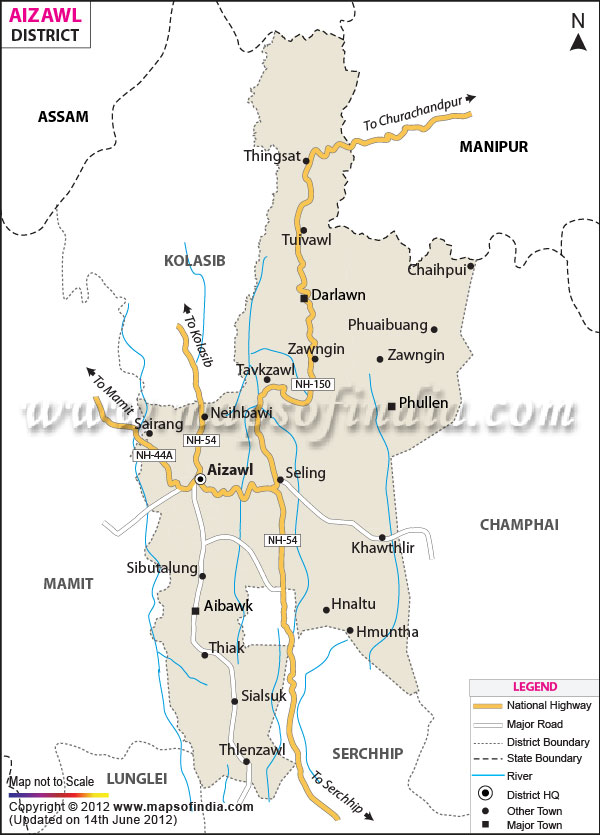
| *Aizawl District Map highlights the National Highways, Major Roads, District Headquarter, etc in Aizawl. |
The Aizawl district is one of the eleven administrative districts of Mizoram state situated in northeastern part of India and which is the political, administrative as well as cultural center of the region. The district is home to the state capital of Aizawl, the most densely populated and urbanised place in Mizoram, where more than a third of the total population of the state lives. The district is located in the northern region of Mizoram and it is a dramatic topography that defines it composed of steep ridges, green valleys and winding rivers that run through the foothills of the Eastern Himalayas.
The outstanding urban nature of Aizawl district is one of its key elements except that almost 79 per cent of the population of the region lives in urban regions. The district has five rural development blocks and has 14 legislative assembly constituencies. It has excellent literacy rate of 98.5 per cent, which is among the best literate districts in India, which is a result of the transformative effect of missionary education that started in the late 19 th century.
History
The history of the Aizawl district is closely connected with the larger history of the British colonialism in northeast India and the ultimate appearance of Mizoram state in its autonomous status. The area prior to the intervention of the British was home to different Mizo tribes who were organised as chieftainship and practised shifting cultivation and animist beliefs. The British were initially acquainted with the region after they had endured a sequence of attacks by Lushai tribes into British occupied areas in the plains of Cachar and Chittagong in the middle of 19 th century.
Such raids made the British carry out a punitive military action in 1871-72 and 1889-90, and this resulted in the gradual conquest of the tribal chiefdoms. On 2 nd February 1890, Fort Aijal was established as a British military post. The Lushai Hills were officially included in the British India in 1895 and in 1898, the North and South Lushai Hills were united to form one administrative unit, the Lushai Hills District with Aizawl as its headquarters.
There was significant social and cultural transformation in the region under British rule. In 1894, with F.W. Savidge and J.H. Lorrain, Christian missionaries, mainly of the Welsh Presbyterian Mission, came and opened the first mission in the town of Aizawl. They brought western education, invented the Roman script of the Mizo language, and launched large-scale conversion to Christians. Most of the Mizo people had converted into Christianity in less than fifty years, and this has greatly transformed the social arrangement and cultural ways of these people.
After the independence of India in 1947, Aizawl remained the seat of the Lushai Hills District which was still under Assam. In 1954, the district was changed to Mizo District. But there was a sense of neglect by the Assam government, especially poor handling of the disastrous Mautam famine of 1959-61, which caused separatism. This frustration led to the rise up of the Mizo National Front that initiated an armed rebellion against the Government of India in March 1966. This struggle went on to last 20 years until Mizoram Peace Accord was signed in 1986 which opened the way to the elevation of Mizoram to full statehood on 20 February 1987 with Aizawl being established as the state capital.
Culture
The Aizawl district cultural environment is a colourful handicraft made of the traditional Mizo heritage and the strong presence of Christianity that has taken a deep root in all spheres of social life. The Mizo people are very communal, hospitable and submissive to the cultural concept of Tlawmngaihna, which is an untranslatable term that signifies selflessness, hospitality, and the imperative to assist others.
The religion of the country is mainly dominated by Christianity with about 94 per cent of the entire population being members of different Christian denominations, most of them being Presbyterian. Sunday is the day of rest in the city which is followed with an unbelievable rigidity, during which the majority of the commercial activities are closed and the people are in the churches. The most popular festival is Christmas, and it is characterized by rich decorations, singing carols, and the Kawnchei tradition that makes the streets their Christmas decorations.
Nevertheless, the district has managed to preserve the links with its pre-Christian past by celebrating the traditional festivals. Chapchar Kut marked the end of jungle clearance, used in jhum cultivation and the beginning of spring in March every year. The festival is characterised by traditional dances, music and donning of colourful Mizo dresses. Other major festivals are Mim Kut that is celebrated in memory of the deceased relatives following the harvest and Pawl Kut that is celebrated to mark the harvest.
Traditional arts and crafts also contribute to the cultural life in the district. Mizo traditional attire especially the puan features elaborate designs and bright colours. Music and dance have always been a part of the cultural expression and especially, cheraw or bamboo dance is quite popular. Bamboo and cane work, handloom fabrics and local food are also unique to the district that has a rice as its main ingredient and serve alongside dishes made of local vegetables, meat and the local fermented preparations.
Language
The language of Aizawl district is inhabited by the Mizo language, which is the mother language of the large majority of the inhabitants, as well as lingua franca among the ethnic groups. The majority of inhabitants speak Mizo as their native tongue with the standardised Duhlian dialect serving as the literary and broadcasting standard.
Mizo is a language family or a language family of the Tibeto-Burman language family and it is a language in Kuki-Chin linguistic group. The speech is melodious and tonal in nature and has a unique nature among the northeast Indian languages. In the past, the Mizo were never in possession of any written script but used oral traditions to retain their history and folklore. This took a new twist when Christian missionaries came in 1894 and the first Mizo alphabet came into being by F.W. Savige and J.H. Lorrain and was created using the Roman script.
The invention of a written language was ground-breaking, and it allowed to codify the Mizo grammar, making literature and establishing a strong educational framework. Mizo is nowadays among the two official languages of Mizoram, the other being English, and is spoken in government, education, media, and in everyday life. The language is studied in schools at both primary level up to the higher education level and there is a flourishing literary culture producing newspapers, magazines, and books in the Mizo language.
English plays a very significant role in the language ecology of the district as it is an associate official language and is widely spoken in the higher education and professional sphere. A good number of the population are multilingual and speak Mizo at home, English in school, and often have some knowledge of Hindi. The various communities represented in the district are found in the minorities such as Hmar, Bengali, Nepali and Paite languages.
Geography
The Aizawl district has a dramatic and complicated geography with rugged landscapes, steep hills and complicated patterns in drainage as is characteristic of the Eastern Himalayan foothill.
The terrain is also very wavy and rocky with the presence of a row of parallel ridges that run approximately northsouth. The heights are drastically varied with the lowest points being 60 metres on the valley floors and highest points standing at 1,509 metres above sea level. Even the capital city of Aizawl lies at the top of a high ridge at an approximate 1132 metres of elevation. This unique topography is due to underlying geology of alternating bands of sandstone, siltstone and shale, which have been tilted and folded due to tectonic force.
The hydrology of the district is characterized by a number of large river systems such as Tlawng River, Tuirial River that are important in drainage and water supply. These rivers are normally permanent where the rainfall in the area is heavy but the water levels in the rivers change significantly during the wet and dry seasons.
The climate is categorised as tropical monsoon, which is moderately temperate and highly humid with the rainfall patterns falling seasonally. Three seasons can be found in the district which include warm summer, monsoon with an average rain of 2,500-3,000 millimetres each year and a cool winter, between November to February. The high level offers natural cooling and extreme heat is eliminated without imposing conditions that make it unbearable. The monsoon rains are however known to cause landslides. The region is Seismic Zone V which means that it is highly susceptible to earthquakes.
The native vegetation is mainly tropical and subtropical moist broadleaf forest with the evergreen forests occupying a large portion of the steeper slopes. These forests have economic and culturally important timber species and bamboo groves. Nevertheless, the original forest cover especially the forests near human settlements have been significantly changed by centuries of jhum cultivation and urban development.
Q.1:What is the literacy rate of Aizawl district?
Aizawl district has an exceptional literacy rate of 98.5 per cent according to the 2011 Census, making it one of the most literate districts in India.
Q.2:When did Mizoram become a full-fledged state with Aizawl as its capital?
Mizoram achieved full statehood on 20 February 1987, following the signing of the Mizoram Peace Accord in 1986.
Q.3: What is the dominant religion in Aizawl district?
Christianity is the dominant religion, with approximately 94 per cent of the population adhering to various Christian denominations, predominantly Presbyterian.
Q.4:What type of climate does Aizawl district experience?
Aizawl district experiences a tropical monsoon climate with moderate temperatures, heavy rainfall during monsoon season, and pleasant winters.
Last Updated on : June 24, 2026
The outstanding urban nature of Aizawl district is one of its key elements except that almost 79 per cent of the population of the region lives in urban regions. The district has five rural development blocks and has 14 legislative assembly constituencies. It has excellent literacy rate of 98.5 per cent, which is among the best literate districts in India, which is a result of the transformative effect of missionary education that started in the late 19 th century.
History
The history of the Aizawl district is closely connected with the larger history of the British colonialism in northeast India and the ultimate appearance of Mizoram state in its autonomous status. The area prior to the intervention of the British was home to different Mizo tribes who were organised as chieftainship and practised shifting cultivation and animist beliefs. The British were initially acquainted with the region after they had endured a sequence of attacks by Lushai tribes into British occupied areas in the plains of Cachar and Chittagong in the middle of 19 th century.
Such raids made the British carry out a punitive military action in 1871-72 and 1889-90, and this resulted in the gradual conquest of the tribal chiefdoms. On 2 nd February 1890, Fort Aijal was established as a British military post. The Lushai Hills were officially included in the British India in 1895 and in 1898, the North and South Lushai Hills were united to form one administrative unit, the Lushai Hills District with Aizawl as its headquarters.
There was significant social and cultural transformation in the region under British rule. In 1894, with F.W. Savidge and J.H. Lorrain, Christian missionaries, mainly of the Welsh Presbyterian Mission, came and opened the first mission in the town of Aizawl. They brought western education, invented the Roman script of the Mizo language, and launched large-scale conversion to Christians. Most of the Mizo people had converted into Christianity in less than fifty years, and this has greatly transformed the social arrangement and cultural ways of these people.
After the independence of India in 1947, Aizawl remained the seat of the Lushai Hills District which was still under Assam. In 1954, the district was changed to Mizo District. But there was a sense of neglect by the Assam government, especially poor handling of the disastrous Mautam famine of 1959-61, which caused separatism. This frustration led to the rise up of the Mizo National Front that initiated an armed rebellion against the Government of India in March 1966. This struggle went on to last 20 years until Mizoram Peace Accord was signed in 1986 which opened the way to the elevation of Mizoram to full statehood on 20 February 1987 with Aizawl being established as the state capital.
Culture
The Aizawl district cultural environment is a colourful handicraft made of the traditional Mizo heritage and the strong presence of Christianity that has taken a deep root in all spheres of social life. The Mizo people are very communal, hospitable and submissive to the cultural concept of Tlawmngaihna, which is an untranslatable term that signifies selflessness, hospitality, and the imperative to assist others.
The religion of the country is mainly dominated by Christianity with about 94 per cent of the entire population being members of different Christian denominations, most of them being Presbyterian. Sunday is the day of rest in the city which is followed with an unbelievable rigidity, during which the majority of the commercial activities are closed and the people are in the churches. The most popular festival is Christmas, and it is characterized by rich decorations, singing carols, and the Kawnchei tradition that makes the streets their Christmas decorations.
Nevertheless, the district has managed to preserve the links with its pre-Christian past by celebrating the traditional festivals. Chapchar Kut marked the end of jungle clearance, used in jhum cultivation and the beginning of spring in March every year. The festival is characterised by traditional dances, music and donning of colourful Mizo dresses. Other major festivals are Mim Kut that is celebrated in memory of the deceased relatives following the harvest and Pawl Kut that is celebrated to mark the harvest.
Traditional arts and crafts also contribute to the cultural life in the district. Mizo traditional attire especially the puan features elaborate designs and bright colours. Music and dance have always been a part of the cultural expression and especially, cheraw or bamboo dance is quite popular. Bamboo and cane work, handloom fabrics and local food are also unique to the district that has a rice as its main ingredient and serve alongside dishes made of local vegetables, meat and the local fermented preparations.
Language
The language of Aizawl district is inhabited by the Mizo language, which is the mother language of the large majority of the inhabitants, as well as lingua franca among the ethnic groups. The majority of inhabitants speak Mizo as their native tongue with the standardised Duhlian dialect serving as the literary and broadcasting standard.
Mizo is a language family or a language family of the Tibeto-Burman language family and it is a language in Kuki-Chin linguistic group. The speech is melodious and tonal in nature and has a unique nature among the northeast Indian languages. In the past, the Mizo were never in possession of any written script but used oral traditions to retain their history and folklore. This took a new twist when Christian missionaries came in 1894 and the first Mizo alphabet came into being by F.W. Savige and J.H. Lorrain and was created using the Roman script.
The invention of a written language was ground-breaking, and it allowed to codify the Mizo grammar, making literature and establishing a strong educational framework. Mizo is nowadays among the two official languages of Mizoram, the other being English, and is spoken in government, education, media, and in everyday life. The language is studied in schools at both primary level up to the higher education level and there is a flourishing literary culture producing newspapers, magazines, and books in the Mizo language.
English plays a very significant role in the language ecology of the district as it is an associate official language and is widely spoken in the higher education and professional sphere. A good number of the population are multilingual and speak Mizo at home, English in school, and often have some knowledge of Hindi. The various communities represented in the district are found in the minorities such as Hmar, Bengali, Nepali and Paite languages.
Geography
The Aizawl district has a dramatic and complicated geography with rugged landscapes, steep hills and complicated patterns in drainage as is characteristic of the Eastern Himalayan foothill.
The terrain is also very wavy and rocky with the presence of a row of parallel ridges that run approximately northsouth. The heights are drastically varied with the lowest points being 60 metres on the valley floors and highest points standing at 1,509 metres above sea level. Even the capital city of Aizawl lies at the top of a high ridge at an approximate 1132 metres of elevation. This unique topography is due to underlying geology of alternating bands of sandstone, siltstone and shale, which have been tilted and folded due to tectonic force.
The hydrology of the district is characterized by a number of large river systems such as Tlawng River, Tuirial River that are important in drainage and water supply. These rivers are normally permanent where the rainfall in the area is heavy but the water levels in the rivers change significantly during the wet and dry seasons.
The climate is categorised as tropical monsoon, which is moderately temperate and highly humid with the rainfall patterns falling seasonally. Three seasons can be found in the district which include warm summer, monsoon with an average rain of 2,500-3,000 millimetres each year and a cool winter, between November to February. The high level offers natural cooling and extreme heat is eliminated without imposing conditions that make it unbearable. The monsoon rains are however known to cause landslides. The region is Seismic Zone V which means that it is highly susceptible to earthquakes.
The native vegetation is mainly tropical and subtropical moist broadleaf forest with the evergreen forests occupying a large portion of the steeper slopes. These forests have economic and culturally important timber species and bamboo groves. Nevertheless, the original forest cover especially the forests near human settlements have been significantly changed by centuries of jhum cultivation and urban development.
| Particular | Details |
|---|---|
| Official Name | Aizawl District |
| Area | 3,576 km² |
| Population | 400,309 (as per 2011 Census) |
| Language | Mizo (official), English |
| Religion | Christianity |
FAQs
Q.1:What is the literacy rate of Aizawl district?
Aizawl district has an exceptional literacy rate of 98.5 per cent according to the 2011 Census, making it one of the most literate districts in India.
Q.2:When did Mizoram become a full-fledged state with Aizawl as its capital?
Mizoram achieved full statehood on 20 February 1987, following the signing of the Mizoram Peace Accord in 1986.
Q.3: What is the dominant religion in Aizawl district?
Christianity is the dominant religion, with approximately 94 per cent of the population adhering to various Christian denominations, predominantly Presbyterian.
Q.4:What type of climate does Aizawl district experience?
Aizawl district experiences a tropical monsoon climate with moderate temperatures, heavy rainfall during monsoon season, and pleasant winters.
Last Updated on : June 24, 2026
