|
||||||||||
 | ||||||||||
|





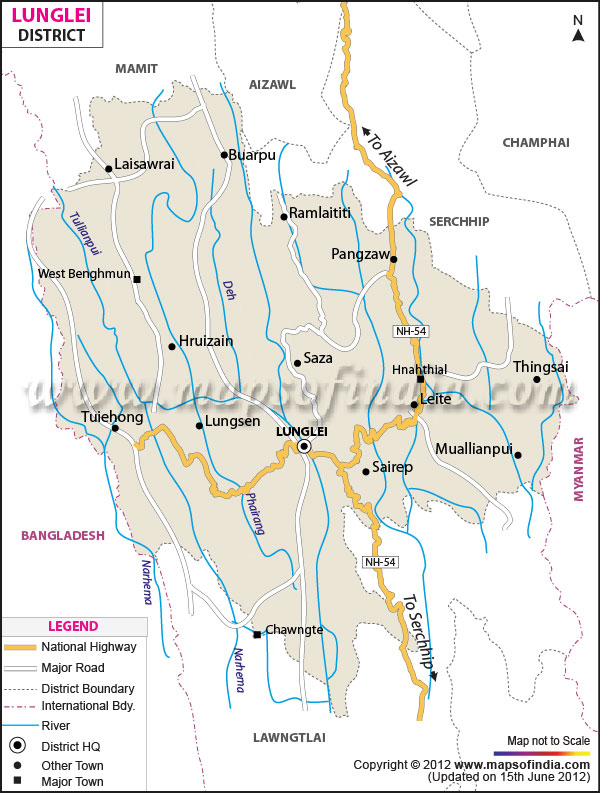
| *Lunglei District Map highlights the National Highways, Major Roads, District Headquarter, etc in Lunglei. |
About
Lunglei District is one of the districts in southern Mizoram. The district is named after its headquarters town called Lunglei, meaning "bridge of rock", after a natural stone bridge in the district, as well as the district's dramatic topography and its historical importance as a crossing point for the north and south of the state of Mizoram. Lunglei town is Mizoram's second-largest town, after Aizawl, the main administrative, educational, and cultural hub for southern Mizoram.
Lunglei district is located some 235km south of the state capital Aizawl and is well connected by road, the Tlabung sub-division being an important and emerging trading centre on the international border with Bangladesh. The topography of the district is largely hilly and undulating of the southern part of Mizoram, with several river valleys, and is also strategically located between Aizawl in the north to Lawngtlai and Saiha in the south.
The Hnahthial sub-division was separated from Lunglei district in 2019 to form the new district of Hnahthial and Lunglei now has a smaller but still significant area and despite this reorganization, Lunglei continues to be one of the most important and historical districts of the state, as it has cultural institutions, a missionary heritage and is the gateway to the southern frontier of Mizoram.
History & Culture
Lunglei is a special place in the religious and cultural history of Mizoram because of its one of the earliest Christian mission stations in the southern part of the state. The early twentieth-century mission work in Lunglei had an important influence on the religious, educational and social life of the district — and indeed much of southern Mizoram — and this impact is still very much felt in the churches, schools and social institutions still in existence today.
Saikuti Hall is an icon of the Mizo cultural landscape, a place of cultural significance in the town of Lunglei that is the site of many community gatherings, public events and concerts, and is also a museum where the local artists display traditional Mizo arts, crafts and historical artefacts. This Hall continues to be one of the main spaces where music, dance, oratory and communal celebration are still expressed and transmitted to younger groups in Lunglei.
Mualchung village is one of the most remarkable cultural heritage sites of the district with a rare stone image of Buddha possessing elaborate ornamentation of dancing girls on its side which is an archaeological and artistic treasure and traces the historical, cultural and trade relations of the hills of Mizoram with other Buddhist countries of Southeast Asia, which took place before even the spread of Christianity in the region.
The villages, e.g., Tlabung and Sazaang, which are in close proximity to the border of Bangladesh, have retained a more traditional Mizo lifestyle, in contrast to the more urbanised lifestyle of the town of Lunglei itself. Like many other communities in Mizoram, community identity in Lunglei is very much tied to Christian belief, church-based social activity and traditional Mizo values of hospitality and communal interaction (tlawmngaihna), with a particular focus on sport and youth development as seen in the Zobawk Sports Academy.
Economy
The economy of Lunglei is mixed, with government services, border trade and agriculture and it is the administrative and commercial centre of the southern part of Mizoram.
Lunglei town is the headquarters of the district and one of the most significant administrative centres of the state of Mizoram, hence, the Deputy Commissioner's office and a number of State Government Departments are located in the town. The government sector is a significant contributor to the formal sector of the economy, especially as Lunglei is a regional administrative and educational hub serving a significantly larger population from the surrounding districts.
Public Sector: Public investment in the district has been targeted towards strengthening its road connectivity, with Lunglei being located on an important highway corridor connecting the state to Aizawl, as well as towards developing the Tlabung border trading point on the Bangladesh border as part of Mizoram's road connectivity and border-trade expansion programmes. The public sector institutions, such as banks and educational institutions, are all in Lunglei town, reinforcing its status as a regional service centre.
Services Sector: The services sector is well developed in the town, which includes trade, transport, health and education services, which provides services to people not only in the town's district but also to neighbouring district of Hnahthial, Lawngtlai and Saïha. The Tlabung sub-division serves as a new trading hub for cross-border trade with Bangladesh, thereby enhancing the trade aspect of the district's service economy.
In addition to these activities, agriculture is still the main occupation of the people of Lunglei, and jhum (shifting) cultivation and settled farming of food crops such as rice is practised widely in the district's hill villages. Other economic activities, such as horticulture and forestry, also make a significant contribution to household incomes, especially in the more remote blocks of the district, outside of Lunglei town.
Tourism
Lunglei is one of the major Tourist hubs in the southern part of Mizoram, which has a mix of cultural heritage, animal sanctuaries, border trade and village life.
Saikuti Hall — A significant cultural landmark in Lunglei town, hosting concerts and community events, and home to a museum showcasing local art and artefacts.
Unique archaeological site in the district: the famous Mualchung village, with the image of the Buddha carved into a stone, which is rare. Tawi Wildlife sanctuary — A natural sanctuary that allows visitors to get away from the town into nature.
Tlabung — A frontier town and a growing trading hub on the Bangladesh border, boasting a unique perspective on frontier life and cross-border trade.
Sazaang Village is another village to visit where one can have a more authentic Mizo experience and engage with the local people, together with Tlabung.
Chawngchilhi Puk – a cave, which is linked with local folklore and legend, along the Lunglei–Thenzawl road.
Lunglei Town — The district headquarters itself is an interesting place to explore that also boasts several churches, markets, educational institutes and is the second largest city in Mizoram.
Zobawk Sports Academy — An impressive sports training academy that showcases the district's dedication to sports development, a significant aspect of sport in Mizoram, of interest to visitors.
Demographics
The 2011 Census of India conducted prior to the creation of Hnahthial district from part of the original district of Lunglei counted a population of Lunglei of 161,428 people, consisting of 82,891 males, 78,537 females and 33,058 households. This was an increase of 17.64% compared with the population of 137,223 in 2001. It had a sex ratio of 947 females per 1000 males instead of 982 to 1000 and a population density of 36 persons per sq. km., one of the more balanced sex ratio and population density in the district of Mizoram.
Lunglei is one of the better districts in the state with an overall literacy rate of 88.86% as per 2011 Census, and has been and continues to be an educational and missionary hub of southern Mizoram. As for rural-urban distribution, 57.41% of the population (92,676 persons) were in rural areas, with a significant 42.59% (68,752 persons) in urban areas, which is a relatively high urban proportion compared to other states, due to the high population of Lunglei town, the second largest urban centre in Mizoram. The number of children in the district (aged 0-6) was 25,117, which accounted for approximately 15.56% of the district's total population.
Linguistically, the district was somewhat homogenous, with 66.48% of the population reporting Mizo as their first language in the 2011 Census with the remaining portion speaking other languages which are linked to minority communities in various parts of the district. The population of Lunglei district in 2019, which included the residual population after Hnahthial was created, was 132,960 persons of which 61,565 (46.30%) were urban dwellers highlighting the continued dominance of Lunglei town, even in the face of its geographic reduction.
Administration
According to the undivided district, the administrative system of Lunglei district is as follows:
Undivided District: There were 4 RD Blocks in the district: Bunghmun (West Bunghmun), Hnahthial, Lunglei and Lungsen. The Hnahthial block was transferred to the new district of Hnahthial in the year 2019.
Administratively and for revenue collection purposes, the undivided district was subdivided into South Tuipui, Lunglei North, Lunglei East, Lunglei West, Lunglei South, Thorang and West Tuipui.
There are 195 villages (161 of which are inhabited) in the undivided district as per the Census 2011; other administrative sources list 4 subdivisions of the district with a total of 131 villages.
There were 3 towns in the undivided district, Lunglei being the district headquarters and the second largest town in Mizoram.
Legislative Constituencies: Lunglei is part of one Mizoram Lok Sabha constituency, whereas the undivided district has 7 Vidhan Sabha (state assembly) constituencies.
This administrative set-up, based on an existing local governance system in Mizoram, which is based on RD blocks and revenue subdivisions, has enabled Lunglei to serve as the key administrative centre for the entire southern part of the State, while newer districts were established to provide better governance to outlying communities.
| Facts of Lunglei District | |
|---|---|
| State | Mizoram |
| Population | 161428 |
| Area | 4536 sq. km |
| Language | Mizo |
FAQs
Q1: How many villages are there in Lunglei district?
According to the 2011 Census, there are 195 villages in total in the undivided Lunglei district, out of which 161 villages were inhabited, while other sources mention 131 villages spread across four subdivisions of Lunglei district.
Q2: How many people live in Lunglei district?
According to the 2011 Census, Lunglei district was home to 161,428 people, which was the undivided district. The remaining, diminished Lunglei district had 132,960 population after Hnahthial district was created in 2019.
Q3: What is the headquarters of Lunglei district?
Aizawl, the State capital, is about 235 km north of Lunglei town which is the district capital.
Q4: How did "Lunglei" get its name?
The name “Lunglei” means “bridge of rock”, which is a natural rock formation that looks like a bridge in the region.
Q5: What percent of the people in the Lunglei district are literate?
According to the 2011 Census, the undivided Lunglei district's literacy rate is 88.86% which is one of the highest literacy rates among the districts of the state of Mizoram.
Q6: What is the ratio of males to females in Lungei district?
As per the 2011 Census, the sex ratio of the undivided Lunglei district was 947 females per 1,000 males.
Q7: What are the district's languages in Lunglei?
Apart from the Mizo language, which is the main language spoken by 66.48% of the population as their main language as per the 2011 Census, there are languages spoken by minority communities.
Q8: What is the total area of Lunglei district?
The total area of Lunglei district was roughly 4,536-4,538 square kilometres; however, this area has reduced as a result of the establishment of Hnahthial district in 2019.
Q9: What are the tourist sites in Lunglei district?
The top places to see are Saikuti Hall, the Buddha image at Mualchung village, Tawi Wildlife, the border town of Tlabung and the traditional village of Sazaang.
Last Updated on : November 17, 2026
