




Introduction
Here, Jalandhar is characterized by the life of a city. Vibrancy and excitement with living current display history and culture entwined with modernity. Jalandhar, dating back from Vedic age as Prasthala to the capital of the Trigarta Kingdom, has been seen at the forefront in deciding the destiny of the region. This along the historic Grand Trunk Road has melted diverse influences into one another to create a new peculiar blend of traditions and customs.
At present, Jalandhar is a matchless industrial city that has diversified into a manufacturing center for sports goods exported to all corners of the world. That is why it is rightly nicknamed "Sports City of India," considering its enthusiastic entrepreneurship and resourceful labor force. Jalandhar is even an educational city where students from hither and thither come to study. There are many colleges and universities offering programs from across all disciplines to produce future leaders and innovators. Hence, this signifies advancement in Punjab through the educational and innovative approach of this city.
Jalandhar is enriched with culture as its history is colorful, and it beautifully displays Hindu, Sikh, and Muslim traditions with many shrines in the city-from Devi Talab Mandir to the calm Gurdwara Chhevin Patshahi. This also reflects the vibrant festivals of Jalandhar from the Harballabh Sangeet Sammelan to others, which are the institutions of arts, culture, and expression of the city. The variety is as much as in food: with few names, dozens of Punjabi specialties to the delight of any taste, for Makki Di Roti and Sarson Da Saag speak of the produce of the region and ingenuity in its preparation, while the Amritsari Kulcha is sure to entice.
History
The pasts of Jalandhar sink into fathomless depths, as an eloquent record in ancient writings such as the Mahabharata describes it as Prasthala. It is believed that legends connect the city with Jalandhara, the mythical being after which the city is said to have derived its name. Ancient Indian literature records form part of the early territory of the Trigarta Kingdom, further knitting it to the historical tapestry of the subcontinent. Archaeological evidence tells of the everlasting past of human existence in the region for millennia, thus unlocking windows into the lives of the early occupants and the development of their culture. 34 Conversion through early trading routes earned the city in very early youth and found it in competition formed of competing cultural influences.
Through its history sprawled over ages, the empires ushered into their time and faded away as they have come. From the beginning of the Mauryas to the supremacy of the Guptas, each dynasty left its echoes in the cultural and administrative spheres of the city. The fertile plains of this region seem to have made the history of Jalandhar a precious jewel which was quarrelled too many times in the tussle of powers. During the medieval times, Jalandhar acting as a very important center under numerous sultanates and empires, especially the Delhi Sultanate and Mughal Empire, watched the art, architecture, and trade thrive adding to the cosmopolitan culture of the city.
The fact that Sikh history stands out as a clear event in the history of Jalandhar is of great importance. Sikhism also came through Jalandhar, which again takes it close to the birthplace of Guru Nanak Dev Ji, who founded Sikhism. Under Maharaja Ranjit Singh's rule, Jalandhar became a Sikh province and enjoyed much peace and progress. The strategic significance of Jalandhar persisted, being a pivotal part in making firm the power of the Sikh kingdom and furthering that power. Gurdwaras all over the city are the hallmarks of this chapter, always echoing the Sikh culture.
The British were to take Jalandhar and change the city completely. The city became a center of administration and military operations by the British, making it an important runway of infrastructural developments in continuation of their rule. With educational institutions being established and modernization creeping in, the lives of the people of Jalandhar underwent a lot of change. Several Jalandharites had instrumental roles to play in the Indian independence struggle. 1947 saw Jalandhar being made part of the newly formed Punjab after India gained independence. It has developed categories into avenues industrious and educational.
The culture of Jalandhar is an ebullient mixture with history, religion, and customs. The most of it is settled by Sikhs, while the cultural influences that flow from all over the world into a Hindu surface are principles such as poonji, sewa, and bhakti. That is exhibited in the many gurdwaras spread out all over the city, mostly acting as sites for worship, also to bring groups to fellowship.
But Jalandhar is also a beautiful blend of a plethora of religions, with temples and churches standing side by side with the mosques, preserving the inclusiveness that has always been a hallmark of the city. A diverse array of religions further creates an atmosphere of belonging and having something in common, enriching the culture of Jalandhar.
Punjabi hospitality is another unique dimension of Jalandhar culture, where people are known for their warmth and generosity. Visitors are thus, very often welcomed into their homes and feasted upon with the delectable food items of the region. Food is at the heart of the culture of Jalandhar, which is richly based on agricultural heritage and bold flavors. From the classic Makki Di Roti and Sarson Da Saag to mouth-watering Amritsari Kulcha, food in Jalandhar is indeed a festivity of culinary art. The aroma of spices, mingled with the sounds of gaiety jubilant patrons, echoes all over the bustling markets capturing the whole of culture experience.
Jalandhar's cultural landscape really disseminates into a fairly robust art scene. The music and dance in celebration and festivals bring to the threads of gathering-the Bhangra to stir up spirits and Giddha to add a traditional spirit and lively colors to the revelry. It's such names as the Harballabh Sangeet Sammelan - India's one of the oldest classical music festivals - that speak volumes of the city's effort to keep alive the musical heritage it boasts. The creative ethos of Jalandhar is reflected through the craft too-involving Phulkari embroidery and other forms of traditional Punjabi apparel. The museums and art galleries of the city discover the rich artistic traditions of Jalandhar and are a stage for showcasing that talent while at the same time preserving the cultural heritage of this region for the future.
Language
Just like any other place in Punjab, Punjabi, an Indo-Aryan language, claims indigenous literature spanning centuries of development, and it is a language of active cultural significance. This is the gharat from the Gurmukh script developed specifically for this language, reflecting in its connection to the Sikh faith. Besides Gurmukhi, Punjabi is also written in the Shahmukhi script, its application found to a minor extent in Pakistan. The language is known for its expressiveness, rhythmic flow, and generous amount of colorful proverbs and idioms flowing from various dialects to further nuance one's talk. The narrative of Punjabi doesn't bind to verbal communication; it speaks up that music and poetry have a leading role as the chief vehicle through which to transmit and carry forth the cultural heritage of the area through storytelling. This language holds the imagery and strength of the Punjabi people, links them to their past, and nurtures a strong sense of cultural identity. High on Punjabi usage, one could see the marks of other languages such as Hindi or English in the urban and formal sections like education and business. Such bilingualism is said to define the cosmopolitan character of the city and its reach to the world beyond.
Geography
Jalandhar stands among the fertile plains of the Doab geographical area between the two rivers- Sutlej and Beas within the state of Punjab- India. Hence, it adds to very fertile soils and makes the region agriculturally a prosperous area. The complete flat alluvial planes yield to a fast harvest of crops like wheat, rice, sugarcane, and vegetables, which feed into Punjab's becoming the 'breadbasket of India'. It was also appropriate for the rich supply of these rivers and canals for the agricultural productivity of the area and almost supported the rural population and economy in this region.
From the days of yore, the geography of the Jalandhar district contributed heavily to its history, and since then, the Doab has been the gateway for some of the ancient civilizations and the impending clashing of arms to extinguish them. Through the ages, Jalandhar witnessed the rise and fall of empires, each trying to stake a claim to this promising region. Armies could then move across this barely undulating land, already extra easy across this trodden trail, while the rivers also acted as natural checks to marching back at times. This heightened conjunction between geography and history forged cultural landscapes in the area and carried it forward through centuries.
The climate of Jalandhar is semi-arid subtropical monsoon in nature. Thus it passes through the changing symptoms of seasons, like a hot summer, then moderate rainfall of the monsoons, and cooler winter months. Most temperature marks occur during the months of April, May, and June, when summer rises up to over 40 degrees Celsius in July, and September brings gentle relief from the monsoon rain and humidity. Winter, on the other end, from November to February, is the season of good times for denizens in Jalandhar, with temperatures sometimes sinking below 10 degrees. And this seasonal variation left a very deep effect on agricultural cycle and even on Jalandharites.
Primarily, Jalandhar means fertile plains; however, there exist some variations in topography here. By and large flat, a few undulations or telltale signs of slightly higher altitude show their presence somewhere. The rivers and their tributaries create some areas that are floodplains and low spots that are subject to some temporary flooding during the monsoon times.
| Facts of Jalandhar District | |
|---|---|
| Location | Punjab, India, within the Doab region (between the Sutlej and Beas rivers) |
| Historical Names | Prasthala (ancient), Jalandhar (legendary) |
| History | Ancient city with mentions in the Mahabharata; part of Trigarta Kingdom; witnessed rule of Mauryans, Guptas, Delhi Sultanate, Mughals, Sikhs, and British; played role in Indian independence movement. |
| Culture | Blend of Sikh, Hindu, and Muslim traditions; known for Punjabi hospitality, cuisine, music (Harballabh Sangeet Sammelan), dance (Bhangra, Giddha), and handicrafts (Phulkari). |
| Language | Punjabi (primary), also Hindi and English spoken. Punjabi written in Gurmukhi script. |
| Geography | Fertile alluvial plains of the Doab region; flat terrain with some undulations; semi-arid subtropical monsoon climate with distinct seasons. |
| Economy | Industrial center (especially sports goods); agricultural hub; educational center. |
| Significance | Historically important city; major industrial and educational hub of Punjab; known as "Sports City of India". |
| Climate | Hot summers, monsoon season with moderate rainfall, and cool winters. |
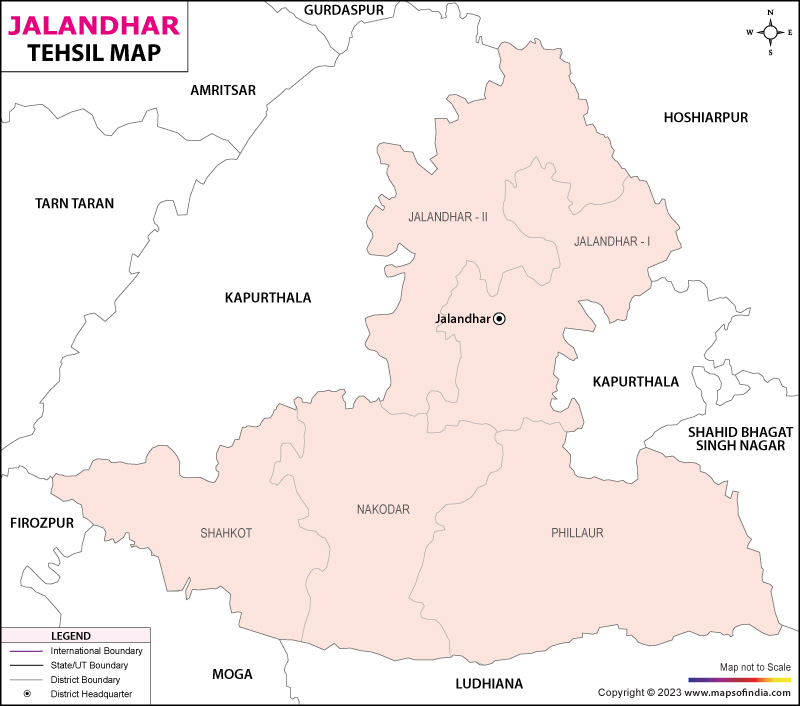
List of Tehsils in Jalandhar District | ||
|---|---|---|
| Tehsil/Taluk Name | Total (Rural + Urban) Population (2001) in Number | Pin Code |
| Jalandhar-I | 965,162 | 144001 |
| Jalandhar-II | 275,311 | N.A |
| Nakodar | 196,237 | 144040 |
| Phillaur | 367,307 | 144410 |
| Shahkot | 158,683 | N.A |
