

|
||||||||||
| ||||||||||
|





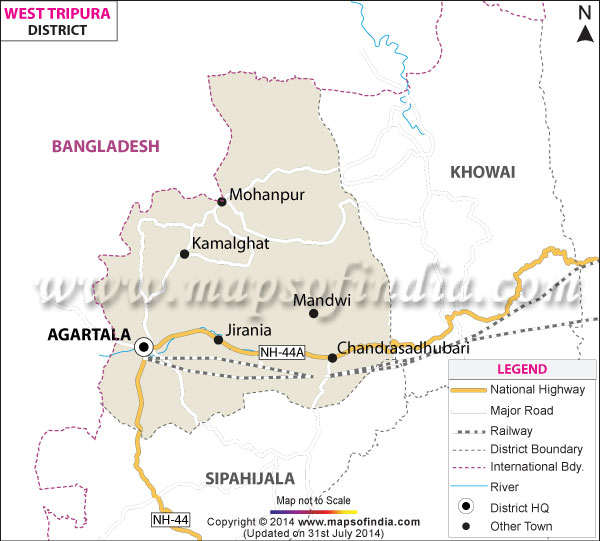
| *West Tripura District Map highlights the National Highways, Major Roads, District Headquarter, etc in West Tripura. |
West Tripura is an important region in the state of Tripura, with a rich history and culture. Agartala, the state capital, serves as the region's administrative and political hub. Tribal monarchs, royal dynasties, and, subsequently, modern administration all ruled over the area. West Tripura has a distinct combination of tribal customs and Bengali influence, as seen by its festivals, cuisine, and daily life. The region features lush plains, rivers, and hills that sustain agriculture and habitation. West Tripura has grown into a location where tradition and modernity coexist.
History
West Tripura is one of the most prominent regions in the Indian state of Tripura. Its lengthy history is intricately intertwined with that of the entire Tripura kingdom. West Tripura has undergone numerous transformations throughout the years, from tribal sovereignty in antiquity to royal dynasties and then contemporary governance.
The region that is presently West Tripura was formerly a part of the Tripuri empire. The Tripuri tribes governed this empire, particularly the Tiprasa people. The monarchs of Tripura dominated the area for centuries, according to regional myths and ancient writings like the Rajmala. These early kings lived near nature and forests, and their power was based on local clans and tribal chiefs.
The Manikya dynasty eventually became Tripura's principal ruling family. For about 500 years, the Manikya rulers ruled. While tribal traditions persisted, Hindu culture gradually expanded over the area during their control.
Religious celebrations spread, and temples were constructed. The kingdom's former capital was Udaipur, but trade routes and fertile terrain made the western area far more important.
Agartala, in modern-day West Tripura, was the capital of the Tripura monarchy in the eighteenth century. Because Agartala was easier to protect and more centrally placed, King Krishna Manikya moved the capital there. West Tripura became the kingdom's political center as a result of this action. Around Agartala, palaces, governmental structures, and marketplaces started to expand.
Tripura remained a princely kingdom during the British era and was not under British direct rule. The rulers were forced to acknowledge British influence, nevertheless. Tripura's independence was diminished when it signed a pact with the East India Company in 1809.
The king was instructed by British commanders, and the modern government gradually took over. Postal systems, schools, and roads were established, primarily in and around Agartala. As a result, West Tripura began to become more urban than other regions.
Maharaja Bir Bikram Kishore Manikya was one of the most significant monarchs of contemporary times. He governed in the early twentieth century and had a significant impact on modern Tripura. He established appropriate urban planning and designed Agartala as a modern town.
Following India's independence in 1947, Tripura experienced an essential shift. Tripura formally joined the Indian Union in 1949. As a result, the Manikya dynasty came to an end. Tripura was first a Part C state and then a Union Territory following the merger. West Tripura remained at the heart of the government as Agartala remained the capital.
It was profoundly affected by India's division. The area became home to a sizable population of refugees from East Pakistan, which is now Bangladesh. The area's social life and population structure were altered as a result.
To make room for the migrants, new cities, villages, and marketplaces emerged. Local tribal people and outsiders occasionally clashed, but over time, a hybrid society emerged.
The district was officially established after Tripura became a full state in 1972. The district, which includes Agartala and its neighboring territories, became the state's most developed region. Later, in 2012, Khowai district was separated from West Tripura, reducing its size. Nonetheless, West Tripura retains political and economic importance.
West Tripura reveals layers of its past. Old royal buildings coexist with modern offices. Tribal traditions exist alongside Bengali culture. The region's history is about more than just monarchs and rulers; it is also about ordinary people who adapted to change time and again. West Tripura is a one-of-a-kind area with a rich and vibrant history.
Culture
West Tripura's culture is diverse, colorful, and heavily influenced by tribal customs as well as Bengali influence. This region is like a crossroads of numerous villages, where traditional customs and contemporary life coexist. Sharing, adapting, and everyday life have all contributed to the development of this culture over time.
West Tripura has a large tribal population, particularly the Tripuri people, also known as Tiprasa. Their traditions are the foundation of the region's culture. Music, dancing, and community festivals play an important role in their lives.
One of the most prominent tribal dances is the Hojagiri, which is mostly performed by women. It is lovely and performed throughout the harvest season. Songs are typically about nature, everyday life, and local tales. Many instruments are handcrafted from bamboo and wood.
Bengali culture, like tribal culture, has had a significant impact on West Tripura. This impact grew when a huge number of Bengalis settled in the region, particularly following Partition. Bengali language, food, literature, and festivals are now an important part of daily life in Agartala and the surrounding areas. Durga Puja is celebrated with great zeal, and the city comes alive during the holiday. Kali Puja, Saraswati Puja, and Poila Boishakh are also frequently celebrated.
The food culture of West Tripura reflects its diverse people. Tribal diet is basic, consisting primarily of rice, vegetables, fish, and fermented things. Tribal households frequently eat dishes such as mui borok (fermented fish). Rice, dal, fish curry, and desserts such as rasgulla and sandesh are all traditional Bengali cuisines.
Traditional attire also reflects the region's cultural diversity. Tribal women typically wear rignai and risa, which are handmade garments with vibrant designs. Men wear simple fabric wraps and shirts. Bengali ladies wear sarees, particularly during festivals, and men wear dhotis or contemporary attire. Many households continue to perform handloom weaving, with designs passed down from generation to generation.
Religion is essential to West Tripura's cultural life. Hinduism is extensively practiced, yet indigenous beliefs are still treated with respect. Many tribes revere natural spirits and ancestors. There are also Buddhist and Christian communities, which increase variety. Festivals of many religions are frequently celebrated jointly, giving a sense of shared existence.
Tradition and change coexist in West Tripura's daily existence. In villages, conventions are strictly followed, whereas in towns, people live more modern lives. Nonetheless, respect for elders, community cohesion, and festivals remain popular. Cultural activities, fairs, and community events keep traditions alive.
Language
West Tripura is a region with various languages spoken, demonstrating its diverse culture and history. Bengali is the most commonly spoken language locally. A considerable proportion of the population speaks Bengali on a daily basis, particularly in towns such as Agartala. It's used in classrooms, offices, marketplaces, and local media. Bengali gradually became the dominant language as a result of migration and long cultural contact with Bengal.
Kokborok, like Bengali, is an important language in West Tripura. The Tripuri tribal people speak Kokborok as their native language. It is predominantly spoken in villages and tribal areas, but it is now also heard in municipalities. The language has its own music, storytelling, and oral traditions. Kokborok was mostly taught orally in the past, but it is now written and taught in schools.
Another language utilized is English, mostly for government employment and education. Basic English is understood and spoken by many young individuals, particularly students. Many people also understand Hindi due to migration from other regions of India, television, and movies.
In daily life, individuals frequently talk in several languages. It is fairly normal to move between Bengali, Kokborok, Hindi, and English with ease. It demonstrates how locals coexist despite their disparate backgrounds.
Geography
West Tripura is situated near the Bangladeshi border in the western portion of the state of Tripura. There are rivers, forests, tiny hills, and plains in the area. The terrain is good for both agricultural and habitation due to its natural diversity. This district contains the state capital, Agartala, which is primarily flat in contrast to Tripura's hilly eastern regions.
Rivers like the Haora and the Manu compose the plains of West Tripura. These rivers aid in irrigation as they flow from the eastern highlands to the west. Many areas of the region have good soil as a result of these rivers. The primary crop farmed here is paddy. Fruits, vegetables, and legumes are grown alongside rice. There are bamboo groves and rubber plantations in certain places.
The district's periphery is primarily home to low hills and woodland sections. Tribal settlements and animals can be found in these places. Bamboo, firewood, and other forest products that sustain local life are produced by the woods. Even if the amount of forest cover has decreased over time, it is still vital to the area.
West Tripura has a mostly tropical climate. Summers are hot and muggy, with highs of above 30 degrees Celsius. From June to September, there is a lot of rain during the monsoon season. Although this rain is beneficial to agriculture, it can occasionally result in floods. Winters are pleasant and moderate, with lower humidity and milder evenings.
Q.1:What are the primary occupations of people in West Tripura?
Many people rely on agriculture, particularly rice cultivation. Others work in government, small business, education, and services. In cities, trade and office employment are popular sources of income.
Q.2:What holidays are held in West Tripura?
Durga Puja is the most popular celebration in West Tripura. In addition, tribal holidays, Kali Puja, Saraswati Puja, Christmas, and municipal fairs are also celebrated with community participation.
Q3: How does the climate in West Tripura affect daily life?
The environment is generally warm and humid. Summers might be scorching, but the winters are nice. Heavy monsoon rains benefit agriculture, but they can also cause issues such as waterlogging.
The district of West Tripura lies at a longitude of 91 degrees 09' east to 91 degrees 47' east and at a latitude of 23 degrees 16' to 24 degrees 14' north. Bordered by North Tripura in the east, by South Tripura in the south and Bangladesh in the north, the district of West Tripura covers a total area of 3544 square Kilometers. The capital of the state of Tripura, Agartala, is also the district headquarter of West Tripura. For administrative purposes, the district of West Tripura are divided into four sub divisions, Sonamura, Sadar, Bishalgarh, Khowai. These sub divisions are further divided into 16 separate blocks, they are:
The district of West Tripura is a beholder of spectacular natural beauty and is dotted with cascading rivers and picturesque mountains. The most prominent physical features of the district of West Tripura include:
Last Updated on : June 24, 2026
History
West Tripura is one of the most prominent regions in the Indian state of Tripura. Its lengthy history is intricately intertwined with that of the entire Tripura kingdom. West Tripura has undergone numerous transformations throughout the years, from tribal sovereignty in antiquity to royal dynasties and then contemporary governance.
The region that is presently West Tripura was formerly a part of the Tripuri empire. The Tripuri tribes governed this empire, particularly the Tiprasa people. The monarchs of Tripura dominated the area for centuries, according to regional myths and ancient writings like the Rajmala. These early kings lived near nature and forests, and their power was based on local clans and tribal chiefs.
The Manikya dynasty eventually became Tripura's principal ruling family. For about 500 years, the Manikya rulers ruled. While tribal traditions persisted, Hindu culture gradually expanded over the area during their control.
Religious celebrations spread, and temples were constructed. The kingdom's former capital was Udaipur, but trade routes and fertile terrain made the western area far more important.
Agartala, in modern-day West Tripura, was the capital of the Tripura monarchy in the eighteenth century. Because Agartala was easier to protect and more centrally placed, King Krishna Manikya moved the capital there. West Tripura became the kingdom's political center as a result of this action. Around Agartala, palaces, governmental structures, and marketplaces started to expand.
Tripura remained a princely kingdom during the British era and was not under British direct rule. The rulers were forced to acknowledge British influence, nevertheless. Tripura's independence was diminished when it signed a pact with the East India Company in 1809.
The king was instructed by British commanders, and the modern government gradually took over. Postal systems, schools, and roads were established, primarily in and around Agartala. As a result, West Tripura began to become more urban than other regions.
Maharaja Bir Bikram Kishore Manikya was one of the most significant monarchs of contemporary times. He governed in the early twentieth century and had a significant impact on modern Tripura. He established appropriate urban planning and designed Agartala as a modern town.
Following India's independence in 1947, Tripura experienced an essential shift. Tripura formally joined the Indian Union in 1949. As a result, the Manikya dynasty came to an end. Tripura was first a Part C state and then a Union Territory following the merger. West Tripura remained at the heart of the government as Agartala remained the capital.
It was profoundly affected by India's division. The area became home to a sizable population of refugees from East Pakistan, which is now Bangladesh. The area's social life and population structure were altered as a result.
To make room for the migrants, new cities, villages, and marketplaces emerged. Local tribal people and outsiders occasionally clashed, but over time, a hybrid society emerged.
The district was officially established after Tripura became a full state in 1972. The district, which includes Agartala and its neighboring territories, became the state's most developed region. Later, in 2012, Khowai district was separated from West Tripura, reducing its size. Nonetheless, West Tripura retains political and economic importance.
West Tripura reveals layers of its past. Old royal buildings coexist with modern offices. Tribal traditions exist alongside Bengali culture. The region's history is about more than just monarchs and rulers; it is also about ordinary people who adapted to change time and again. West Tripura is a one-of-a-kind area with a rich and vibrant history.
Culture
West Tripura's culture is diverse, colorful, and heavily influenced by tribal customs as well as Bengali influence. This region is like a crossroads of numerous villages, where traditional customs and contemporary life coexist. Sharing, adapting, and everyday life have all contributed to the development of this culture over time.
West Tripura has a large tribal population, particularly the Tripuri people, also known as Tiprasa. Their traditions are the foundation of the region's culture. Music, dancing, and community festivals play an important role in their lives.
One of the most prominent tribal dances is the Hojagiri, which is mostly performed by women. It is lovely and performed throughout the harvest season. Songs are typically about nature, everyday life, and local tales. Many instruments are handcrafted from bamboo and wood.
Bengali culture, like tribal culture, has had a significant impact on West Tripura. This impact grew when a huge number of Bengalis settled in the region, particularly following Partition. Bengali language, food, literature, and festivals are now an important part of daily life in Agartala and the surrounding areas. Durga Puja is celebrated with great zeal, and the city comes alive during the holiday. Kali Puja, Saraswati Puja, and Poila Boishakh are also frequently celebrated.
The food culture of West Tripura reflects its diverse people. Tribal diet is basic, consisting primarily of rice, vegetables, fish, and fermented things. Tribal households frequently eat dishes such as mui borok (fermented fish). Rice, dal, fish curry, and desserts such as rasgulla and sandesh are all traditional Bengali cuisines.
Traditional attire also reflects the region's cultural diversity. Tribal women typically wear rignai and risa, which are handmade garments with vibrant designs. Men wear simple fabric wraps and shirts. Bengali ladies wear sarees, particularly during festivals, and men wear dhotis or contemporary attire. Many households continue to perform handloom weaving, with designs passed down from generation to generation.
Religion is essential to West Tripura's cultural life. Hinduism is extensively practiced, yet indigenous beliefs are still treated with respect. Many tribes revere natural spirits and ancestors. There are also Buddhist and Christian communities, which increase variety. Festivals of many religions are frequently celebrated jointly, giving a sense of shared existence.
Tradition and change coexist in West Tripura's daily existence. In villages, conventions are strictly followed, whereas in towns, people live more modern lives. Nonetheless, respect for elders, community cohesion, and festivals remain popular. Cultural activities, fairs, and community events keep traditions alive.
Language
West Tripura is a region with various languages spoken, demonstrating its diverse culture and history. Bengali is the most commonly spoken language locally. A considerable proportion of the population speaks Bengali on a daily basis, particularly in towns such as Agartala. It's used in classrooms, offices, marketplaces, and local media. Bengali gradually became the dominant language as a result of migration and long cultural contact with Bengal.
Kokborok, like Bengali, is an important language in West Tripura. The Tripuri tribal people speak Kokborok as their native language. It is predominantly spoken in villages and tribal areas, but it is now also heard in municipalities. The language has its own music, storytelling, and oral traditions. Kokborok was mostly taught orally in the past, but it is now written and taught in schools.
Another language utilized is English, mostly for government employment and education. Basic English is understood and spoken by many young individuals, particularly students. Many people also understand Hindi due to migration from other regions of India, television, and movies.
In daily life, individuals frequently talk in several languages. It is fairly normal to move between Bengali, Kokborok, Hindi, and English with ease. It demonstrates how locals coexist despite their disparate backgrounds.
Geography
West Tripura is situated near the Bangladeshi border in the western portion of the state of Tripura. There are rivers, forests, tiny hills, and plains in the area. The terrain is good for both agricultural and habitation due to its natural diversity. This district contains the state capital, Agartala, which is primarily flat in contrast to Tripura's hilly eastern regions.
Rivers like the Haora and the Manu compose the plains of West Tripura. These rivers aid in irrigation as they flow from the eastern highlands to the west. Many areas of the region have good soil as a result of these rivers. The primary crop farmed here is paddy. Fruits, vegetables, and legumes are grown alongside rice. There are bamboo groves and rubber plantations in certain places.
The district's periphery is primarily home to low hills and woodland sections. Tribal settlements and animals can be found in these places. Bamboo, firewood, and other forest products that sustain local life are produced by the woods. Even if the amount of forest cover has decreased over time, it is still vital to the area.
West Tripura has a mostly tropical climate. Summers are hot and muggy, with highs of above 30 degrees Celsius. From June to September, there is a lot of rain during the monsoon season. Although this rain is beneficial to agriculture, it can occasionally result in floods. Winters are pleasant and moderate, with lower humidity and milder evenings.
| Particular | Details |
|---|---|
| Official Name | West Tripura |
| Location | Tripura, India |
| Area | 983.63 sq. km |
| Population | 918,200 |
| Language | Bengali, English, Kokborok |
FAQs
Q.1:What are the primary occupations of people in West Tripura?
Many people rely on agriculture, particularly rice cultivation. Others work in government, small business, education, and services. In cities, trade and office employment are popular sources of income.
Q.2:What holidays are held in West Tripura?
Durga Puja is the most popular celebration in West Tripura. In addition, tribal holidays, Kali Puja, Saraswati Puja, Christmas, and municipal fairs are also celebrated with community participation.
Q3: How does the climate in West Tripura affect daily life?
The environment is generally warm and humid. Summers might be scorching, but the winters are nice. Heavy monsoon rains benefit agriculture, but they can also cause issues such as waterlogging.
The district of West Tripura lies at a longitude of 91 degrees 09' east to 91 degrees 47' east and at a latitude of 23 degrees 16' to 24 degrees 14' north. Bordered by North Tripura in the east, by South Tripura in the south and Bangladesh in the north, the district of West Tripura covers a total area of 3544 square Kilometers. The capital of the state of Tripura, Agartala, is also the district headquarter of West Tripura. For administrative purposes, the district of West Tripura are divided into four sub divisions, Sonamura, Sadar, Bishalgarh, Khowai. These sub divisions are further divided into 16 separate blocks, they are:
- Khowai
- Padmabhil
- Mohanpur
- Kathalia
- Hezamara
- Jirania
- Tulashikar
- Teliamura
- Jampuijala
- Melaghar
- Kalyanpur
- Mungiakami
- Mandwi
- Bishalgarh
- Boxanagar
- Dukli
The district of West Tripura is a beholder of spectacular natural beauty and is dotted with cascading rivers and picturesque mountains. The most prominent physical features of the district of West Tripura include:
- River Howrah: Rising from the Baramura range this river in West Tripura has a number of tributaries including, Dhobatilachhara, Bangeswargang, Dowaigang, Ghoramara, Charupanadi and Debda.
- River Burigang: Even this river originates from the Baramura range and flows west into Bangladesh. The colossal alluvial deposit of this river creates a number of river valleys which are extremely fertile.
- River Gomati: Formed by the confluence of two rivulets, the Raimas and Sarma, the Gomati river is the principal river of West Tripura.
- The Atharamura Range: This range starts from the district of South Tripura and enters ther West Tripura district through the Khowai Sub-division. The Niungnanwra is the highest peak in the region.
- Baramura Deotomura Range: The Saisum Sib is the highest peak of this range and the Baramura Deotomura Range covers a distance of 47 kilometers in the district of West Tripura.
- MalanchaNiwas
- Neermahal
- Sepahijala
- Venuban Vihar
- Jagannath Temple
- Old Agartala
- State Museum
- Agartala
- Ujjayanta Palace
- Kunjaban Palace
- Kamalasagar
Last Updated on : June 24, 2026
District Map of Tripura
