

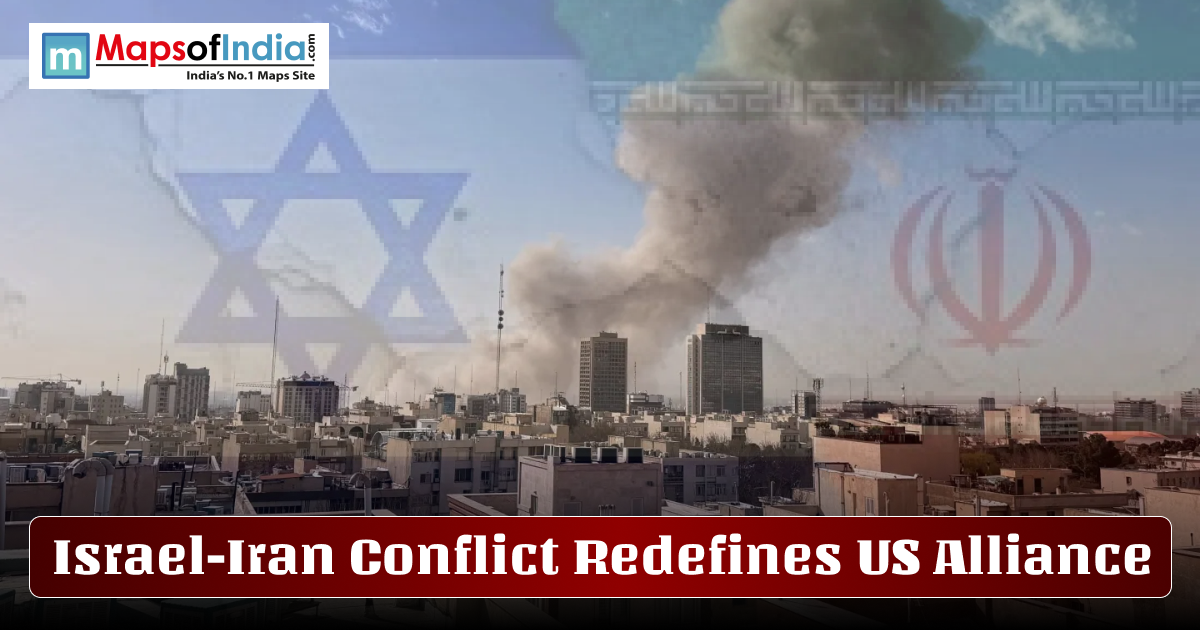
The ongoing standoff between Iran and Israel is no longer a regional hotspot within the Middle East. It has become a marking geopolitical moment that is not only changing the alliance strategy of the United States but is also putting its diplomatic integrity to the test, and as well compelling Washington to redefine its priorities internationally. What was seen as a shadow war of covert operations, cyberattacks, and proxy battles has now become more of a direct confrontation – drawing the United States further into the equation.
Not only is the future stability of the region at stake, but also the future forms of American alliances in a world that is becoming more and more multipolar.
A Longstanding Rivalry Turns Direct
Israel and Iran have been rivals at odds for decades, using indirect warfare. Israel has considered Iran as an existential threat due to its support of armed groups in Lebanon, Syria, Gaza, and Iraq. Meanwhile, Tehran has positioned Israel as a destabilizing faction, supported by Western powers. The tension has been fought mostly during the intelligence operations, airstrikes in Syria, and targeted actions to slow down the Iranian nuclear and missile programmes.
Nevertheless, recent upsurges have changed the balance. The art of proxy warfare has been superseded by direct attacks, bare threats, and military messages. With Israel making an effort to stem the military capabilities of Iran, America is in a precarious state of pushing the boundary between unwavering support of its closest ally in the Middle East and the overall impact of the war in the region.
The US–Israel Alliance Under a New Lens
Among the modern geopolitical alliances, the United States and Israel have one of the best bilateral relationships. The alliance is based on security cooperation, intelligence sharing and advanced defence collaboration, which has been termed as ironclad. Washington gives Israel military support, missile defense and political support at international forums.
However, the developing war with Iran has changed the ideals towards this alliance. The opponents believe that American aid is no longer viewed as in defense but more of a concerted strategic stance against Tehran. This perception matters. In geopolitics, action is sometimes less important than optics.
In the case of Washington, the dilemma is whether to keep deterrence, which is not seen to promote escalation. The closer the confrontation is to the United States, the more difficult it becomes to establish the United States as a stabilizing force as opposed to an active one.
Regional Reactions: Caution and Calculation
The Middle East is keeping a close eye. Gulf countries, most of which are in convoluted relations with the United States and Iran, are walking on the outside. Even though a few states are worried about the influence of Iran in the region, they also have the acute realization that a full-scale war would ruin energy markets, infrastructure and economic well-being.
Cases in point, Saudi Arabia and the United Arab Emirates have, over the last few years, sought diplomatic openings with Tehran despite the US security guarantees. The escalated war between Israel and Iran puts them into a strategic dilemma of either being outspoken and publicly siding with American alignment with Israel or undergoing low-profile de-escalation to foster their own interests.
Turkey, Iraq, and Qatar are not an exception as they have to strike a balance between diplomatic impartiality and regional realities. Any intensification will transform their territories into targets of counterattacks or proxy attacks.
The Nuclear Question and Strategic Pressure
The Iranian nuclear ambitions are also one of the underlying causes of this confrontation. Israel has always declared that it will not permit Iran to become a country with nuclear armaments. The United States, in the meantime, has been alternating between diplomacy and economic coercion.
The more the tension, the less room there is to achieve diplomacy. The war-waging body language has a way of strengthening moderate opinions and emboldening extremists on both ends. The Foreign threats in Iran tend to enhance the national demand to resist. In Israel, the issue behind the popular opinion is security, which supports ruthless action. In Washington, policymakers have to balance between the dangers of proliferation and the effects of military build-up.
This is a triangular pressure that is redefining the way alliances work. The United States needs to assure Israel, to discourage Iran, and to ensure a wider regional meltdown, a more complicated balancing act.
Domestic Opinion in the United States
The other crucial element that is reforming the alliance is the changed popular opinion in the United States itself. The politics of the Middle East are more polarized in American society than in the past several decades. The younger generations tend to doubt the established international obligations and prefer peaceful resolutions to armed engagements.
This does not imply that the US-Israel relationship is weakened, but it adds a twist to it. The upcoming administrations can become more conditional about the alliance commitments or insist on clearer strategic goals, and then direct confrontation.
In democratic regimes, foreign policy is affected by domestic opinion. In case of escalation, which might create long-term instability or disruption to the economy, pressure back home might modify the long-term model of regional relationships by Washington.
Global Power Competition
The challenge between Israel and Iran also happens to cross over to the global confrontations. Russia and China are monitoring developments with a keen interest, and both are aiming to increase their presence in the Middle East. The heavily harnessed United States would encounter strained bandwidth in its strategic managerial capabilities, particularly in the management of tensions in Eastern Europe and the Indo-Pacific.
China, especially, has enhanced economic relations throughout the Gulf and assumed a role of a diplomatic mediator in the reconciliation process of the region. Any feeling that the United States is creating instability would leave points of vulnerability to other power structures.
So, a conflict of the regional scope has a worldwide connotation. The American leadership and the strength of its alliance system are also questionable.
Redefining Alliance Politics
Historically, alliances were formed with a definite axis: the objectives of the common threat, the defense against rivals and long-term guarantees. Nowadays, lines are less angular. Allies expect help and yet tactical restraint. It is their aim to get security assurance and an independent foreign policy.
This change is highlighted by the Israel-Iran confrontation. The United States should replace its system of automatic alignment with that of calibrated engagement in its alliance model. That is to strengthen Israeli security and pursue off-ramps to wider war vigorously diplomatically.
Contemporary alliances are not fixed treaties anymore; they are dynamic partnerships that are influenced by economics, technologies, masses and shifting global powers..
The Road Ahead
The further development or stabilization of this conflict, based on backchannel negotiations, will define the extent of restructuring of US alliances. The existence of low confrontation can strengthen deterrence and build strategic alliances. However, wider war might shatter regional alliances, disrupt energy markets, and fuel world competitions.
Strategic clarity is the ultimate test for Washington. Is it able to defend its allies and still not be overstretched? Is it able to keep off enemies without shutting off diplomacy? And will it have international confidence in manoeuvring through national politics?
The war between Israel and Iran is a security crisis that has turned out to be more than that. It has become one of the landmark moments in American foreign policy -the one that can define the way of functioning of alliances in the world order that is fast changing.
With the situation still developing, the only thing that is evident is that the old US alliances in the Middle East are being rewritten on the fly.