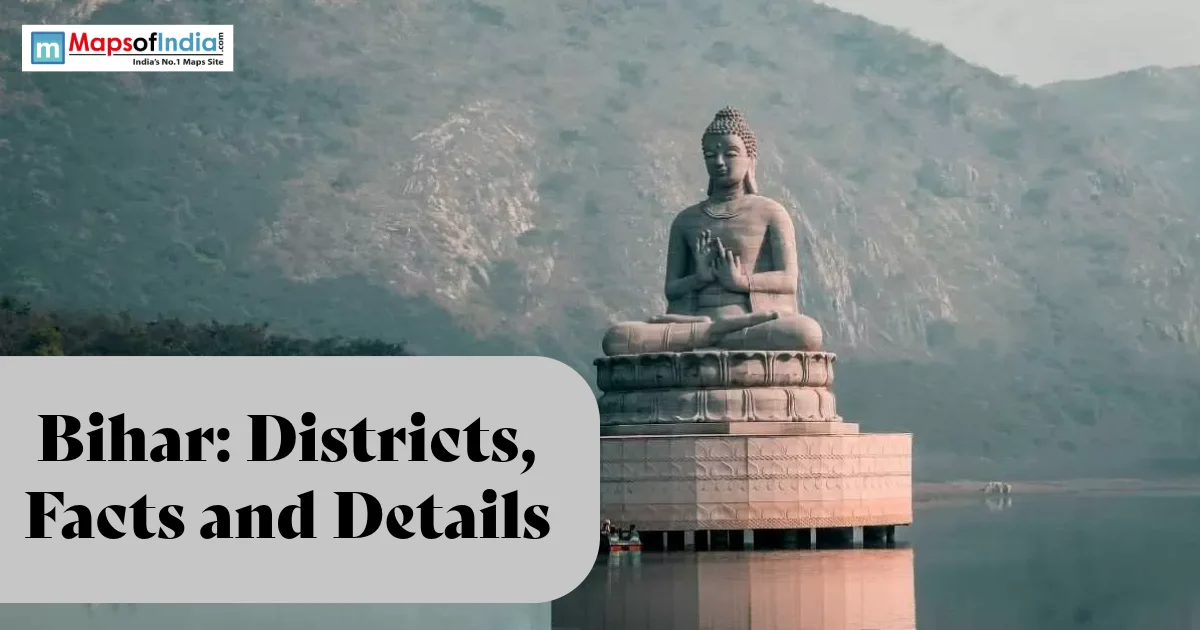
Bihar, one of the oldest inhabited areas of India, is a land of history, spirituality and resilience. It is in the eastern part of the country where the ancient empires, important religions and great learning centres have all been born. The spiritual banks of the Ganga and the relics of ancient Universities are all part of the rich heritage of Bihar, and its potential is immense. You will find a state that is shaping Indian civilization and is still evolving, with strong cultural roots. Here’s a complete look at Bihar: Districts, Facts and Details.
Geography and Location
Bihar is an eastern state in a flattish geographical area, where there is enough water from rivers for irrigation. Uttar Pradesh, Jharkhand, West Bengal, and, on the other side, Nepal follow it. Cutting right through the very strong current of the Ganga River. Down there, that's the silt that feeds rich ground where crops grow. The seasons here are well marked with warm weather and regular rain. To the north, land becomes hilly, approaching the mountains. Old rock edges creep in down south, from the Chota Nagpur highlands. Here, floods form the land, but thick crops grow over the land. Life springs from the ancient waters of the eastern plains where the Ganga flows.
Historical Significance
Bihar has contributed significantly to the history of the Indian states. Ashoka made it the centre for his large empire, and it seemed to echo that power under Gupta rule. From this point, two great religions developed, Buddhism and Jainism. Schools were not only located at Nalanda or Vikramshila, but they also attracted thinkers from far away. Explore places associated with Lord Buddha and Mahavira, which are centuries old. Imagine a country where kings once established kingdoms, and religions started to make history.
Patna District: The Capital
Patna is on the banks of the Ganga, a city that has never slept for thousands of years. Here is the rhythm of day and night in Bihar every day through the offices, the markets, the shops. Known places include the sacred Patna Sahib Gurudwara, the quiet dome of Golghar and the halls of time at the Patna Museum. Old roots entangle with new roads, slow rises of new buildings. Much like a pulse that recalls the old echoes and moves forward.
Gaya District: Land of Enlightenment
Gaya district attracts people from all over, in fact, because it has been of great importance to the Buddhists. Here, under an old tree, now under the protection of UNESCO, the Buddha awakened. People in huge numbers come to the Mahabodhi Temple every year, for no specific reason. Hindus also venerate this. Particularly at the Vishnupad on the riverbank. Here, it's easy to find quiet moments, like the air remembering a thousand years of stillness.
Bhagalpur District: Famous for Silk
Bhagalpur is considered to be the “Silk City” of India, known for silk threads. The calm of the Ganga's banks keeps swaying the life there. Vikramshila is a place of old stones, which tell stories that are buried in time. At dawn, steps on the riverbanks light up, witnesses to centuries of time. Weaving shapes days and seasons, and shapes lives here. A tradition of hands passes, and fabric is produced. Trade sneaks in softly, trudges along with the patience of the slowest of horses. Crafts are not celebrated; they are survived. Each Saree has some knots of memory and patterns that are passed on without any words.
Muzaffarpur: Home to Lychees
Bursting with sweet fruit fame, Muzaffarpur is India's Lychee Capital. Its crop is one of the highest quality of all crops in the world. This is the strength of North Bihar's agricultural production and trade. In the place where the villagers live, the city's advancement languishes. This was a scene of the struggle for independence some time ago. Honey flows from the busy bees, and Bihar's backbone agriculture does the same into the laps of farmers.
Nalanda District: Home of Old Learning
The old stones of Nalanda University, once covered with scholars' excitement from far-flung lands, lie scattered in quiet fields. The place has been named a UNESCO World Heritage Site today, and the ideas continue to pass through the classrooms. Here, broken walls and forgotten foundations tell quieter tales of the past, scattered across the land. History is close by, in the ground and under the trees, some old, some new, minds that have gone and thought and written. Time seemed to stand still to allow for wisdom to dwell.
Culture and Festivals
Bihar is a culture that has rhythm and roots, with bathing in the light of the morning. It is the time of devotion in the midst of the Chhath Puja, celebrated by millions of people around. Much more than a prayer mela, the Sonepur mela attracts visitors for the large herd of cattle in Asia, which is the largest in the world. The Bhojpuri spirit is alive in the villages, with folk songs echoing the sound. Handmade crafts abound: Handmade hands create them. Here, the doors are open for you, and you’ll be welcome in their home in no time at all. A location where the old traditions are followed, one by one, through the seasons. The celebrations spill onto the streets, uniting neighbours with neighbours in a rhythm. Culture can't be put behind glass; it flows in the lives of people.
Economy and Agriculture
Agriculture is the major contributor to Bihar's economy. The state has significant rice, maize, sugarcane and fruit production. The infrastructure development, such as roads, electric power generation, schools, etc., is quite apparent today. As recently as a few years ago, the sites of construction were once again sites devoid of buildings. Slow changes have planted deep roots that still remain securely in the ground, and the branches grow year after year.
Why Bihar Stands Out?
Bihar is the focus of attention here because it is the birthplace of ideas and faiths that contributed to the shaping of modern India. It was once the home of grand centres of learning and of mighty kingdoms, and is now the heart of paths for both the Buddhist and the Jain. Today, youth below thirty are pushing forward with goals, with methods they were handed down by those who have gone before. It's an area that's emerged after centuries, and is strong without being loud.
FAQs
1. How many districts are there in Bihar?
Bihar has 38 districts, grouped into 9 administrative divisions. Each district has its own administrative headquarters and unique cultural and historical significance.
2. What is Bihar famous for?
Bihar is famous for its rich history, ancient universities like Nalanda, Buddhist pilgrimage sites such as Bodh Gaya and Patna Sahib, silk production in Bhagalpur, and the grand celebration of Chhath Puja.
3. Which is the capital city of Bihar?
Patna is the capital of Bihar. Located on the banks of the Ganga River, it is one of India's oldest continuously inhabited cities and serves as the state's political, cultural, and economic centre.
4. Why is Bihar important in Indian history?
Bihar was the centre of the Maurya and Gupta Empires and the birthplace of Buddhism and Jainism. It was also home to the ancient Nalanda and Vikramshila universities, renowned centres of learning.
5. What are the major tourist attractions in Bihar?
Some of Bihar's top tourist destinations include Mahabodhi Temple (Bodh Gaya), Nalanda University Ruins, Patna Sahib Gurudwara, Golghar, Vikramshila Ruins, and Vishnupad Temple in Gaya.
6. Which rivers flow through Bihar?
The Ganga River is the principal river of Bihar. Other important rivers include the Kosi, Gandak, Son, Bagmati, Punpun, Falgu, and Mahananda, which support agriculture, irrigation, and livelihoods across the state.
7. Which is the best time to visit Bihar?
The best time to visit Bihar is from October to March, when the weather is cool and pleasant for sightseeing. This period is also ideal for experiencing festivals like Chhath Puja and visiting popular destinations such as Bodh Gaya, Nalanda, Patna, and Rajgir.