|
||||||||||
| ||||||||||
|





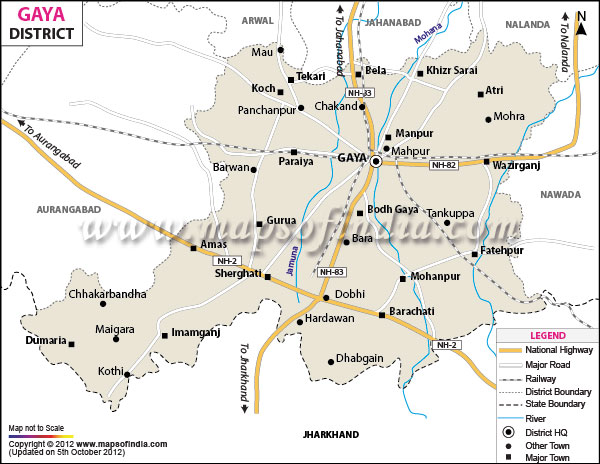
| *Gaya District Map highlights the National Highways, Major Roads, District Headquarter, etc. |
About
Gaya district is a region of the state that is historically and culturally one of the most important in the south of Bihar. It is located on the banks of Phalgu River and is encircled by small rocky hills, thus having a different landscape as compared to the plains in the north. The district is an area of great religious significance both regarding Hinduism and Buddhism.
History and Culture
Gaya district, in south Bihar has a long, stratified history that extends back to ancient times and thus forms one of the most historically important areas in the eastern part of India. The region was a part of the great kingdom of Magadha in antiquity and the central point of the great empires of the Mauryas and the Guptas. It was not just significant politically, but also depply religious and philosophical in nature and it influenced key events in Indian thought.
However, among the earliest historical associations of the region are its early Hindu traditions, as it became a holy place where the ancestors could perform religious rites. Sites of its ritual significance are present in ancient literature, which means that it was very common long before the existence of structured empires. Even more recognition of the region came during the Mauryan period, particularly when the Mauryan Emperor Ashoka was in power, as it was also identified with Buddhism. Close to Bodh Gaya was the land where Siddhartha Gautama received enlightenment which was pivotal to make the region one of the major pilgrimage sites in the Buddhist world. Mahabodhi Temple complex and other monuments were built, which became a turning point in its historical path.
The presence of archaeological evidence in and around the district (like the Barabar Caves) indicates a highly developed craftsmanship and religious patronage in the Mauryan period. They are also one of the oldest extant examples of this type of architecture in India and were occupied by ascetic communities. Throughout the centuries, the area remained under the impact of the next dynasties with the Guptas being the most successful in developing art, culture and education.
Islamic rule came into the picture during the medieval era bringing new aspects of culture, administration systems and architecture. With the change of political dominance over time, the district did not lose its character of a religious and cultural center. During the reign of the British colonialists, it entered the Bengal Presidency and then the state of Bihar, where the administrative system was reorganised and underwent socio-economic transformation processes.
The area is covered with a cultural fabric that is very diverse and rich in religious traditions, rituals and daily practices. It is particularly associated with ancient worship practices with thousands of pilgrims coming to visit it every year. Vishnupad Temple is also a key location of such rituals; families conduct rituals there, commemorating their ancestors. This practice remains an important aspect of showing how beliefs are carried on between generations.
Festivals are held with religious zeal mainly focused on temples and banks of rivers. Traditional music, folk practices, and local crafts also form an integral part of cultural life.
The food in the area represents the culinary heritage of Bihar, focusing on simplicity and using the products that are produced locally. Social life is deeply connected to seasons of agriculture, and religious beliefs, which further contribute to the strong sense of community.
Economy
Gaya district has an agrarian economy which depends on farming as the main source of livelihoods to most of the citizens. The rich plains comprise irrigated and seasonal rainfall support of the Phalgu River and other local water bodies, facilitating the production of primary crops of rice, wheat, maize and pulses. Farming is mainly traditional with slight forms of gradual advancements in irrigation and use of modern equipment in recent years. The rearing of livestock such as cattle and goats will be an additional activity in the agricultural activities and incomes in the rural areas.
Tourism is an important part of the economic fabric of the district and its motivation is its religious importance globally. Bodh Gaya, one of the most important Buddhist destinations of pilgrimage and a UNESCO World Heritage site, attracts travelers from the countries of Sri Lanka, Thailand, Japan, and Myanmar. This constant stream of foreign and domestic tourists boosts a large scale of service premises undertakings such as hotels, guesthouses, restaurants, transport services and local markets. Pilgrimage-related tourism offers a great income-generating opportunity to locals due to seasonal spikes in pilgrimage activities.
There are also small-scale and cottage industries that also play a role in the local economy, but are not as developed as the bigger industrial centers. Limited production is done in the Stone carving, traditional goods, and handicrafts targeting the tourists and domestic market. Trade and commerce is also centred on local markets and town centres where agricultural produce and the various everyday goods are traded.
An incremental development of infrastructure has been seen where accessibility is enhanced to economic activities through better road accessibility and connectivity with surrounding urban areas. The challenges that the district has had to deal with still have been low rates of industrialization, poor reliance on monsoon patterns and rural under employment. There have been continued efforts of expanding education, infrastructure development that are related to tourism, so as to promote economic growth.
Tourism
The Bodhi Tree is the main attraction and the location where Siddhartha Gautama experienced enlightenment is Bodh Gaya. Buddhism is a religion with its main focus within the Mahabodhi Temple complex that is a UNESCO World Heritage site. The site has a global significance and its global character is expressed in monasteries and temples constructed by various nations such as Thailand, Japan, and Bhutan, contributing to its cultural diversity.
The Vishnupad Temple that is situated on the shores of the Phalgu River is another important attraction. This temple is extremely important in the Hindu tradition, particularly since it is important in funeral rites. Each year, thousands of people come to perform these rituals, and this religious tourism is coming in a constant stream. The banks of the river and environs are so lively during key religious moments.
Besides these large attractions, the district has a few other historical attractions and some natural attractions. One of the oldest surviving rock-cut caves in India is the Barabar Caves which belong to the Mauryan period and attract both the attention of historians and other travellers. Dungeshwari hills which are linked with ascetic practices before enlightenment of Buddha are a more serene and inquisitive place that visitors can visit and have spiritual encounters.
Accommodations, transport, guiding services, and small-scale trade are also some of the services provided by tourism to support local livelihoods. Handicrafts, souvenirs and local goods are available in markets around major points of interest and serve visitors. Minor advances in infrastructure such as roads and hospitality services have made things easier over time, as well as the experience of the visitors.
Even with these advantages, some of the challenges of tourism in the area have been its seasonal nature, infrastructure disparities in the rural areas, and the need to have improved preservation of heritage sites. Sustainable tourism and conservation of the heritage should continue to be tried to ensure that it remains appealing.
Demographics
With a population of more than 4.3 million in the 2011 census of India, the district is one of the most populated ones in Bihar. Population density is relatively high, which is generally the same in the entire state. The urban population is easily concentrated in municipal towns whereas the rural areas prevail in the context of both population and land use.
The sex ratio within the district is slightly less than the state average. Increasingly literacy levels have been improving and based on the statistics at present the literacy levels are lower than the national average. The male literacy is much higher than that of females, and the increasing gender inequalities expressed through education accessibility. Education programs and government initiatives have led to an increase in school attendance in particular among the younger age bases.
The community is also varied in social structure with different caste groups and communities. Scheduled Castes comprise a significant portion of the population, with Scheduled Tribes comprising a smaller portion. It is mainly composed of Hindu religious composition, with a large Muslim minority, and small minorities of other religions.
The languages used in the district are Hindi and regional languages, like Magahi, which is commonly used in normal communication. These are languages that are significant to the formation of local identity and cultural representation.
A sizable segment of the population is in the working-age bracket, but since the country relies on agriculture, the jobs are usually scarce and seasonal. The tendency of younger citizens to migrate to urban and other states to work is typical.
Administration
Gaya district administrative set-up is the typical Biharian model of a district government, which provides a mixture of the state government and local self-government. A District Magistrate (DM), or Deputy Commissioner, heads the district and enforces law and order, administers government policies and supervises development programs. Other officials who assist the DM include the Superintendent of Police who is in charge of law enforcement and safety.
To facilitate administration, the district is further divided into subdivisions which are headed by a Sub-Divisional Officer (SDO). These divisions are further broken down into blocks, which serve as important entities of administration and development of the rural areas. Block Development officers (BDOs) are in charge of welfare programs, agricultural programs and infrastructure projects implementation in the grassroots.
The Panchayati Raj system is used for governance at the village level and encourages local participation in decision making. Gram Panchayats, an elected institution, are instrumental in the management of local resources, small scale disputes, and development projects. This decentralized system enhances democracy and the policies can be made to increase local demands.
City centres in the district are governed by municipal authorities such as municipal corporations and councils. The role of these institutions is to offer basic civic services including provision of water supply, sanitation, waste management and urban planning among others. The administrators or administrative officials join hands with elected representatives to administer city-level governance.
The district is also represented in the state legislative assembly and the national parliament therefore making sure that it is involved in the wider political processes. There are various government departments such as health, education, agriculture and social welfare departments at many administrative levels to provide people with its services.
| Facts of Gaya District | |
|---|---|
| Official Name | Gaya |
| Division | Magadh |
| Area (km2) | 4,976 |
| Population | 4,359,700 |
FAQs
Q1: How many villages are there in the district?
2,886 villages.
Q2: What is the population of the district?
4,359,700 (2011 census).
Q3: What is this district famous for?
Mahabodhi Temple, Bodhi Tree, Vishnupad Temple, Phalgu River, Mangla Gauri Temple, Great Buddha Statue, Barabar Caves, Dungeshwari Cave, and various International Monasteries.
Last Updated on : June 24, 2026
