






About
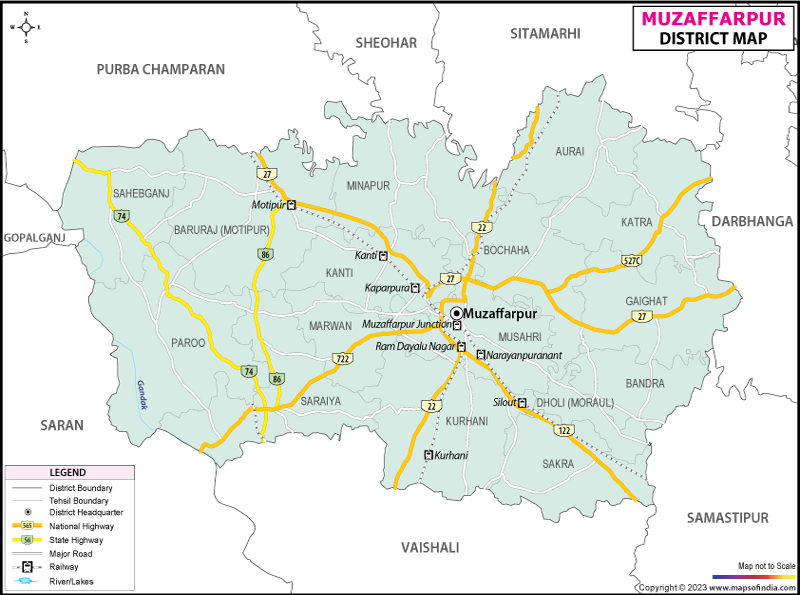
Sweet lime groves color the image of Muzaffarpur, often called the "Land of Lichis," standing out across Bihar due to rich farms and deep-rooted traditions. Northward within the state lies this key piece of the Tirhut region, touching East Champaran, Sitamarhi, Vaishali, alongside Darbhanga. At its heart sits Muzaffarpur town - the busy core where business pulses and government work unfolds for much of northern Bihar. Stretching over nearly 3,173 square kilometers, it lines critical roads including NH 28 and NH 57, while rail routes thread through consistently. Because of these links, movement of goods and people flows easily here, shaping access across wider areas.
Besides being known for farming, the district holds opposing worlds side by side - one moment busy town life, the next quiet rural calm; new colleges appear near ancient shrines steeped in history. Through it all moves the Burhi Gandak, winding across land, feeding crops, supporting livelihoods, influencing where people build homes and towns. At the heart lies Muzaffarpur city - an energetic mix shaped by old customs meeting present-day needs, packed markets sharing space with schools and government buildings. Yet each corner tells a different story, layered but never quite complete.
Education shapes much of what defines this area, serving as a focal point for learners across northern Bihar through a spread of institutions that pull in youth from nearby zones. Festivals breathe life into community spaces here, especially during Chhath Puja, when riverside gatherings swell under intense commitment and shared ritual. A past threaded with resistance marks another layer - take 1908, when Khudiram Bose made moves that still echo through local memory. What stands out is how deeply history and learning are woven into everyday presence.
History and Culture
Alive with history, Muzaffarpur breathes through time, tied deeply to Mithila and north Bihar. Far beyond mere dates or kings, its past pulses quietly in how people live now. Well before lines on maps appeared, it belonged to Videha - an old realm governed by King Janaka, Sita’s father in the Ramayana. Because of this thread to an epic cherished across India, the region carries a spiritual hum - earth touched by legend and faith.
Long ago, powerful families ruled - one after another fading into history. From the Mauryan era came structured rule alongside spiritual teachings rooted in Buddhism. Art flourished under Gupta leadership, with knowledge passed down through generations. Meanwhile, Mughal influence reshaped buildings and how authority was exercised. Traces lingered, slipping quietly into daily habits and shared traditions. In the present-day district, fragments remain visible within ancient shrines, carried in melodies sung by villagers, held softly in stories told across time.
Though marked by unrest, the colonial years stirred new awareness across regions. In Muzaffarpur, defiance took root - locals stepping beyond silence into collective action against imperial rule. One such instance unfolded in 1908, when Khudiram Bose tried to kill a British magistrate, his bold move echoing through time.
Deep in the rhythm of daily routines, Muzaffarpur holds fast to Maithili roots. Not shouted but felt - its language flows through hamlets and city corners alike, soft on the ear, rich with history. Instead of fading, old ways persist: workers hum folk tunes at harvest time; families gather when seasons shift. From grandmothers’ voices to young ears, tales move slowly, like rivers branching. What stands out most? The hush before dawn prayers in Chhath Puja - devotion laid bare without spectacle. With first light, crowds form on muddy banks, arms raised toward the morning glow - voices rise, steady and low, carrying hymns into the quiet sky. Not found elsewhere, this ritual pulses strongest in Bihar, where rows of people move as one, drawn by belief that runs deep.
Cooking pots simmer for days, tended by elders passing recipes to younger hands without written notes. Artisans shape clay idols, weave garlands, stitch garments - objects later displayed on verandas or sold at roadside stalls. Sound carries through lanes: voices rise in Maithili ballads, feet strike earth in folk dances learned informally, often late at night. These moments do not announce unity - they simply show it, quietly, in motion.
Among Muzaffarpur’s many cultural layers, sacred places hold distinct weight. Quiet devotion fills Garibnath Temple, where worship of Lord Shiva continues without pause, rooted deeply in time. Instead of mere stone, the Kolhua Ashokan Pillar carries words - etched proclamations from Emperor Ashoka promoting kindness and harmony. Far beyond architecture, these locations breathe meaning into the past, shaping how history feels present.
History lives beyond books here - felt instead in rhythms of festival drums. Through folk melodies passed across generations, culture finds fresh voice daily. Rituals mark time differently; they stretch backward while anchoring now. Everyday acts carry echoes older than records admit. Identity forms slowly, shaped by layers unseen at first glance. Walking these streets means moving between timelines casually intertwined. Myth slips into conversation like common fact. Memory does not sit still - it shifts, adapts, grows alongside concrete buildings and bus stops. Present moments gain depth because they borrow from what came long before.
Economy
Muzaffarpur's economic structure spreads across multiple sectors, yet farming remains central. Rivers feed the rich silt deposits, allowing successful growth of rice, wheat, pulses, alongside maize. What sets this place apart globally happens to be litchi farming. Grown locally under the name Shahi Litchi, it reaches buyers overseas, shaping livelihoods as much as regional reputation. Mangoes together with sugarcane stand as additional key harvests in these fields.
Among sectors, governance stands central when aiding farming via structured programs, financial aid, economic incentives, alongside studies aimed at improvement. Scientific advice reaches cultivators mainly through bodies such as Rajendra Agricultural University located close by in Samastipur. Services related to the well-being of citizens, learning centers, and office-based management roles give work to many residents across regions. Support systems built around state functions shape daily life more than often noted. Despite its modest size, industry in the district spans sugar production, farm-based processing, alongside fabric manufacturing. Employment in the countryside gains support through member-owned groups as well as state-run operations.
Among economic activities, growth stands out most clearly within services. Education forms one core component - Muzaffarpur hosts many schools, colleges, and tutoring centers, drawing students across North Bihar. Alongside it, health infrastructure expands gradually while serving patients beyond local boundaries. Commerce gains strength through shops, movement of goods, and lodging options for visitors. What supports these functions rests largely on daily transactions made by nearby residents. Still, farming shapes much of the region's output - litchis stand out despite gradual shifts toward services. Yet fields continue feeding livelihoods even as offices rise nearby.
Tourism
Among Bihar's districts, Muzaffarpur stands out for more than commerce. While markets thrive here, so do quiet temples tucked beside dusty lanes. Old structures appear where least expected - near fields, riversides, even within village squares. Rather than modern appeal, it leans on layered pasts shaped by decades of change. Scattered across its terrain are sites that draw visitors without fanfare. Nature contributes too, through groves, seasonal streams, and open skies at dusk. Culture surfaces in routines: morning rituals, local crafts, ways of speech preserved over time. Few places balance utility and heritage quite like this.
Each season brings visitors to Garibnath Temple, a place of worship honoring Lord Shiva. Though quiet in appearance, its presence holds steady through time, drawing those who seek stillness. Devotion finds form here, not in grand displays but in consistent footsteps on stone. Year after year, people arrive, guided by something older than words. Reverence lingers where prayers meet silence.
Here stands the Kolhua Ashokan Pillar, tied through time to Emperor Ashoka’s teachings. Once spoken at, perhaps, by the ruler himself during his journey across ancient lands. Silent now, yet drawing those who seek traces of old beliefs and royal footsteps. Not merely stone, but memory shaped into form, reaching forward without words. Pilgrims arrive slowly; others follow curiosity handed down through years.
Jubba Sahni Park stands as a tribute to the independence activist whose name it bears, blending remembrance with public use. History finds room here alongside rest, paths winding where stories linger. Not merely greenery, but memory shaped into open ground. One walks through quiet reflection rather than a grand display. The past stays close without overt markers - felt more than stated. Space unfolds gradually, thought unfolding with each step.
Demographics
In 2011, census data showed Muzaffarpur district held close to 4.8 million people, placing it among Bihar's most densely populated areas. Fertile soil supports farming life, which helps explain why so many live there. About two-thirds of residents can read and write, yet men still show higher rates than women. Despite this difference, programs now work toward balance in learning access.
Spoken languages across the region consist of Maithili, Hindi, Bhojpuri, alongside Urdu, illustrating varied cultural roots. Rural zones show a stronger presence of Maithili, whereas cities lean on Hindi for daily interaction. Youth make up a significant share of residents; farming along with related work occupies much of the workforce. Despite differences in speech patterns, economic life remains closely tied to land-based livelihoods.
Administration
Governance in the district follows an intricate framework built for wide coverage across its large area. Divided into 16 blocks along with multiple tehsils, each segment operates as a distinct administrative entity. More than 1,800 villages are nested inside these blocks, every one governed by a Panchayat - serving as the foundational layer of authority. Through the Panchayati Raj setup, rural populations gain influence, shaping choices on growth projects, support programs, when conflicts arise.
Healthcare and learning receive focused attention in Muzaffarpur, where assigned officials oversee medical facilities ranging from hospitals to local clinics along with educational institutions. Under supervision of the district education authority, public schools operate while efforts track adult reading initiatives and work alongside nonprofit groups aiming at higher student numbers staying enrolled. On another front, farming support comes through expert advice shared with cultivators, updates on current methods used in fields, availability ensured for financial aid linked to harvests and protection plans covering crops.
City affairs in Muzaffarpur fall under the Municipal Corporation, responsible for cleanliness, drinking water, road lights, alongside building public works. With oversight of market rules, green spaces, and basic services, it supports residents amid rising urban demand.
| Facts of Muzaffarpur District | |
|---|---|
| Official Name | Muzaffarpur |
| Area (km2) | 3122.56 |
| Population | 4801062 |
| Language | Hindi |
FAQs
Q1: How many villages are there in the district?
There are more than 1,800 villages spread across its administrative blocks.
Q2: What is the population of the district?
As per the 2011 Census, the population is approximately 4.8 million, making it one of Bihar’s largest districts.
Q3: What is it famous for?
Muzaffarpur is world-famous for its Shahi Litchi, a fruit that has earned GI recognition and is exported internationally.
Muzaffarpur Distance Chart
