|
||||||||||
| ||||||||||
|





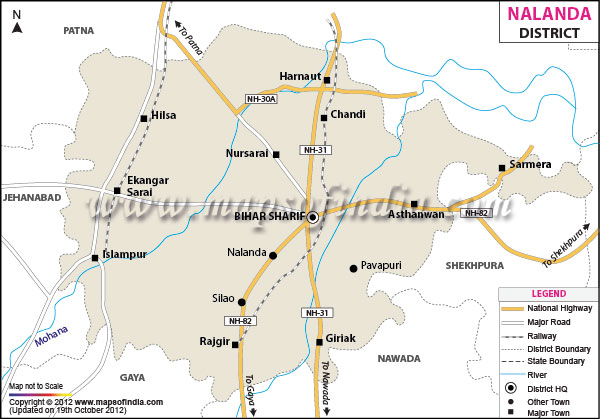
| *Nalanda District Map highlights the National Highways, Major Roads, District Headquarter, etc. |
About
Once home to a famed center of knowledge, Nalanda district lies in Bihar, India. Not just any old place, it carries weight through its deep roots in history and culture. Though quiet now, the land once hosted Nalanda University - known far and wide. That university held what was then the planet’s greatest collection of books. From the fifth century right up to the twelfth, its library stood unmatched. Today, ruins remain - a UNESCO-recognized heritage spot - echoing older ways of teaching and belief. Buddhist thought flourished here alongside scholarly pursuit. Power runs from Biharsharif, where trade and governance mix easily. To the north stretches Patna, while Sheikhpura and Lakhisarai border the eastern edge. Look south and you’ll find Nawada watching quietly. Gaya closes the ring on the western side. Each neighbor marks a boundary, yet stories flow beyond them all. Farms spread wide across the land here, with rice taking up large patches, while wheat follows closely behind, alongside various vegetables tucked between. Sitting within this stretch stands the Pawapuri temple, visited often by Jain pilgrims because it marks the spot where Lord Mahavira found moksha
History and Culture
Deep in India’s past stands Nalanda, alive for over two millennia, respected across the region. Some believe its title comes from ancient terms - nalam, symbolizing wisdom like a lotus, then da, offering it forward, thus forming "giver of knowledge." From such roots grew a culture where learning took hold and never let go. Century after century, this spirit held firm, shaping what the place remains today.
One bright moment in the past shines through the rise of an old university, built around 400 AD when the Gupta rulers held power - Kumaragupta I played a key role. When it reached its peak, thousands lived there: over ten thousand learners, two thousand instructors, drawn from distant corners like China, Tibet, Korea, Japan, Mongolia, Sri Lanka, Turkey, and lands across Southeast Asia. Studies covered many fields - not just belief systems and deep thinking but numbers, sky patterns, healing arts, reasoning too. A well-known visitor from China, Xuanzang, arrived in the 600s and wrote down what he saw: towers rising high, clusters of prayer spaces, teaching rooms standing strong - an unmatched sight. Even after times changed, royal backing kept learning alive, first under King Harsha, then by kings of the Pala line who valued Buddhist thought.
Late in the 12th century, everything changed when a Turkish leader named Bakhtiyar Khilji swept through the area around 1193 CE. Not long after his arrival, the vast library called Dharmaganja was reduced to flames - fire that fed on scrolls and texts for nearly 3 months straight. Because of those burning weeks, countless writings built over generations vanished without trace. What once stood as a towering center of thought crumbled into silence, its voice lost beneath smoke and time. That moment marked more than ruin - it carved a lasting wound across India’s intellectual past.
Pawapuri sits quietly in Nalanda, yet holds deep meaning. There, long ago, the last Tirthankar - Mahavira - left his body behind, stepping into peace around 527 BCE. Because of that moment, people travel far even now, drawn by what happened on those grounds. For followers of Jain teachings, this place breathes history.
Deep in Nalanda, old beliefs blend - Buddhist stillness meets Jain vows, Hindu rhythms pulse alongside local ways shaped by time. Faith runs steady here, where people mark their days by ritual more than clocks. Come Chhath Puja, devotion ignites across households, not just in this district but through Bihar’s villages and towns. As light breaks or fades, water edges glow with clusters of worshippers facing the sun, prayer rising like mist from rivers and ponds.
Out here, music pulses through village gatherings - Bidesia rhythms echo at weddings while Jat-Jatin steps mark the harvest season. These sounds travel without pages or books, passed down by memory from one lifetime to another. When celebration strikes, so do dancers weaving stories barefoot on packed earth. From clay shaped under quiet hands come pots marked with ancestral patterns. Woven cloth unfolds slowly on wooden looms, thread by patient thread. Brass takes form in dim workshops where artisans chisel symbols older than towns. Each object carries a whisper of old Bihar, not shouted but felt. Tradition doesn’t announce itself - it simply stays.
Among fields and farms, its food stands out through humble taste rather than grand design. A dish like Litti-Chokha appears often at celebrations, carried forward by tradition instead of trend. Sattu shapes much of what people eat here, forming meals that stick to the bones. Dal-pitha shows up when families gather, wrapped in memories more than wrappers. Thekua, sweet and crisp, arrives with seasons, tied to timing rather than choice. Meals shift with harvests, rooted firmly in soil, sun, and rhythm.
Economy
Most folks make their living through farming, since the land shapes life here. Rain falls generously because rivers wind across the flat ground, making soil rich for planting. Rice, wheat, and maize grow alongside lentils, greens, while mustard spreads wide under sunlit fields. Fruits join these harvests, standing out more each season as demand rises beyond village borders. Near village edges, small ponds host fish farming, quiet but steady in its output. These efforts feed nearby markets without much fanfare. Rural life leans on such activities, even if they seem modest at first glance.
Small workshops help shape how money moves in the district. Making pots, weaving cloth, crafting metal items - these jobs give work to skilled locals. Instead of just bringing income, such crafts keep old creative ways alive across generations.
Tourism
Among the ruins here, the old university stands out - once a hub of knowledge, now quiet under open sky. Foundations peek through soil where scholars once walked, talking ideas long gone silent. Buildings rise in fragments: halls cracked, stairways leading nowhere, walls holding echoes. This place holds breath like memory does - faint, heavy, real. Nearby, a small museum shelters pieces pulled from dust and time. Stone faces watch from shelves; broken pots sit beside tokens used centuries ago.
Near the old university grounds stands the Xuanzang Memorial Hall, built in honor of a famous Chinese monk and thinker who studied at Nalanda long ago, around the 600s AD. Though quiet today, its halls echo centuries of shared learning between China and India. A calm garden wraps around the building, drawing visitors without saying a word. Chinese architectural touches mark every corner, a silent nod to distant ties once deeply rooted in wisdom and travel.
Pawapuri lies in the Nalanda district, known for hosting a key Jain holy spot. Where Lord Mahavira, the last Tirthankara, reached liberation - this quiet truth shapes its essence. Rising from water thick with pink lotuses, the gleaming Jal Mandir draws eyes without trying. White stone forms its walls; stillness surrounds it. Visitors come steadily through each season, not just during Kartik Purnima, though numbers grow then.
Rajgir, an old hillside town, draws travelers with layered history. Once the seat of the Magadha rulers, it holds deep meaning for Buddhists and Jains alike. Perched high on Ratnagiri Hill, the bright white Vishwa Shanti Stupa stands calm, reached by cable car. From there, eyes follow winding green slopes far below.
Besides Rajgir, there lies a quiet lake called Ghora Katora, ringed by leafy slopes where people often stop for lunch on weekends. Instead of loud attractions, it offers calm water views under green cover most days. During winter, the area wakes up when performers gather for the Rajgir Mahotsav, filling evenings with folk songs and handcrafted stages. Colorful dances unfold beside ancient paths, drawing travelers who prefer rhythm over resorts. While mornings stay still, nights pulse briefly with drumbeats and local tales told through movement.
Demographics
Home to nearly 2.877 million people, the region stands among Bihar’s busiest districts. Spread across eastern India, such density isn’t rare here. Most live scattered through village clusters and modest townships tucked within block boundaries. Town life mixes with countryside rhythms - residents split between fields, lanes, and low-rise neighborhoods. Numbers from 2011 show it clearly: packed settlements form a core part of Bihar’s human landscape.
Though close to the state norm, female-to-male balance tilts at 921 women for every thousand men - just beneath India’s overall mark. When it comes to young kids under seven, the count of girls lagging behind boys raises red flags. That gap? It tugs harder on public awareness than most numbers do. Efforts by officials and local groups must sharpen here, quietly but firmly.
Back then, Nalanda wasn’t doing too well on reading and writing skills. Come 2011, about 64 out of every 100 people could read, though more men than women had that advantage - clearly showing one group getting fewer chances. Over years, efforts by local authorities and independent groups focusing on girls’ learning began making small but real differences. Progress crept in slowly, mostly where it mattered most.
Most folks follow Hinduism, though Muslims and Jains also form noticeable communities across the area. While Hindi dominates daily talk, voices often shift into Magahi - a native tongue rooted deeply in village life. This regional speech carries old stories, songs, poems passed down through years. Culture here flows from varied roots, all tied closely to Bihar's historic Magadh belt.
Administration
Biharsharif sits at the heart of Nalanda’s governance, shaped by India’s familiar district framework within Bihar state. This town holds the keys to administration, law, and business across the area. Once known for bustling markets long ago, it now draws visitors to spiritual sites tied to Sufi tradition. Rulers once gathered here; today courtrooms and offices fill those old footsteps.
Around here, leadership falls to the District Magistrate - often called the Collector - who comes from the Indian Administrative Service. This role handles tax matters, keeps peace steady, manages emergencies, plus oversees how public aid plans roll out locally. Standing alongside them is the Superintendent of Police, a key figure in crime control and head of all local policing tasks. Their work ties closely to stability, even when challenges rise without warning.
Deep inside the district, twenty blocks take shape - each guided by a Block Development Officer. Oversight here means steering rural progress without stepping too far from village voices. Instead of distant control, power slips down to panchayats carved out within each block. These small clusters breathe life into self-rule, rooted in the Panchayati Raj design. From elections forward, Gram Panchayats pull plans together, then set them in motion where dirt paths meet daily needs. When work begins on the ground, it travels through these councils first. Nothing spreads across the district unless tested locally. Governance grows best when planted close. Reach matters more than reach-out.
| Facts of Nalanda District | |
|---|---|
| Official Name | Nalanda |
| Location | Bihar |
| Area (km2) | 2367 |
| Population | 2,877,653 |
FAQs
Q1: How many villages are there in the district?
1,084 (revenue villages).
Q2: What is the population of the district?
2,877,653 (2011 census).
Q3: What is this district famous for?
Ancient Nalanda University (UNESCO), Nalanda Museum, Rajgir, Vishwa Shanti Stupa, Pawapuri Jal Mandir, Xuanzang Memorial Hall,, Ghora Katora Lake, Pant Wildlife Sanctuary, Modern Nalanda University, Cyclopean Wall, Griddhakuta Hill, Chhath Puja, Magahi Language, Litti-Chokha.
Last Updated on : June 24, 2026
