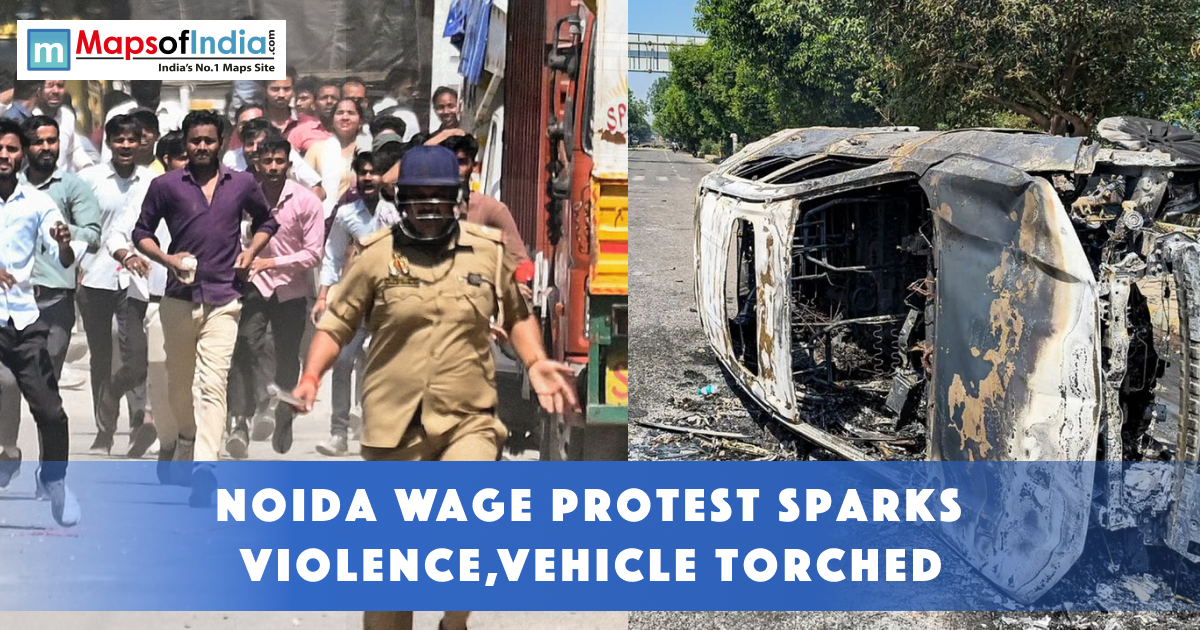
The industrial city of Noida, which is a major component of the National Capital Region (NCR), experienced an outburst of violence when a labour protest against wage demands by workers became violent. What started as a unified demand for higher salaries and better work conditions soon turned into a riot, with the news of cars being burned, property being destroyed, and protesters confronting the police. The event has again brought into focus the increasing tensions between the labour forces and the industrial management in the fast urbanizing areas of India.
Background of the Protest
Noida hosts a huge industrial and manufacturing industry, which employs a large number of people in the area and operates in the electronics, textile, automotive parts, and consumer goods industries. A good number of these employees are migrants who depend on the daily or monthly wages as a means of their living. Low wages, working long hours, and a lack of proper benefits have been brewing beneath the surface over the years.The direct cause of the protest seems to be the lack of satisfaction with the non-hike in wages in the context of the increase in living expenses. The employees have been pressuring for a salary increment that is in tandem with inflation and rising prices of basic amenities like food, shelter, and transport. There have also been demands for fixed working hours, overtime pay and better working standards at the workplace.
The Day of the Incident
During the protest day, a massive crowd of workers assembled in one of the industrial areas in Noida to express their grievances. At first, it was a peaceful demonstration, and workers gave slogans and demanded a dialogue with the factory management and local authorities. But the tension started to build up because the negotiations were not yielding any immediate benefits.The frustration increased with the number of people. According to eyewitness reports, a part of the demonstrators got heated, and the fights with police officers who were on the scene ensued. The events quickly got out of control as the people supposedly threw stones, which resulted in the vigorous reaction of the police.Violence soon ensued. A number of vehicles in the area were burnt, and others were destroyed in the riots. The smoke was flying around the place, and there was panic among local inhabitants and employees. What was once a well-organized protest had become a scene of disorder and destruction.
Police Response and Crowd Control
Police forces were strengthened in response to the growing violence to put the situation under control. The use of tear gas and, allegedly, the use of lathi charges to break up the crowd was also reported. Law enforcers were concerned with minimizing the additional destruction of property and safeguarding people.Inquiries were launched to find out the people who were propagating violence. Officials stressed that peaceful protest is the right of democracy, but vandalism and arson would be unacceptable.The timely action of the law enforcement ultimately put the situation under control; however, not before the situation was severely disrupted.
Impact on the Local Area
The ripple effect of the violence was experienced in Noida and other areas. The unrest has had a drastic impact on traffic movement as key roads are blocked. There were a lot of delays among commuters, and disruption of public transport services in some places.Industrial activities also suffered a blow, with most factories closing down temporarily so as to guarantee the safety of their workers. The incident has made business owners conscious of the stability of their operations and the economic impact that the disruption can have.Even local residents were in the crossfire. The image of burning cars and the presence of the heavy police force made the atmosphere of fear and uncertainty. To most, it was a chilling lesson on the speed at which tensions can run high when the problems that lie under the surface are not addressed.
Root Causes of the Unrest
The wage dispute, although it was the immediate cause of the violence, is much more complex in its underlying causes. The increasing gap between wages and the cost of living is one of the main factors. With the urban centres such as Noida ever expanding, the cost of living in terms of housing, transport and other daily needs has swelled. To the low-wage workers, it has been more challenging to make ends meet.Job security is another critical issue. A significant number of employees in factories are on contract or temporary employment, which exposes them to a lack of long-term stability and other benefits like medical and insurance. This lack of security adds to their grievances and fuels dissatisfaction.In addition, workers and management are usually separated by a communication barrier. In most situations, employees believe that they are not listened to or addressed properly and therefore, they become frustrated and ultimately, take action as a group.
The Role of Government and Policy
The case has created awareness of the role played by government policies in terms of dealing with labour problems. It is necessary to ensure that the wage is fair, that labour laws are upheld, and that there is a dialogue between the workers and employers in order to avoid such cases.The government has expressed that it is trying to negotiate with the employees and the companies so as to reach a compromise. The arguments about wage increases, better working hours and a more effective implementation of labour laws are likely to be on the front burner in the days ahead.Meanwhile, proactive actions are required as opposed to reactive ones. Frequent check-ups, redressal of grievances and awareness programs can be used to close the gap between workers and management, which will ensure that the conflict does not escalate to violence.
Lessons and the Way Forward
The Noida wage protest is a bitter lesson of how slippery the slope between economic development and social stability is. Although industrial development has its opportunities and prosperity, it should also take care of the well-being of the workforce which pushes it.To employers, the incident highlights the need to ensure open channels of communication with employees and make sure that their concerns are addressed promptly. To the workers, it brings to the fore the necessity of forcing their demands in a peaceful and constructive way.To the policymakers, most importantly, it is a wake-up call that economic gains should not be at the expense of worker well-being by enhancing the labour structures.
Conclusion
The type of violence that broke out in Noida wage protest is a worrying trend, as it signifies a deeper structural issue in the labour ecosystem. As much as the immediate situation has been controlled, the underlying issues are yet to be solved.To continue, it is essential to adopt a participatory strategy between workers, employers, and the government in order to develop sustainable solutions. Such incidents can only be prevented in the future with dialogue, fair policies and mutual understanding so that industrial growth can be accompanied by social harmony.