




Introduction
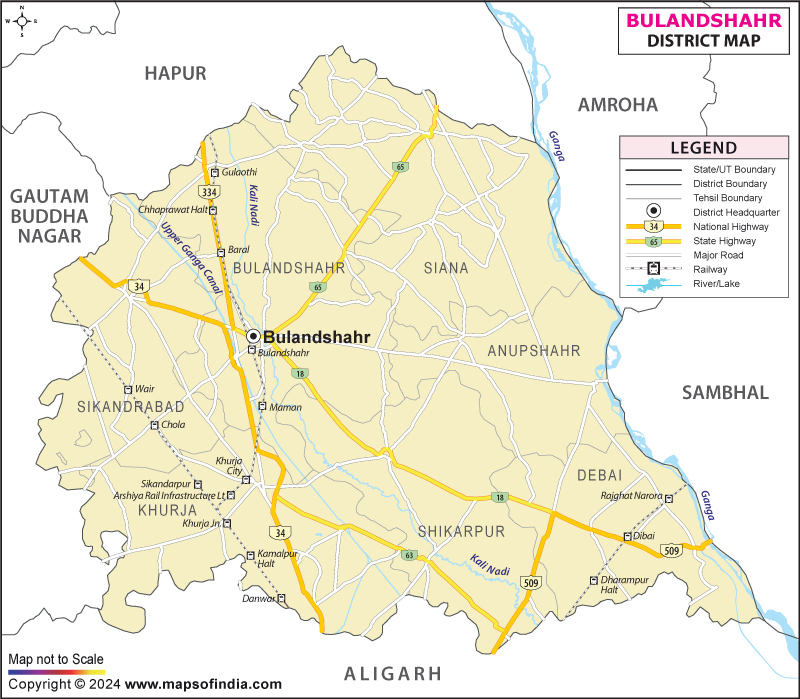
Bulandshahr is a district, which is a significant territory in the west of the Indian state of Uttar Pradesh. The district is located in the National Capital Region and stands at a strategic point between big cities of the country including Delhi and Agra. Its proximity to major cities in Northern India facilitates a steady flow of trade and enhances connectivity with other major trade and transportation activities. The main governmental centre of the district is the city of Bulandshahr which serves as the major administrative, commercial as well as educational location in the district.
The district belongs to the historical area of Upper Doab which is located between the rivers Ganga and Yamuna. It has a history of fertile agricultural land and rich water resources, thus the development of settlements and farmland took place over centuries. The local economy remains farm-based with wheat, sugarcane, rice and pulses being popular farm crops. In addition to agriculture, small industries, trade and services are also a part of the economic activity in the district.
It is a combination of village areas, growing towns and classic market centres. Villages still have a strong connection with the old ways of agrarianism, though the cities are all the more affected by modernization and economic transformation. The infrastructure of the district has been changed slowly due to educational facilities, transport facilities, and emerging industrial growth.
History
The development of Bulandshahr district has a close connection with the overall political and cultural history of the northern part of India. The evidence shown by archeologists indicates that the area was inhabited at an early time. It was also in the fertile Doab region and suitable for the early settlements and agricultural societies. There are historical traditions which links the nearby areas to the ancient Indian kingdoms and the initial urbanisation along the plain of Yamuna and Ganga.
There were diverse local dynasties and chiefs of the Rajput who governed the region during the early medieval period. The region was later became part of bigger political entities which governed over northern India. The geographical position of the place between significant trade routes contributed to the evolution of the area into the centre of trade and communication.
During the 13th century, the region came under the Delhi Sultanate, which introduced a great deal of administrative and political transformations. The region was included in the growing Muslim empire located in Delhi. Existing settlements expanded under Sultanate administration, the systems of revenues were restructured, and new trade networks were created during this period. These changes slowly led to the development of Bulandshahr as an administrative centre.
The region was relatively politically stable with economic development experienced during the Mughal period especially under the reign of emperors like Akbar and Shah Jahan. The administrative reform of the Mughal state enhanced land revenue systems and promoted the growth of agriculture. The plains were very fertile and this facilitated massive agricultural activities fostering local markets and trade centres.
The district also became prominent in the uprising of 1857 which was also called the first war of independence. The local people participated in the uprising against British rule in large numbers and this illustrates the amount of dissatisfaction of the colonial policy. The British crushed the uprising and had enhanced the administrative force and had introduced more reforms that were designed to restore order.
Nationalist movements started to make their impacts on the political life of the district at the start of the twentieth century. Following the examples of such leaders as Mahatma Gandhi, residents took part in a number of stages of the Indian freedom movement, the Non-Cooperation Movement and the Civil Disobedience Movement. There was constant political awareness among students, farmers, and urban population.
In 1947, the reorganized Uttar Pradesh state absorbed Bulandshahr district, following the gaining of India independence in 1947. The agrarian relations were also changed greatly through land reforms which focused on eliminating the zamindari system. Development programs were directed at irrigation, rural education, road network and modernizing of agriculture.
Culture
As a part of everyday life, religious celebrations play a significant role. Big festivals like Diwali, Holi, Eid-ul-Fitr and Navratri are enjoyed in the whole district. Gestures such as decorations, sweets and traditional clothes fill the markets during such occasions. Festivities in both villages and towns are fostered by community events, religious rituals and cultural acts.
Another cultural aspect that is important is local fairs and melas. These events usually occur along temples, shrines or historic places and draw multitudes of people in the surrounding regions. These gatherings are characterized by a lot of traditional music, dance and folk performances. Trade of handicrafts, food, and household goods make the fairs significant social and economic activities by vendors.
The district represents Indian cuisine of the north. Foods made of wheat, e.g. rotis and parathas are another common staple food, with lentils, vegetables and dairy products. During festivals and weddings, seasonal foods and sweets are made. Local markets and bazaars sell food items like samosas, kachoris and jalebis in great quantity.
Community and family relations are the core part of social life. Conservative traditions related to marriage, birth, and rituals are still practiced, but the contemporary forces are slowly changing the way people live.
Language
Bulandshahr district has language patterns which are derived from western Uttar Pradesh. The major language in administration, education and official communication is Hindi. The standard Hindi is learned and studied in schools and is thus the major used language in terms of official and educational purposes.
Another historical significance of Urdu in the district can be seen through Muslim communities and literature traditions. Urdu poetry and prose have been cherished in North India since medieval times and literary meetings in the forms of mushairas are also common in towns and schools. These happenings display the cultural diversity akin to the language.
With modern education and the growth of employment, English has become more important. English typically is a mandatory part of the curricula of schools and colleges, especially in university and professional programs. The new generations find it easier to use English both in the academic and professional world without losing the ability to speak Hindi and their native dialects.
Language is also a significant part in the maintenance of cultural traditions. The folk songs, proverbs and story telling activities are mostly carried in local dialects. These traditions are oral and are taught to the new generation of the society by the previous generation passing historical memory and teachings on morality and culture of the society. By practicing this, linguistic heritage would still be part and parcel of the social life in Bulandshahr district.
Geography
The geographical position of Bulandshahr district is defined by the fact that it is located in the fertile Doab region between the Yamuna and Ganga rivers. The landscape is generally elevated upland and composed mostly of alluvial plains which have been deposited by the rivers over the centuries. Its rich soil helps in a large-scale agricultural application and has in the past promoted a dense rural population.
The eastern border of the district is the Ganga River which is an important ecosystem in the area. The river provides irrigation in the surrounding agricultural lands and ensure that soil is kept viable. There are several canals and irrigation facilities developed to spread the water in the district so that there is constant supply of crops.
The climate is described as subtropical and the summers are hot, the seasons being monsoon and the winters relatively cool. The temperatures in the summer season may be higher than 40°C, whereas winters are cool and comfortable. Most of the yearly rainfall is experienced during the monsoon that takes place between June and September and is very essential in agricultural production.
The economic activity of the district is still centered in agriculture. The common crops are wheat, rice, sugarcane, maize and pulses. Crops like sugar cane have been cultivated which has facilitated the growth of sugar mills and other agro-industries in the area. There is also widespread dairy production, which is used in the domestic and local markets.
The district has good road and rail road networks that connect it to the big cities like Delhi, Agra, and Aligarh. These transport corridors enable trading as well as commuting and interaction with other regions in terms of economics. Increasing highways and enhanced infrastructures have enhanced the interests of the district in the National Capital Region.
| Facts of Bulandshahar District | |
|---|---|
| State | Uttar Pradesh |
| District | Bulandshahar |
| District HQ | Bulandshahr |
| Population (2011) | 3499171 |
| Growth | 20.12% |
| Sex Ratio | 896 |
| Literacy | 68.88 |
| Area (km2) | 3719 |
| Density (/km2) | 788 |
| Tehsils | Anupshahr, Bulandshahr, Debai, Khurja, Shikarpur, Siana, Sikandrabad |
| Lok Sabha Constituencies | Bulandshahr, Gautam Buddh Nagar (certain assembly segments) |
| Assembly Constituencies | Anupshahr, Bulandshahar, Debai, Khurja, Shikarpur, Sikandrabad, Syana |
| Languages | Hindi, Urdu |
| Rivers | --- |
| Lat-Long | 28.408313,77.849021 |
| Travel Destinations | Karnavas, Belon, Ahar, Chola, Kala Aam Chauraha, Bhuteshwar Mandir etc. |
| Government Colleges/Universities | --- |
FAQs
Q1: Where is Bulandshahr district located?
Bulandshahr district is located in western Uttar Pradesh in the National Capital Region (NCR). It lies between Delhi and Agra and is part of the fertile Upper Doab region between the Ganga and Yamuna rivers.
Q2: What is Bulandshahr famous for?
Bulandshahr is known for its rich agricultural production, historical significance, religious sites, and its proximity to Khurja, which is internationally renowned for its ceramic pottery industry.
Q3: What is the headquarters of Bulandshahr district?
The administrative headquarters of Bulandshahr district is Bulandshahr city.
Q4: How many tehsils are there in Bulandshahr district?
Bulandshahr district has several tehsils, including Bulandshahr, Anupshahr, Debai, Khurja, Shikarpur, Sikandrabad, and Syana.
Q5: Which rivers flow through Bulandshahr district?
The Ganga River forms the eastern boundary of Bulandshahr district, while the Kali River also flows through parts of the district and supports agriculture.
Q6: What are the major tourist attractions in Bulandshahr?
Popular tourist attractions include Anupshahr, Karnavas, Belon, Ahar, Bhuteshwar Mandir, Kala Aam Chauraha, and Khurja, which is famous for its pottery.
Last Updated on : July 27, 2026
