

|
||||||||||
| ||||||||||
|





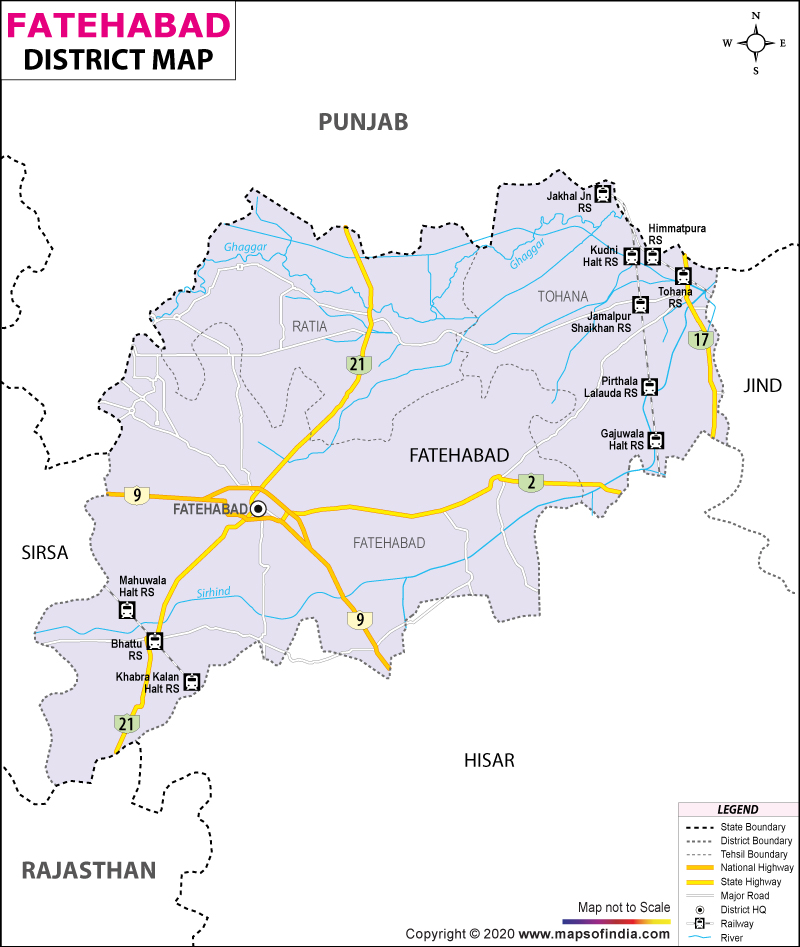
| **Fatehabad District map showing National highways, district headquarter, roads, towns, etc. |
About
Fatehabad district is one of the administrative districts of the Indian state of Haryana. The district is famous for its horticultural development, its historical significance and is experiencing a rapid growth of infrastructure. Students, travellers or researchers frequently look into the Fatehabad district map to comprehend its geographical location, connections of roads and settlement patterns.
It is an area of approximately 2,538 sq. km. in the semi-arid plains of north-western India. Areas of the district have historically been agricultural areas with the Ghaggar River running through. On 15 July 1997, the district of Fatehabad was created out of Hisar district. Since then, it has been a stable growth in education and transport, irrigation and rural development sectors. Visitors looking to find out the location of big towns like Fatehabad, Tohana, Ratia and Bhuna use the Fatehabad district map quite often. There, more information about the transport facility available to the particular district to reach various cities like Chandigarh, Hisar, Bathinda, and Delhi is also provided in the Fatehabad district map.
History and Culture
Fatehabad district has a rich history, which highlights the cultural changes and development of the state of Haryana and north-western India. This area is believed to have an ancient origin in the early settlements around the Ghaggar River. The Indus Valley civilisation and the later Vedic people's influence are shown by the archaeological finds of nearby regions. Establishment of settlements and administration in the area which are mentioned in the records. The Fatehabad district map has been the subject of many studies focusing on the region's ancient trade routes and historical settlements.
During the Mughal and British rule, there were also political and social changes in the district. Agriculture continued to be the main source of livelihood with a slight expansion in developing local markets around the villages and along the transport routes. Prior to then, the colonial era, the rural economy of that area was changed due to irrigation projects and revenue schemes. After the establishment of the Fatehabad district, map stuck as an important administrative reference.
The culture of the Fatehabad district is a source of the rural culture of Haryana. In the village life, folk music, dance and oral stories are still important. There are also traditional Ragini Singers and Haryanvi folk people who have also played their role in the tradition. Traditional forms, such as Ragini singers and folk performers of Haryanvi style, are also accepted during fairs and gatherings. There are local festivals and celebrations, which are often accompanied by music, wrestling matches and communal feasting. The district honours many festivals which are of major importance, such as Diwali, Holi, Teej, Dussehra, Baisakhi and Makar Sankranti. Sikh festivals are also celebrated in a few places in the district, as there are Punjabi-speaking people here.
The traditional dress of the area is simple and functional. Traditionally, men wear kurta pyjamas or dhoti-kurta while women wear salwar-kameez with colourful dupattas in common.In common, the men wear kurta pyjama or dhoti-kurta, whereas women wear salwar-kameez with colourful dupattas. Local markets and village fairs offer rural handicrafts, handmade decorative and embroidery work. The district food system reflects the agriculture and dairy farming sector. Common foods are bajra roti, churma, kadhi, lassi and fresh milk products. The Fatehabad district map is also found beneficial for cultural researchers for understanding the information about the distribution of villages and traditional communities in the district.
Due to geographical and cultural influences from neighbouring regions, Punjabi and Bagri are also spoken in some areas of the district. Folk traditions and cultural heritage are closely held by educational centres and cultural institutions, which take part in regular events. A Fatehabad district map can be included in the educational materials, which are used to acquaint students with the cultural geography of the world.
Economy
Agriculture and allied activities form the backbone of the economy of Fatehabad district. The district is an important agricultural region of Haryana due to the fertile soil, irrigation facilities and industrious rural labour. There are several major crops grown in the district, including wheat, cotton, mustard, paddy, barley and guar. In addition, livestock raising and dairy production play an important role in the economy of rural areas. The modern approach of agricultural chemicals, low-cost seeds and irrigation is adopted to boost productivity for farmers. Agricultural departments and planners often use the Fatehabad district map in order to determine irrigation networks and cropping areas, as well as rural markets.
The government sector has significant influence on the district economy in terms of administrative services, education, healthcare, and rural welfare programmes. Thousands of people work in district administration offices, the police service, the courts, schools and public health facilities. The initiative of the government for irrigation, crop insurance, road construction and development of rural houses has helped to improve the economy. To boost infrastructure development, connectivity between villages and towns has grown. The Fatehabad district map is helpful in the planning of roads, schools and welfare projects by the development agencies.
The electricity supply, irrigation management and transport services provided by the public sector have promoted development. Farmers are helped by the Haryana State Agricultural Marketing Board and other public institutions in procuring their produce through their mandis. Fatehabad, Tohana and Ratia markets have the largest numbers of grains, cotton and oilseeds each year. Co-operative societies and banks also help farmers and small companies in various ways, such as supplying finance and loans.
The services sector has continued to grow over the years. Jobs in banking, retail industry, transport, health, hospitality and education are now becoming significant. Increasingly, educational institutions, coaching centres and private schooling have expanded greatly across urban centres. In addition, the healthcare sector has seen better developments given the presence of hospitals, clinics and diagnostic centres. There are different cotton processing-based small-scale industries, rice mills, agro-based industries and agricultural machinery industries in different sections of the district. This Faithabad district map is utilized by traders, transport operators, etc., for planning different types of moves and trade in this particular district.
Tourism
The district is also a recreational hotspot for tourists and is a great place to learn about the local history and culture. Fatehabad district map is used by tourists and researchers to identify the key heritage sites or any route they follow while travelling in the city.
One of the ancient places related to Firuz Shah Tughlaq in Fatehabad town is very interesting. The historical buildings and monuments related to the Tughlaq period testify to the historical and administrative importance of the area during the medieval era. Anyone with an interest in history and archaeology will definitely want to visit here for the ancient inscriptions and archaeological sites of the sultans' era.
The district is very religious too. Several temples, Gurudwaras and the local shrines are visited regularly throughout the year by the followers of these. The religious festivals thrown on the village fairs give an idea of Haryana's traditional way of life. Folk music, wrestling matches and rural markets displaying handicrafts and traditional food are a common part of the activities at local fairs. Fatehabad district map is also useful to tourists, particularly for traveling in rural roads and sightseeing in the district.
Demographics
The population of the Fatehabad District is varied and mainly rural. The 2011 Census Population for the district was 942,011. Males numbered some 495,360 and females some 446,651. The district enjoyed improved living conditions along with the development of Agriculture, which has been gradually increasing its size. The Fatehabad district map is used by demographers and planners for research on the distribution and settlement of the population.
The literacy rate of the district is around 67.92 per cent. Men are more literate than women, and the education among women has been progressing significantly in recent years. Certain aspects are widely attributed to the Schools/College/vocational institutions with regard to education awareness, increase in literacy. There has been considerable improvement in the education program in the urban areas of Fatehabad and Tohana.
Hindi is the official language of the district and perfect application is in administration and education. Even though people are speaking with Haryanvi more and more and their interest in the language has intensified following the revival of national languages, Haryanvi is still an important part of the local identity in rural areas. The language spoken by its population also has Punjabi and Bagri as the first language due to its geographical location and its cultural linkage with the adjacent states of the country.
Administration
Fatehabad district is under the administrative jurisdiction of the Haryana Government. Major offices and administrative institutions of the district are in the town of Fatehabad. The district administration takes care of Police and security, development works, revenue collection, welfare schemes and maintenance of infrastructure. Governance, Planning and Allocation of resources takes place regularly through the Fatehadbad district map.
The district has been divided into the following major tehsils of the district, namely, Fatehabad, Ratia, and Tohana, as the administrative areas. These tehsils will assist in the effective administration of revenue and rural management with public services. Subdivisions and blocks are further provisions for local government and the implementation of government programmes.
There are also municipalities and urban local bodies that carry out civic administration in towns within the district. There are district or local administrative offices that manage public services like healthcare, education, electricity supply and road maintenance. Administrative and regional planning records continue to be important source materials for developmental activities across the district.
| Facts of Fatehabad District | |
|---|---|
| State | Haryana |
| District | Fatehabad |
| District HQ | Fatehabad |
| Population (2011) | 942011 |
| Growth | 16.85% |
| Sex Ratio | 902 |
| Literacy | 67.92 |
| Area (km2) | 2538 |
| Density (/km2) | 371 |
| Tehsils | Fatehabad, Ratia, Tohana |
| Lok Sabha Constituencies | Sirsa |
| Assembly Constituencies | Tohana, Fatehabad, Ratia (SC) |
| Languages | Haryanvi Punjabi, Hindi And Bagri |
| Rivers | Ghaghar |
| Lat-Long | 29.654642,75.623589 |
| Travel Destinations | ---- |
| Government Colleges/Universities | Ch. Mani Ram Godara Govt. College For Women (Bhodia Khera), Govt. College For Women (Ratia), Govt. College, (Bhattu Kalan), I.G. Govt. P.G.College (Tohana), K.T.Govt.College (Ratia), M.M College (Fatehabad) etc. |
FAQs
Q1: How many villages are there in the district?
Fatehabad district has around 245 villages.
Q2: What is the population of the district?
According to Census 2011, Fatehabad district had a population of 942,011 people.
Q3: What is this district famous for?
Fatehabad district is famous for agriculture, especially cotton and wheat cultivation, and its historical connection to Firuz Shah Tughlaq.
Last Updated on : June 11, 2026
