




Introduction
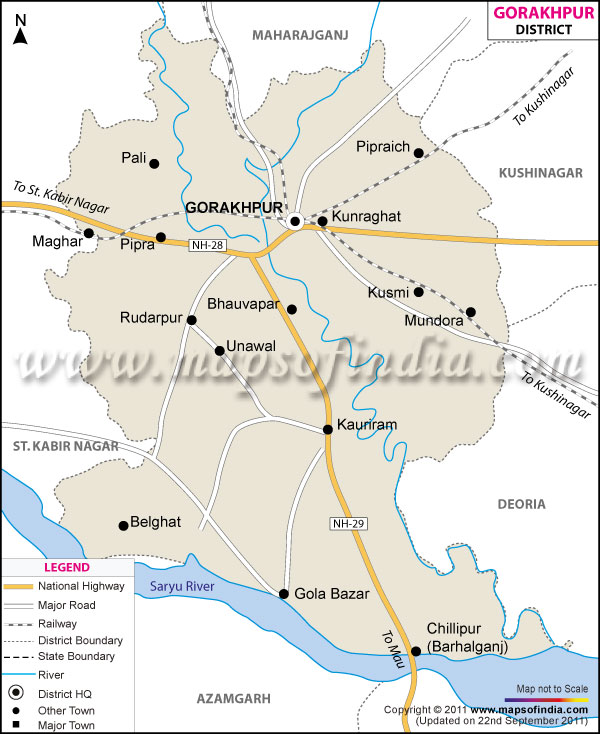
Gorakhpur is located in the eastern Uttar Pradesh region, clearly visible on the gorakhpur district map. It is famous for its rich cultural heritage, lush plains and spiritual importance. The city is named after the holy St. Gorakhnath whose temple is still a major landmark and a representation of who it is. It is located on the Nepal border along the Rapti river, clearly visible on the gorakhpur district map and has been a Center for trade agriculture and cross-cultural interaction for ages. The language diversity, mainly Hindi bhojpuri and Urdu reflects the harmony that the city has maintained. The terrain characterized by River Forest and lakes sustain a thriving agricultural economy.
History
Gorakhpur is a major city in Uttar Pradesh eastern region, clearly visible on the gorakhpur district map. The history of the place dates back to thousands of years and is both lengthy and fascinating. The city bears the name of the famous St. guru gorakhnath who was a famous teacher and a spiritual leader. One of the most important places in the city is the gorakhnath temple which is constructed in his honor. Every year a large number of people go to the temple from all over. The history of gorakhpur is linked to politics, trade , culture and religion. The region surrounding gorakhpur was earlier part of the kosala Kingdom which is often referenced in the holy Hindu scriptures. The area is thought to have been close to locations associated with Lord Buddha's life.
Go to put is not far from Kushinagar which is a well known Buddhist place where Gautam Buddha attained Mahaparinirvana. Therefore the area developed into a major Buddhist hub several centuries ago. This region gained importance for its religious significance because of its link to numerous monks and tourists who went through it. It became a major hub for the Nath yogis, a religious order led by guru gorakhnath in the early Middle Ages. Guru gorakhnath beaching inspired many people in northern India. The city gradually grew around the temple and the religious activities associated with it.
There’s a time when the local markets and the towns grew in the region. The farmers from the adjacent villages traded their crops at the town. Rapti river also played an important role in the lives of people. It helped the farmers and also facilitated the transportation of goods across places. During the medieval time gorakhpur was ruled by various dynasties. It was ruled at various periods by local kings, the Delhi sultanate and subsequently the Mughal empire. During the Mughal administration particularly during the rule of Akbar the territory was divided into administrative units and the city formed part of the Mughal government system. Agriculture improved throughout the time and the trade expanded to far off places. However, like many other regions, the area suffered issues with high taxation and local tensions among the rulers.
The region experienced political turmoil in the 18th century after the decline of the Mughal empire. Various local powers Warren tassel to govern the region. It eventually came under the jurisdiction of the British East India company in the early 19th century. And rose to prominence as an administrative centre during the British control.they built roads offices and most importantly railway lines. The railway connection transformed the city into a major transportation hub in eastern Uttar Pradesh. Development of the railway facilitated the trade and the mobility of the people.
Correct but also had an important role to play in the independence struggle. During the 1857 revolt it saw anti British groups and rallies. Later in the 20th century many people from the region joined the national movement which was led by Mahatma Gandhi. Meeting Protestant campaigns were held. The people strongly supported the freedom movement. After independence also the importance did not decline but only rows. Schools, colleges , hospitals , and the marketplace were established. The university was founded in 1957 and quickly rose to prominence as a traditional higher educational hub. It became the headquarter of the north eastern railway which further enhanced its status as a railway hub. Gorakhpur has changed dramatically over the last few decades. It has become a political center. Many well known figures have been associated with the gorakhnath temple and local politics for the longest time in history.
Culture
The culture of gorakhpur combines a spiritual tradition and daily life in a unique way. Doctor Ramos St. Gorakhnath and the temple serves as both cultural and spiritual centre. It attracts visitors from all across India and has an important impact on the character of the city. Religion and spirituality are deeply woven into daily life but despite this the city is home to diverse communities including Hindu Muslim Buddhist and Christians who live together with mutual respect. The blending of traditions gives the city a sense of balance. It celebrates the festivals with considerable zest.
Diwali, holi, navratri, ram navami unites the families and communities through light colors and prayers. The local fairs and the mailers are also important as they bring people together for shopping, food and entertainment. These ceremonies are more than just simply religion. They promote social bonding and harmony among the people one of the most well known events is the yearly Makar sankranti fair at the gorakhnath temple which draws thousands of people. This demonstrates how culture in this area is both spiritual and social.
Art and music are other important aspects of cultural life. The folk songs, spiritual bhajans and the traditional dance forms are performed at festivals and family gatherings. The city is also strongly associated with literature. The Geeta Press which is one of the world’s greatest publishers of Hindu sacred scriptures is also located in gorakhpur it has helped to spread Indian culture and spirituality. It is not only a cultural hotspot but also the center of information and learning.
The cuisine in the region reflects the entire Uttar Pradesh especially the eastern part. People like simple yet delicious food like little choka samosa jalebi and seasonal sweets. The street food culture is vibrant. The vendors sell spicy appetizers and sweets which bring people together in the evening. The local food is a combination of traditional recipe and modern taste. It demonstrates how culture evolves throughout the time.
Language
Multiple languages are spoken in Gorakhpur. The three main languages spoken in the region are Hindi, Bhojpuri and Urdu. Each of these languages are important in daily life and culture. Hindi is the official language and is used in educational institutions, government offices, publications and formal communication. It serves as a common link for people from all origins who probably understand the language and the district. Educated people and professionals mostly use Hindi in official situations which reinforces the status of the language as an administrative and educational language.
Bhojpuri is the language which people mostly speak. It is spoken in the home market village and conveys the warmth of local customs. Bhojpuri folk tales in everyday conversation define the cultural character of the place. It is not just a means of communication but also means of maintaining the legacy as many festivals and family gatherings feature the most period music and expression. The language connects it to a wider speaking region in eastern Uttar Pradesh and Bihar.
Urdu is widely spoken in gorakhpur and is used in literature, poetry and cultural expression. It is known as one of Uttar Pradesh's official languages. The language enhances the city’s cultural diversity particularly in artistic and religious situations. Together Hindi Bhojpuri and Urdu form a multilingual canvas in which people frequently transition between languages according to the circumstances. This linguistic combination exemplifies societal harmony and diversity.
Geography
Gorakhpur is located in eastern Pradesh, clearly visible on the gorakhpur district map and has a landscape which is both diversified and strategically important. The city is located along the rapti river, clearly visible on the gorakhpur district map which is a tributary of ghaghara. It has traditionally influenced the settlement pattern agriculture and trade in the region. The proximity to the Nepal border which is only 65K makes it a major cross-cultural economic interaction hub. The geography of the city is mostly flat and fertile and is part of the vast gangetic plain. It allows for extensive cultivation and supports a dense population. The region is known for having a bowl-like geographical form and natural boundaries which adds to uniqueness. The Rapti river in the West contributes to climate cooling in addition to providing water supplies.
Sal forest which extends eastward provides a calm setting and supports biodiversity. Ramgarh Tal, a sizable lake that marks the southern portion of the city and provides recreation and water enhances the natural attractiveness of the area. Because of the expansion and development in the city the northern regions are more urbanized. Over 4.4 million people live in the Gorakhpur district which occupies an area of roughly 3483 sq. km. The bulk of them reside in the rural areas. The crops include rice, wheat and sugar crane. Agriculture is the backbone of the local economy because of the rich soil and the plentiful water supplies found in the region.
| Facts of Gorakhpur District | |
|---|---|
| State | Uttar Pradesh |
| District | Gorakhpur |
| District HQ | Gorakhpur |
| Population (2011) | 1300000 |
| Growth | 17.81% |
| Sex Ratio | 950 |
| Literacy | 70.83 |
| Area (km2) | 226 |
| Density (/km2) | 1336 |
| Tehsils | Bansgaon, Campierganj, Chauri Chaura, Gola, Gorakhpur, Khajni, Sahjanwa |
| Lok Sabha Constituencies | Gorakhpur, Bansgaon |
| Assembly Constituencies | Bansgaon, Caimpiyarganj, Chauri-Chaura, Chillupur, Gorakhpur Rural, Gorakhpur Urban, Khajani, Pipraich, Sahajanwa |
| Languages | Hindi, Urdu, English, Bhojpuri |
| Rivers | Rapti, Ghaghara |
| Lat-Long | 26.735799,83.336391 |
| Travel Destinations | Gorakhnath Temple, Vishnu Temple, Kusumi Vinood Van, Geeta Vatika, Ramgarh Tal, Rail Museum, Water Park etc. |
| Government Colleges/Universities | Deen Dayal Upadhyay Gorakhpur, B.R.D. Medical College, M.M.M.Engineering College, Government Degree College (Campierganj), Government Girls Polytechnic, Pavitra Degree College, Jawad Ali Shah Imambara Girls, P.G. College, Sant Kabir Mahavidyalayaa, Jamuna Prasad Bhagwandas Mahajan Degree College, J.B. Mahajan Mahila Degree College, Pd. Ramkomal Dwivedi Degree College etc. |
FAQs
Q1: Which festivals are celebrated in gorakhpur?
Diwali holi navratri and Ramnavami are some of the major festivals. Local fair and melas particularly in Makar sankranti festival held at gorakhnath temple attracts people together for worship, shopping and cultural performance.
Q2: What type of food is common in the region?
Litti chokha, samosa jalebi and seasonal seats are examples of the simplicity and flavor of the cuisine of gorakhpur. The street food culture is popular with spicy snacks and sweets enjoyed by both locals and the visitors.
Q3: What is the primary job of people in Gorakhpur?
Agriculture is the backbone of the economy with crops like rice, wheat and sugar cane. Many individuals work in trade, education, transportation and small companies which demonstrate a blend of rural and urban lifestyle.
Last Updated on : May 08, 2026
